 Disclaimer: If you are strongly opposed to the killing of animals for the purpose of food or may be turned off to discussion about spiritual or religious traditions that include offering animals to the spirits/divinities, read no further. This article is sure to enrage you at worst and irritate you at best.
Now let’s get down to business. As a starting point, I’ll present a quote from William Kent Krueger’s latest book in a series about a law enforcement officer in a town in the Minnesota wilds named Corcoran (Cork) who’s part Native American. He has a close connection with a local shaman named Sam who taught him to “hunt in the old wayâ€:
“The next fall, he and Sam hunted white-tail deer. It was challenging in a way that rifle hunting with his father had never been. To kill a deer required that he be almost close enough to hear it breathing. It was a shockingly intimate experience, and after he’d brought down his first buck, he understood why it was necessary for his own spirit that he sing to the spirit of the animal he’d killed, that he explain the violence and promise the beautiful creature that his body would feed The People and they would be grateful.†—Trickster’s Point (p. 60, Atria Books, New York, 2012)
Most people who eat meat of any sort or fish rarely think about the animal or creature it once was. They may say a prayer at mealtime, but that’s usually about giving thanks for the food.
Part of the Native American tradition includes offering animals to the spirits. It is also part of the Yoruba tradition; deities are “fed†on a regular basis. It does not always involve a blood sacrifice, but sometimes it does. The premise is that what Orisa and Egun want, they get.
I can identify with Cork’s awareness of the true meaning of the killing. I wasn’t always so closely connected to similar sacrifices in my own Yoruba faith, though I never had a problem with it. For me, it was always about doing what I was expected to do.
That changed for me when my 5-month-old Irish setter puppy was hit by a speeding van up the road from my house. In truth, he saved my life (and in that way, he was an offering). He was still alive, and the men who hit him were responsible enough to drive me to the vet in town. Holding him in my arms on the way there, connecting to a spirit that was in so much pain, and knowing it very easily could have been me who was being rushed to medical care touched me in a way that still brings tears to my eyes. In those moments, he and I were one. He didn’t survive, and I grieved the loss of him long afterward.
Since that time, whenever I am called upon to offer a live creature to Orisa or the ancestors, part of the process is to make sure I am fully present and to thank the animal for offering his life on my behalf. In this way, I am always deeply moved by the sacrificial act—and grateful.
In this season of Easter, it may help to think of the crucifixion of Jesus as a human offering (which was more common in those days). Perhaps Jesus’ death was required in the same way other religions make their offerings. We can be grateful to him even if we are not Catholic (or Christian) because when one sentient being is offered, us who survive are the beneficiaries of that sacrifice.
 Unconditional love is a concept that is bandied about frequently in religious/spiritual and secular contexts. I’ve been thinking of it more frequently as a result of some premarital counseling I recently provided to a young couple. The opinion (and keep in mind it was my opinion) I expressed was that unconditional love was not possible between adults; that all adult love was, in fact, based on certain expectations and requirements. Because adult love comes with expectations and requirements, it is therefore conditional. I also said that the time we are supposed to receive unconditional love is when we are born and are infants. (Hopefully this occurs, but it is not always the case.) Unconditional love occurs between mother and infant, as well as between human and dog and human and God.
I started to reflect on what I had said about God’s love being unconditional and read a few online articles on the subject. The opinions seem split between those who believe it is unconditional and those who don’t.
What I’ve concluded is that it’s a paradox, intentionally so. God’s love is unconditional, but God also has expectations and requirements. If we don’t meet those expectations and strive to fulfill those requirements, God doesn’t stop loving us—but is not happy, and expects us to continue to strive to do better next time. God is also extremely patient and appreciates effort. God does not expect perfection (unlike some humans, who expect it of themselves and thus think they know better than God) because only God is perfect. From that perspective, perfectionism takes on the qualities of narcissism, doesn’t it? (That’s a whole other article.)
So what are God’s expectations and requirements? I suppose that depends on one’s spiritual/religious orientation. As a Yoruba priest, according to God (Olodumare) and the Orisas (the divinities who interact with humans), I am expected and required to: develop good character (Iwa Pele); honor my ancestors; respect the earth; honor and practice the traditions of the faith; and live in gratitude. (There are others, but hopefully you get the point.)
If I don’t do those things, it’s not as if Olodumare and the Orisas will no longer love me, but my life will not turn out well. Things will not happen as expected or hoped for, and there may be unforeseen reversals of finances, health, and relationships. It’s not that I will be punished (as in the concept of being punished for sins), but rather that I will have blocked my own blessings.
Therefore, it makes sense to do what Olodumare and the Orisas want me to do. I know what they want through divination, which takes some of the pressure off me to figure it out alone. Once I have the information, it is my choice to do it or not, but given the consequences, there’s really no other healthy choice.
I have found that since I became a Yoruba priest almost 12 years ago, when I did what I was told to do by the divinities that guide me, my life either improved, changed in a significant way, or took a direction that might have been scary initially but ultimately worked out for the best. When I did not do what I was instructed to do (which wasn’t very often) or dragged my feet, I felt like I had abandoned not only my strongest supporters but myself as well. In a word, I started to become depressed.
Even though my belief system is specific, I believe we are all looking for that unconditional love we may or may not have experienced as infants from our mothers. Unconditional love (even with requirements and expectations) brings with it feelings of serenity and calm, a sense of completeness and wholeness and a hopeful attitude toward life. For those who have found it on a spiritual path, it is the only love that can fill the space left by not getting that love from other humans.

I’ve been thinking about grief, mourning, and loss a lot lately. It shows up as a theme in my work as a psychotherapist all the time. I’ve also been studying the literature on methods of providing grief counseling and grief therapy. What I realize is that my sub-specialty in this area is not limited to working with individuals who have experienced the death of a loved one. It is more far-reaching than that. Judith Viorst wrote a wonderful book, Necessary Losses: The Loves, Illusions, Dependencies, and Impossible Expectations That All of Us Have to Give Up in Order to Grow, in the mid-1980s in which she described the losses we experience along the life cycle. It’s a must-read for people who are unfamiliar with it.
[fat_widget_grief_right]
I would venture to say that most of the work we as psychotherapists and spiritual counselors do is about coping with loss. We help our clients grieve about their losses, whether it’s loss of youth, money, job, socioeconomic status, or friends. They need to be helped to grieve the loss of hopes and dreams. They even grieve the loss of fantasies and illusions, although much of this happens unconsciously. In this case, our job as psychotherapists and counselors is to help them recognize that they are in mourning and provide tools to cope. The idea is that grief takes up a lot of psychic space in our beings, and it is only by coming to terms with our losses that we create room for the new.
The focus of this article is how many people typically grieve. The ways—which are not healthy—include:
- deny
- become anxious or depressed, or a combination of both
- engage in risk-taking behavior such as drinking excessively and driving, compulsive spending, and sexually acting out
- become an abuser, a victim, or a combination of the two
- over-eat or under-eat, and other “overs†and “undersâ€
- become controlling
- hoard
These are just a few of the many ways people attempt to fill the space loss creates in their psyches and spirits. With methods such as these, the loss is not completely grieved or grieved at all. The feelings may even become worse, leading to a cycle of self-harming behavior.
So what predisposes someone to engage in the self-harming and ultimately unsatisfying behavior described above? There can be many factors, including low self-esteem, a history of untreated anxiety and depression, an inability to express feelings—especially difficult ones such as anger—and the lack of a support system. There are also more complex reasons involving one’s family of origin, including trauma in early childhood and the absence of a secure connection with early caregivers.
This sense of emptiness and lack of safety makes loss intolerable rather than simply painful, and it is this inability to tolerate it that leads to the behavior described above.
In addition to these internal factors, society in general and specific cultures in particular make grieving difficult. Part of this stems from our lack of recognition of the universality of loss, i.e., as something that permeates all aspects of life and isn’t just about death. In addition, we have become a culture of short-term fixes—the “just-get-over-it-and-move-on†philosophy. This puts pressure on individuals to minimize their sense of loss.
Finally, there is the over-arching reason grief is given short shrift. It makes many, if not most, people uncomfortable because it touches unhealed grief in themselves.
Next month, I will discuss some effective and healing ways to cope with grief and loss.
 Saturday April 28th was my 11th Ocha Birthday. That is to say it was the anniversary of my initiation as a Yoruba/Lucumi Priest of Obatala (April 28, 2001). To me, it’s as important a date as my natal birthday. Traditionally, to mark the anniversary, we purchase food and cook for the Orishas (the divinities we worship), read each Orisha we have with Obi (4 quarters of coconut), and generally strive to have a peaceful and meditative day. Sometimes, if possible, we open our homes to other Orisha Priests to come and salute our Orishas and to offer their blessings. Since I was in a somewhat isolated location, I chose to spend the day with only one other person (my significant other).
My experience on the day of my anniversary was a very positive one. The Orishas were basically happy and were satisfied with my offerings of fruit, candy, and in some instances the food I had prepared for them. One or two wanted a bit more but nothing complicated.
Spending this day basically on my own, taking the risk of reading my Orishas on my own (previously I always had someone else do it) was a real boost to my confidence. I also prayed and sang and felt the presence of spirit. It reaffirmed for me that I was truly blessed. I felt truly grateful that the Orishas had guided me to them and had chosen me as their child.
Now I know this must sound kind of confusing to many of you; maybe even a little bit alarming. My religion is virtually unknown by many if not most Americans, despite the fact that there are millions of observers worldwide. But my specific belief system is not the point of this article.
What I have in my life at this time in my life (I’m an Elder) is a solid foundation of faith, which is something I have never had before. I trust in the divinities to guide me, and I do what they say as I learn through divination. I feel protected and held. I have support and love that is unconditional. The Orishas are patient and giving as long as you are respectful and follow their advice (if you don’t, there can be consequences).
What this faith has done for me after decades of psychotherapy is help me heal. In treatment I gained a great deal of understanding, and the relationship with my therapists was healing in itself. There is great value in it. However, it was and is my faith that has taken me to the next level where I was able to finally forgive those who had wronged me; where I was able to either let go of or moderate my fear; and where I was able to accept myself and others as I am/they are.
For most of my life, psychotherapy was my higher power. That is different now. As I observe the patients I treat in my practice, I see that those who have some spiritual connection are those that make the most significant and lasting progress. Those that are what I would call spiritually bankrupt struggle the most for the longest.
People come to me knowing of my dual credentials as Psychotherapist and Ordained Yoruba/Lucumi Priest, and even though we talk about the issues and problems of the day, I believe some at least are seeking help in connecting to their spiritual selves. When they state this outright, I work with them on this. Otherwise, I am very patient.
Related articles:
Part 3: Source Energy Optimizes Life—Escalating Source Energy Through Trauma Resolution
Spirituality and Therapy: Opening the Portal with Prayer
Turning It Over
 A dear friend was telling me the other day about a bumper sticker that had symbols of some of the world’s religions and writing that said “coexist.†What a shame that as we approach the start of the Easter/Passover season, in which many of the world’s believers participate, people are far from accepting the right of others to worship as they see fit without judgment or condemnation. Why is it that many people feel that their religion is the one true way to believe in and connect to God?
I can only speculate from my perspective as psychotherapist and Yoruba/Lucumi priest. Here are some random guesses.
- This attitude is a hedge against feeling inferior or less than. If someone follows the “superior†faith, then that means that they are superior and everyone else is beneath them.
- It is a means of wielding control or having power over others. In other words, only the truly enlightened are capable of ruling, decision-making, or governing. This entitles them to natural resources, land, livestock, workers and so on.
- It satisfies a sense of entitlement—to more wealth, power, prestige, position, material things, and opportunity. In reality, a sense of entitlement is just a defense against feeling shame, unworthiness, and powerlessness.
- It is a way of fighting fear—of annihilation, conquest, enslavement.
- It represents an urgent demand for respect and reverence. However, in reality, one cannot demand respect; it must be earned. And reverence should be reserved for the divine.
- It justifies conquest and oppression of others—nations, individuals, a particular gender (in most cases, women).
- It serves as a substitute for good parenting and can be used to threaten children with punishment on a divine level if they don’t behave.
- It is a statement that people feel threatened by anyone who is different than themselves. Perhaps that goes back to instinct—the hardwired flight or fight response.
So what can we as individuals do to combat this worldwide pathologic response of religious fundamentalists who are ironically supposed to have a love of God and God’s children?
- For one, we can be aware of our own biases and judgments. This can be a challenge, especially in extremist situations, such as in some parts of the world where women are treated so badly. We can try to all be New Yorkers as described on a New York City subway poster: NYC: where we accept your personal beliefs; where we are judgmental about your shoes. (That’s a joke.)
- We can challenge others who claim religious moral superiority when we are in their company, pointing out the weaknesses of their positions (of course, only if it is safe to do so).
- We can support individuals, groups, and others who promote tolerance and acceptance of religious differences (and other differences).
- By the same token, we can boycott, whenever possible, those who/that promote intolerance. This statement is ironic in view of a recent news item I heard about the Christian right wanting people to boycott Starbucks, which was supporting acceptance of choice in relationships. (Asking New Yorkers to boycott Starbucks is totally unrealistic, I might add.) Probably goes for other parts of the country as well.
I’m sure my readers will have something to say about what I have written in this article. Please feel free to offer your own list of examples of reasons why it is so hard for many to coexist and what solutions are possible.
And if you’re a practitioner, have a joyful Easter-Passover holiday.
 Every so often I will be treating a couple, one of whom says that the other doesn’t care about religion or spiritual matters. The complainant may cite a lack of support for his or her spiritual or religious activities. Sometimes the partner resents the time devoted to religious/spiritual pursuits. Sometimes one or the other person feels alone when it comes to events that are more couple or family oriented (such as holiday celebrations). In my religion, the Yoruba/Lucumi faith, the activities, initiations, drumming, etc. are so labor-intensive, it is hard to imagine being with someone who isn’t in some way in the faith.
When working with these couples, I explore if there is really some other issue lurking beneath the surface of the presenting complaint. Sometimes there is something not readily apparent; for example, feelings of neglect in general, sexual problems, addictions, abuse, and so on. Ultimately, these “hidden†are the issues that must be worked on in the treatment.
However, if most of the relationship is working well and this is the real complaint, I tend to explore the feelings on both sides rather than the issue of why someone is or isn’t religious/spiritual. The feelings that typically surface are those of abandonment: sometimes there is a feeling of scorn and contempt on the part of the religious/spiritual one, loneliness on both sides, a lack of joint purpose/values/goals, or a drastically different world view and outlook on life, just to cite a few examples.
I also explore why it is so difficult for one or the other to allow the partner to be on his or her own path. Is perhaps this some form of codependence that requires homogeneity in thought and belief? Is it perhaps threatening to one or the other to be different? Are there fears that unless the two are the same, they can’t survive as a couple?
While it is important in a relationship to have shared interests and values and to some extent goals, each person in a couple does not have to be a carbon copy of the other. After all, it is different points of view that make a relationship interesting.
As long as the other person is not critical, contemptuous or belligerent as far as the other’s religious/spiritual beliefs, it is important for each person in the couple to follow his or her heart when it comes to religion and spirituality. Too many people have been pressured by parents, extended families, social groups, communities and other such entities to follow along with a certain religious/spiritual example. Ideally, this is one area where there should be freedom of choice (even though that is often not the case). So, to perpetuate that lack of choice in a relationship makes it even worse for both parties.
I do appreciate that the issue becomes more complex when it comes to raising children. If this hasn’t been discussed prior to making a commitment to the other, then it needs to be worked out with mutual respect. Often compromise is the only way to resolve something like a conflict in this area, knowing full well that the children will probably decide what they want to do in the long run anyway.
Ultimately, what couples should strive to avoid is using religion/spirituality as a tool for manipulation of one another. That goes against the very purpose of belief, and in the long run is divisive and destructive to the relationship. Respecting another’s differences is really the only choice to make.
Related Articles:
Five Domains of a Healthy Relationship
What is “This”? An Exercise in Contemplation
Appropriate Conversations about Spirituality in Counseling
 The term “spiritual bankruptcy†is a word used in the rooms of 12-step programs to characterize addicts who have lost their connection to “higher power.†One dictionary definition describes spiritual bankruptcy as “a state of complete lack of some abstract property.†Recently, I’ve been pondering what I believe “spiritual bankruptcy†means and how it appears in the people I know personally and treat in my practice.
If I were to think of the personal qualities of someone who seems to be spiritually bankrupt, what comes to mind is despair. The spiritually bankrupt person cannot envision a future different from the present. The spiritually bankrupt person has lost his/her moral compass and makes poor choices. The spiritually bankrupt person is self-absorbed and often oblivious of the effects of his/her actions on others.
As I write this, these qualities are sounding an awful lot like how I would describe someone who is deeply depressed. And I also wonder, what’s chicken and what’s egg. Does someone become depressed because he/she is spiritually bankrupt or is it the other way around?
People become depressed for many reasons including genetics, life circumstances and temperament (sensitivity). Can we say that a person who has faith and is deeply spiritual will never become depressed? That faith and being spiritually grounded will always be the antidote to depression?
I’m not so sure. But what I do know is that those who have faith, who are connected to the God of their understanding, who have a relationship with a higher power do recover from bouts of depression faster and more completely.
The reasons for this I believe are that a spiritually connected person knows somewhere in the depths of his/her being that the depression is temporary, an aberration as opposed to a constant and permanent state of being. The spiritually connected person can look at the depression as holding value for him/her, perhaps in the form of some opportunity for deeper understanding of self and life.
In other words, the spiritually grounded person may not succumb to the same level of despair or lack of hope that someone without a spiritual connection might.
In my particular faith (Yoruba), we believe each individual has a destiny and it is his/her obligation to fulfill that destiny. Everything is part of it, including sadness, pain and even depression. Depression is not viewed as punishment for wrong doing or as some moral failure. Knowing that can be a strong hedge against losing that connection to higher power. It is a hedge against the sort of spiritual bankruptcy I started out describing in paragraph one.
We must each find our own spiritual path. Our beliefs can take many forms. We can be a part of many different spiritual and religious communities. But one thing all religions and spiritual paths have in common is the presence of the divine. A spiritual connection can help people feel a greater sense of fulfillment in life. The emphasis is on the “fill†in the word fulfillment. It is one of the best remedies for that deep-seated emptiness that many people feel. We as humans, by connecting to our spiritual selves, have the opportunity to compensate for what we never received in our families of origin and perhaps from society.
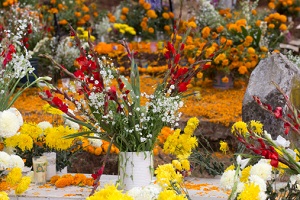 As a Yoruba priest, I frequently make offerings to the Orishas (divine spirits who guide our lives) and my ancestors. The type of offering varies, with the simplest being a white candle, glass of water, white flowers, and a bowl of fruit on my ancestral altar. We Yoruba also make offerings we call “Ebo.†The expression is to “do Ebo†in order to ask for something we want or to give thanks for something we have received.
In this article, I’d like to expand the notion of “doing Ebo†to include those actions/offerings, perhaps not as obvious, that we all take and make in honor of the divine or the ancestors. To illustrate this, I’ll tell a personal story.
For the past year, I’ve been doing extensive research on my family of origin. As far as I can tell, just about all of them have passed on. They were never very forthcoming about family history when they were alive.
One person, however, my paternal uncle, loomed very large in the family constellation. Not much was said about him by my paternal grandmother or my father. To me there was also a great deal of mystery surrounding him. I never knew where he was buried, when and where he died, or who he really was. All I did know was that he had drowned when he was 22, allegedly after getting a cramp while swimming in a lake.
When she was alive, my grandmother continuously eulogized him. I believe she suffered from what can be called pathological mourning, which is when someone experiences a loss so devastating it haunts him/her throughout, and interferes with, his/her life. My father rarely talked about his brother who was clearly the favorite son. I was going to be named after him (but in the end I wasn’t). All I gathered from them was that he was a budding superstar, on his way to law school, brilliant, talented, and full of promise. In other words, a tough act to follow.
Through research and an off-hand conversation with my father’s second wife, I managed to find out where he died and was able to get a copy of his death certificate. The death certificate told me where he was buried. I visited his grave and did an Ebo, which consisted of some simple offerings and prayers. During the visit to the gravesite, I was struck by the powerful impact his death had on my grandmother and father (and, hence, on me). It was an overwhelming and, for me, life-changing experience.
Jump ahead to this past April. I’m taking my dog to a canine internist in West Caldwell, New Jersey. The plan is to continue on to my house, upstate. I ask for directions from the receptionist at the office who tells me to make a right, then take Route 46, which would then get me to Route 23. I follow her directions and take 46 West. I’m driving and driving, sensing that I’m going the wrong way. But thinking, at some point, I was going to be heading in the right direction. Lo and behold, after more than an hour, I see a sign that says Delaware 7 miles, and I know I’m way off track. I keep going hoping to see a highway heading north. Within minutes I see the sign and then drive past Budd Lake—the very lake my uncle drowned in 72 years ago! I don’t stop but clearly feel he has been calling me to that place to remember him, and to bear witness to what had happened to him. I also felt he wanted something from me.
One of my spiritual advisors suggested I go to a local church and have them say a mass for him. Since my ancestors were Jewish, that didn’t feel right. So I went to the local synagogue, near my house, and was told that they were going to have a Yiskor (a ceremony honoring the dead) on May 20, which seemed appropriate.
Start time for the Yiskor was 9:30. Turned out it was also a holiday (the day that God gave the Ten Commandments to Moses). Unbeknownst to me, that was going to be acknowledged first. So as a group we prayed, and prayed, and prayed and finally about 11:30 a.m. we got to the Yiskor. I prayed for my uncle and my family and touched his photo to the Torah. I cried at his loss and prayed for his elevation. I didn’t leave there until after noon. It was the longest time I had ever spent in a synagogue, certainly the longest time I had spent reciting Hebrew prayers (in English, of course).
When it was over, I genuinely felt that I had done an Ebo. The Ebo was not only finding out about the Yiskor, but also spending far more time than I had intended remembering my uncle. I know he appreciated it.
So think about those sacrifices/offerings you have made for others, living and dead, in your life and take comfort that in doing so, you have been blessed accordingly.
 What prompted this article was something I read recently in AARP Magazine. (I guess I’m dating myself with that one!)
“The older you are, the more likely you are to value religion, says a new Pew Research Center survey, ‘Growing Old in America.’ Do religious folks outlive their secular age-mates? Maybe. Earlier research indicates that people who worship regularly follow a healthier lifestyle and share a life-lengthening social network. And for some, faith grows with age: a third of those 65-plus said religion became more important over the course of their lives.†(AARP Magazine, November and December 2009).
What’s interesting to me is, not so much whether or not interest in religion grows with age, but WHY?
I can come up with a few reasons:
1. One obvious reason might be that as people age, they are more aware of their mortality. It takes a certain amount of years and experiences to fully appreciate that they do not live in human form forever. Though it is not true that all young people feel like they will live forever. There are many youthful folks who have been exposed to death at an early age, and, as a result, have become aware of their own mortality. But, for most of us, it is an awareness that increases with age.
2. Another reason might be that, as people age, some become more reflective about their lives. This makes sense because there has been more life on which to reflect. As people get older, they tend to think about what that life has meant, and what they will leave behind. Those thoughts often get people thinking about what does happen when they die. This may be what inspires many people to think about some kind of higher power or divine force who, perhaps, rewards us for a life well-lived (or conversely punishes for a life lived badly), or who might be available to help make the transition.
3. When people think of their mortality, most don’t want to be alone as they make that transition to the other side. That’s when someone might turn to spirituality and/or religion for support. People know instinctively that no human will be with them as they cross over, but perhaps the divine will be there. So, some of this increased importance on religion may be driven by fear.
4. Another possibility is that the focus of older people is different from younger folks. In their twenties and thirties, much of the focus is on establishing themselves professionally and personally. What will they do? How will they support themselves? How will they acquire what they need and want? What about having a family? These questions often preoccupy them for a certain length of time. In their forties and fifties, they often are just living the life they have created. Perhaps in their sixties, many people begin to realize that they want more from life than just the acquisition of material things and status. Perhaps this is a result of gaining a certain amount of experience with the transitory nature of life. This may lead them to turn to religion and spirituality as an opportunity to get some answers about life’s deeper meaning.
5. Lastly, some people, as they get older, finally stop being reactive to the values and choices of their family of origin, and start to think about their own about spirituality and religion. I’ve worked with a number of individuals in my spiritual psychotherapy practice who say that they were so focused on distancing themselves from the religion of their parents, that they did not think about their own choices in this realm. Finally, with more confidence in themselves and true emotional separation from their parents, they were able to think about this for themselves.