 Transgender kids face alarming rates of bullying and abuse. GLSEN’s 2017 National School Climate Survey found 83.7% of trans and 69.9% of gender nonconforming (GNC) students experience bullying at school.
Bullying can erode self-esteem, increase isolation, and make it more difficult for a child to assert their gender identity. Some bullied children become depressed and suicidal. Centers for Disease Control and Prevention (CDC) reports that any involvement with bullying—whether as a victim, bully, or both—raises a child’s risk of suicidal behavior.
Parents, educators, and other adults have significant power to reduce bullying and support trans kids at school.
Transphobia Statistics
Transphobia is animus toward transgender people. It can cause bullying, physical aggression, and other forms of abuse.
Research consistently finds that gender-related discrimination is a problem in schools. GLSEN’s annual National School Climate Survey looked at over 23,000 children in grades 6-12. The study found 42.1% of trans and GNC kids are prevented from using their preferred pronouns. Nearly half of these kids (46.5%) are forced to use the wrong bathrooms.
Other research has found high rates of transphobic bullying.
- Research published in 2017 found trans kids are two to three times more likely than their peers to be bullied.
- A 2016 survey of adult transgender individuals found 60% have avoided public restrooms because they feared confrontation and bullying.
- A 2012 survey found 61% of students have heard peers make negative remarks about gender expression. The same survey found 27% of students face physical abuse because of their gender expression.
Creating a Safe Environment for Trans Kids
Many parents and educators worry that there’s nothing they can do to stop transphobic bullying. Yet research consistently finds that creating an inclusive, gender-affirming environment can greatly reduce bullying. Even when kids are bullied in these environments, they may feel more comfortable reaching out to an adult than they would in less inclusive environments.
According to GLSEN, students at inclusive schools with curricula that feature LGBTQ-affirming content are less likely to experience bullying, hear transphobic remarks, or feel unsafe at school. They are also less likely to be forced to use the wrong bathrooms or the wrong pronouns. Inclusive curricula can also raise self-esteem, reduce the risk of depression, and even improve grades.
Some strategies that promote a safe environment for trans kids include:
- Creating a trans-inclusive curricula. Schools can participate in LGBT History Month, feature notable transgender historic figures, and discuss transgender history and civil rights with students.
- Asking students about their preferred pronouns or names and then using them
- Educating teachers, school counselors, and others who work with students about transgender issues.
- Establishing safe spaces, such as counselor’s offices, where students can safely discuss gender issues and bullying.
- Refusing to tolerate any bullying or transphobia, even from teachers or other adults.
Parents who want to support a transgender child should urge their child’s school to promote an inclusive environment that actively works to prevent transgender discrimination. At home, parents can help by allowing children to assert their own gender identity in a safe, judgment-free zone.
It is important to let the child determine what gender means to them. Parents should avoid reinforcing gender stereotypes or rigid gender ideologies. For example, a trans girl does not need to turn her entire wardrobe pink in order to “prove” she is a girl. No toy or clothing should be off limits to anyone solely because of gender.
Parents can also support their trans or GNC children by introducing them to the wider LGBT community. They may read books with their child that feature people of many gender identities and presentations. They may identify trans or GNC role models for kids to learn about. They may also help their children meet other trans kids through support groups, trans camps, and other communities.
Lastly, parents may wish to educate themselves about transgender history and issues. Children pick up on what parents believe, not just what they say. Parents who are uncomfortable with their child’s gender presentation may inadvertently stigmatize their child. Education can help parents reevaluate their own ideas about gender and become better advocates for their children.
Understanding Your Child’s Rights
Federal, state, and local laws determine a student’s legal rights. Trans students in some states have more protections than students in other states. Individual schools may extend additional rights to trans students.
Many courts have ruled that transgender individuals are protected under Title IX. This federal law forbids schools from discriminating against students based on their sex or gender expression. Under Title IX, transgender and GNC students have the right to:
- Be protected from bullying, harassment, and violence.
- Use restrooms and locker rooms that match their gender identity.
- Be called the correct name and pronouns.
- Dress and present themselves according to their gender identity (so long as they follow the general school dress code).
- Access the same educational opportunities and school events as other students.
- Maintain their medical privacy, including the right not to disclose being transgender.
However, not all states share this interpretation of Title IX. According to the American Civil Liberties Union, only 17 states have laws explicitly protecting transgender students from harassment and discrimination. These include Arkansas, California, Colorado, Connecticut, Delaware, Hawaii, Illinois, Iowa, Maine, Maryland, Minnesota, New Jersey, New York, North Carolina, Oregon, Vermont, and Washington. The District of Columbia also has anti-discrimination laws.
Even between these states, the extent of civil protections can vary. For example, only California, Connecticut, and Washington currently allow transgender students to join school sports teams consistent with their gender identity. School districts within a state may also vary in their policies.
The rights of transgender students at school are continually evolving. Parents who worry their child is facing discrimination should consider consulting a lawyer who specializes in educational law or who has experience with transgender issues.
How Therapy Can Help Transgender Kids
Therapy can offer immense support to transgender kids and their families. Family counseling can help a family identify strategies for supporting a child’s gender identity and fighting back against bullying. When family members do not fully understand or accept a child’s trans identity, family therapy can educate them and encourage acceptance.
Individual counseling can help transgender kids who struggle with depression, low self-esteem, and anxiety due to bullying. The right therapist can also affirm a child’s gender identity and point them toward trans role models and literature. In therapy, a child can learn that being trans is not a mental health problem or a weakness, but an important component of a person’s identity that should be respected and celebrated.
You can find a therapist here.
References:
- GLSEN 2017 National School Climate Survey. (2018). Retrieved from https://www.glsen.org/article/2017-national-school-climate-survey-1
- Know your rights: Transgender people and the law. (n.d.) ACLU. Retrieved from https://www.aclu.org/know-your-rights/transgender-people-and-law
- McKay, T., Misra, S., & Lindquist, C. (2017). Violence and LGBTQ+ communities: What do we know, and what do we need to know? RTI International. Retrieved from https://www.rti.org/sites/default/files/rti_violence_and_lgbtq_communities.pdf
- Supporting transgender and gender diverse students in schools [PDF]. (2015). American Psychological Association. Retrieved from https://www.apa.org/pi/lgbt/programs/safe-supportive/lgbt/school-administrators.pdf
- The relationship between bullying and suicide: What we know and what it means for schools [PDF]. (2014). Chamblee: Centers for Disease Control and Prevention. Retrieved from https://www.cdc.gov/violenceprevention/pdf/bullying-suicide-translation-final-a.pdf
- Trotta, D. (2016, December 08). U.S. transgender people harassed in public restrooms: Landmark survey. Reuters. Retrieved from https://www.reuters.com/article/us-usa-lgbt-survey/u-s-transgender-people-harassed-in-public-restrooms-landmark-survey-idUSKBN13X0BK
- What are my rights at school? (n.d.). Retrieved from https://transequality.org/know-your-rights/schools
 With greater access to treatment, more people find they can take on the monumental venture of earning a degree. Yet once they are in school, their risk of mental health problems increases. Graduate students in particular may struggle to manage school, finances, and self-care. The combined stress can be devastating to mental well-being.
The American Psychological Association says the need for mental health care on campuses is increasing. A 2015-2016 report from the Center for Collegiate Mental Health surveyed college counseling centers across America. The report showed an increase in student hospitalization, medication use, and suicide. More than 55% of the centers saw increases in salary budgets to meet demands for care. But some clinics still face challenges in meeting students’ needs. They may have limited hours of service or high costs of care.
Meanwhile, almost a third of PhD candidates may be at risk for mental health concerns. Around 34% of graduate students may already experience moderate to severe depression.
[fat_widget_right]
Researchers continue to study the specific differences between undergraduate and graduate students’ health. Further surveys may determine how to improve psychological care for each population. The goal is to promote mental well-being in colleges and universities.
Risk Factors for Mental Health Concerns in Grad School
Some populations are more at risk of developing mental health concerns. As the population of graduate students grows more diverse, so do mental health needs. Minority and international students may need help with multicultural issues. LGBTQ+ students can also face discrimination.
These populations can benefit from seeking mental health treatment on campus. Yet not all students may feel represented at their school’s counseling center. Around 71% of counseling center staff members are white. The number of openly LGBTQ+ counselors is limited. Counseling centers could better serve minority students by hiring more diverse staff.
Another risk factor is academic performance. Students who feel they are behind in their classes are more likely to report stress and anxiety. The Graduate Assembly of University of California, Berkeley rates academic performance as one of the top three predictors of depression in graduate students.
Yet catching up may be easier said than done. Many graduate students have responsibilities outside school such as childcare or employment. In a 2014 survey, graduate students cited job outlook, financial stress, loneliness, and alienation from mentors as contributing factors to depression and negative well-being.
Graduate students can help improve mental health outcomes by learning what signs to watch for. Any of the following symptoms may indicate a larger mental health concern:
- Irritability
- Sleeplessness
- Panic attacks
- A dependence on drugs or alcohol
- Inability to complete daily tasks
- Feelings of worthlessness
- Suicidal thoughts
How Grad Students Can Use Counseling Centers
Psychological care addresses diagnoses that affect students as well as the general population. For example, cognitive behavioral therapy can help individuals cope with anger or anxiety. Acceptance and commitment therapy can help busy students focus on their priorities.
Graduate students are a population with unique mental health needs.
Counseling centers can also introduce students to alternative treatments to complement traditional therapies. Some therapists might assign internet-based worksheets to help reprogram harmful thoughts. Others may direct students to mindfulness practices like yoga.
Treatment can be especially helpful for students whose diagnoses impact learning. When a survey asked students if campus counseling services helped with their academic performance, over 70% answered positively. These results suggest counseling can help both mental health concerns and academic issues.
Preventing Mental Health Issues During Grad School
Self-care practices like sleep and exercise can promote more positive mental health outcomes. Students who limit their schedules and have a social life have less risk for burnout. Experts encourage students to find a therapist before their symptoms become overwhelming.
There are several ways graduate schools can reduce students’ risks of mental health concerns. Schools can accommodate students’ schedules, aid their career preparations, and improve campus mental health care. Schools can also help by educating students about time management and self-care. Close mentorship is also linked to improved mental health and academic outcomes. Academic advisors are particularly helpful for international students.
Graduate students are a population with unique mental health needs. If schools improve their campus mental health care, they can not only lower the rate of mental health concerns, but also promote academic success. Mental health care on campus can improve all aspects of graduate student life.
Lifelines and Further Resources
- Jed Foundation is an advocacy group for teen and young adult mental health. Students can find information about their legal rights related to mental health.
- The National Grad Crisis Line provides suicide prevention services specifically for graduate students. Individuals can reach the hotline by calling 1-877-GRAD-HLP (1-877-472-3457). People studying abroad can access the hotline through a Skype number.
- ULifeline.org is a service of the Jed Foundation. It offers self-assessment tools to evaluate mental wellness and suitability for counseling. There are also resources for those who need immediate help.
- American Psychological Association has an online section of articles especially for graduate students. Helpful pages include self-care tips and advice for seeking mentorship.
Resources:
- Barry, K. M., Woods, M., Warnecke, E., Stirling, C., & Martin, A. (2018, January 19). Psychological health of doctoral candidates, study-related challenges and perceived performance. Higher Education Research & Development, 1-16. Retrieved from http://www.tandfonline.com/doi/abs/10.1080/07294360.2018.1425979?journalCode=cher20
- Bershad, C., Reetz, D. R., LeViness, P., & Whitlock, M. (2016). The Association for University and College Counseling Center Directors annual survey. Association for University and College Counseling Center Directors. Retrieved from https://taucccd.memberclicks.net/assets/documents/aucccd%202016%20monograph%20-%20public.pdf
- Butler, A. C., Chapman, J. E., Forman, E. M., & Beck, A. T. (2006). The empirical status of cognitive-behavioral therapy: A review of meta-analyses. Clinical Psychology Review, 26(1), 17-31. Retrieved from https://www.sciencedirect.com/science/article/pii/S0272735805001005
- Campus Mental Health. (n.d.). American Psychological Association. Retrieved from http://www.apa.org/advocacy/higher-education/mental-health/index.aspx
- Dyrbye, L. N., Thomas, M. R., & Shanafelt, T. D. (2006). Systematic review of depression, anxiety, and other indicators of psychological distress among U.S. and Canadian medical students. Academic Medicine, 81(4), 354-373. Retrieved from https://journals.lww.com/academicmedicine/Abstract/2006/04000/Systematic_Review_of_Depression,_Anxiety,_and.9.aspx
- Eisenberg, D., Downs, M. F., Golberstein, E., & Zivin, K. (2009, May 19). Stigma and help seeking for mental health among college students. Medical Care Research and Review, 66(5), 522-541. Retrieved from http://journals.sagepub.com/doi/abs/10.1177/1077558709335173
- Graduate Student Happiness and Well-Being Report. (2014). Graduate Assembly of University of California, Berkeley. Retrieved from http://ga.berkeley.edu/wp-content/uploads/2015/04/wellbeingreport_2014.pdf
- Grappling with graduate student mental health and suicide. (2017, August 7). Chemical and Engineering News. Retrieved from https://cen.acs.org/articles/95/i32/Grappling-graduate-student-mental-health.html
- Hofmann, S. G., Sawyer, A. T., Witt, A. A., & Oh, D. (2010). The effect of mindfulness-based therapy on anxiety and depression: A meta-analytic review. Journal of Consulting and Clinical Psychology, 78(2), 169-183. Retrieved from http://psycnet.apa.org/record/2010-05835-004
- Hyun, J., Quinn, B., Madon, T., & Lustig, S. (2007). Mental health need, awareness, and use of counseling services among international graduate students. Journal of American College Health, 56(2), 109-118. Retrieved from http://www.tandfonline.com/doi/abs/10.3200/jach.56.2.109-118
- Ickes, M. J., Brown, J., Reeves, B., & Martin, P. D. (2015). Differences between undergraduate and graduate students in stress and coping strategies. Californian Journal of Health Promotion, 13(1), 13-25. Retrieved from http://www.cjhp.org/volume13Issue1_2015/documents/13-25_Formatted_Ickes_CJHP2015_Issue1.pdf
- Karyotaki, E., Riper, H., Twisk, J., Hoogendoorn, A., Kleiboer, A., Mira, A., … & Andersson, G. (2017). Efficacy of self-guided internet-based cognitive behavioral therapy in the treatment of depressive symptoms: A meta-analysis of individual participant data. JAMA Psychiatry, 74(4), 351-359. Retrieved from https://jamanetwork.com/journals/jamapsychiatry/article-abstract/2604310?redirect=true
- Levecque, K., Anseel, F., De Beuckelaer, A., Van der Heyden, J., & Gisle, L. (2017). Work organization and mental health problems in PhD students. Research Policy, 46(4), 868-879. Retrieved from https://www.sciencedirect.com/science/article/pii/S0048733317300422?via%3Dihub
- More and more students need mental health services. But colleges struggle to keep up. (2017, May 4). USA Today. Retrieved from http://college.usatoday.com/2017/05/04/more-and-more-students-need-mental-health-services-but-colleges-struggle-to-keep-up
- Why do so many graduate students quit? (2016, July 6). The Atlantic. Retrieved from https://www.theatlantic.com/education/archive/2016/07/why-do-so-many-graduate-students-quit/490094
 Do you have strong interpersonal skills and a passion for helping students navigate the world of education? If so, you could excel as a school counselor. School counselors provide resources for students who want to learn how to pursue their academic and professional futures, and they also work with students who have learning difficulties or mood issues that interfere with their success in school. Whether providing K-12 education support, helping undergraduates navigate the world of higher education, or getting students to the next step in graduate school, thousands of opportunities for school counselors exist.
Like many health-related fields, specific requirements for becoming a school counselor can vary from state to state, so check with the American School Counseling Association for details. Otherwise, read on to find out how you can get started.
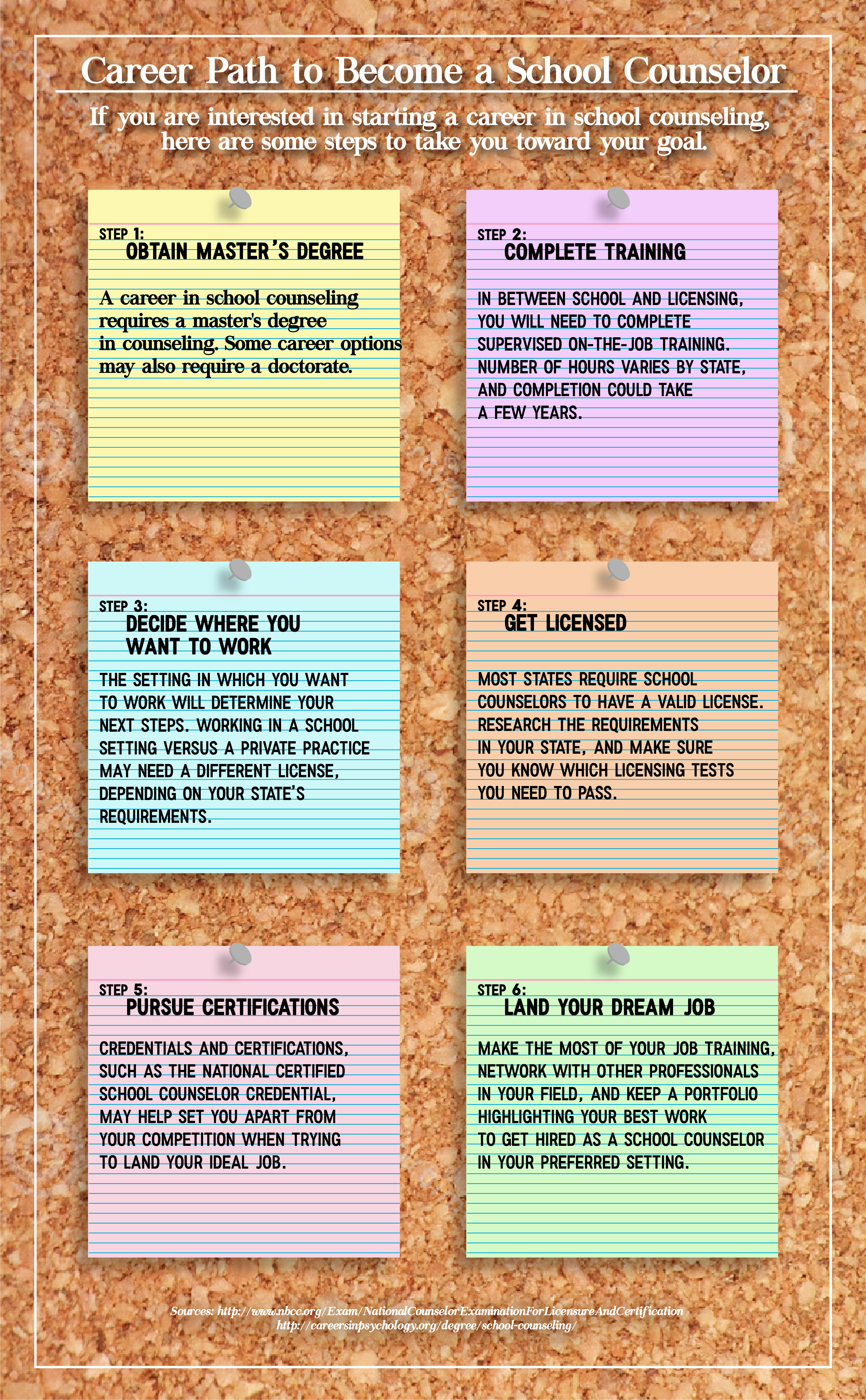
1. Lay the Foundation with Undergraduate Studies
As with similar fields of study, people intending to become school counselors will need a substantial academic background. Your first step is to decide where you want to go to college and apply. Depending on your current level of education, this could mean applying for an undergraduate or graduate program. While your undergraduate degree is not typically required to be in education or counseling, it is often helpful to choose a major that reflects knowledge and understanding of the theories and practices required for counseling. Students who major in subjects such as psychology, sociology, or counseling may find they have acquired a feel for the work involved with becoming a school counselor, and as an extension, are well prepared for their graduate studies. [fat_widget_right]
2. Get Your Master’s Degree in School Counseling
Depending on your program, receiving a master’s degree means learning counseling and guidance techniques for multiple age groups and ability levels. During this process, which may take 1-2 years, you can explore areas of specialization, such as K-12 education, behavior issues, or education for children with developmental delays. According to US News & World Report, some of the top-rated counseling programs in the country are at University of Maryland, College Park, and University of North Carolina, Greensboro. However, there are many worthwhile programs across the country depending on your preferred home base.
 Infographic by Hannah Johnson
3. Work Under Supervision After Graduation
During or after your study program, you can intern or complete a practicum as part of your course requirements. Many programs set a certain number of these hours for you to complete, either as a graduation requirement or part of your future doctorate studies, if you decide to pursue that course. For example, one school counselor program might require 100 practicum hours, 40 of which are in direct contact with K-12 students. Additionally, to take the licensing exam to become a school counselor, you must have completed hundreds of hours of practicum or internship work.
Get familiar with the day-to-day workings of your site and don’t be afraid to ask your supervisor for any tips or important things to know while working there—it is better to ask more questions than less, especially when you are still in a learning environment.
During your school counseling internship or practicum, you will get hands-on experience in the field, generally at a school site you have chosen. You will perform most of the duties associated with your field under the direct supervision of both an on-site supervisor and your instructor or supervisor on campus. Get familiar with the day-to-day workings of your site, and don’t be afraid to ask your supervisor for any tips or important things to know while working there—it is better to ask more questions than not enough, especially when you are still in a learning environment.
4. Get Licensed as a School Counselor
After completing your educational and working hour requirements, it is time to become a board certified school counselor. First, you will need to know your state’s requirements, as they vary. The National Counselor Examination (NCE) is a 200-item exam you might sit for, as it is required to become licensed in most states. It may also be required for a national license or any potential military work you are interested in doing. The NCE website lists all the requirements for the exam and provides information on where to take it in your state. It’s a good idea to study and prepare for this exam like you would for other important, long-term tests. Find example questions from past exams and consider borrowing or ordering an NCE test prep book, which will contain helpful strategies and tips for passing your NCE successfully.
5. Optional Credentials for School Counselors
Before hiring you, most schools will prefer that you have one to two years of hands-on classroom experience. You may also need to get a teaching certificate or license. Research your state’s teaching certificate requirements, as these can differ depending on the education system. Additionally, you can pursue specializations such as career counseling or an emphasis in students experiencing addiction.
6. Get Hired as a School Counselor
The field of school counseling has many opportunities and benefits: more than 200,000 school counselors are employed every year as of 2014, and the profession has a median salary of $50,000 a year. Most educational institutions, whether K-12 schools or colleges, need counselors. Openings for these positions are generally posted through school districts or university careers sites for internal positions. You might begin your job search by researching where you would like to work and begin looking for school counseling postings in that location or ask your own college counselor for help finding a placement. Sometimes the connections you make during your internship or practicum hours can lead to future employment opportunities.
References:
- Danzinger, P. & Newman, H. (2011). School counseling concentration practicum/internship handbook. William Patterson University College of Education. Retrieved from https://www.wpunj.edu/dotAsset/315254.pdf
- National counselor examination for licensure and certification. (n.d.). National Board for Certified Counselors. Retrieved from http://www.nbcc.org/Exams/NCE
- School and career counselors: Summary. (2017, October 24). Bureau of Labor Statistics. Retrieved from http://www.bls.gov/ooh/community-and-social-service/school-and-career-counselors.htm#tab-1
- School counseling degree programs & schools. (n.d.). Retrieved from http://careersinpsychology.org/degree/school-counseling
- State certification requirements. (n.d.). American School Counselor Association. Retrieved from https://www.schoolcounselor.org/school-counselors-members/careers-roles/state-certification-requirements
 Exclusion from school, such as through suspension or expulsion, is correlated with psychological distress and increased risk of long-term mental health issues, according to a study published in the journal Psychological Medicine. The study also found children with mental health issues are more likely to experience school exclusion.
School Exclusion and Mental Health Issues
For the study, researchers gathered data on more than 5,000 children who participated in the 2004 British Child and Adolescent Mental Health Surveys, and in the 2007 follow-up. The study included data on school exclusion and on symptoms of mental health conditions such as depression, attention deficit-hyperactivity (ADHD), and anxiety.
Classroom behavioral issues were the most common reason for school exclusion. Children with learning difficulties and mental health diagnoses were more likely than other kids to be excluded from school.
Exclusion from school was correlated with an increase in mental health and learning issues. Three years later, children who had been excluded from school were more likely to have mental health issues. This suggests even a one- or two-day exclusion from school can have long-term psychological consequences.
[fat_widget_right]The study found children living in socioeconomically deprived families and those in poor health were also more likely to be excluded from school. Previous research has found some groups are disproportionately excluded from school. Black children are almost four times more likely than white children to be suspended from school. In the 2013-2014 school year, 18% of black boys and 10% of black girls were suspended from school. This is compared to 5% of white boys and 2% of white girls.
The Consequences of School Exclusion
The study’s authors say being excluded from school can be a significant disruption in the lives of children and parents. Though exclusion might seem like a short-term punishment, its effects can extend far beyond the time of the suspension.
Some research has found school suspensions disrupt a school’s culture and may stigmatize excluded children. According to the 2014 Policy Statement on Expulsion and Suspension Policies in Early Childhood Settings, a joint project of the U.S. Department of Health and Human Services and U.S. Department of Education, students who are excluded from school may be as much as 10 times more likely than other students to drop out of high school.
References:
- Exclusion from school can trigger long-term psychiatric illness. (2017, August 29). Retrieved from https://www.sciencedaily.com/releases/2017/08/170829124507.htm
- Ford, T., Parker, C., Salim, J., Goodman, R., Logan, S., & Henley, W. (2017). The relationship between exclusion from school and mental health: A secondary analysis of the British Child and Adolescent Mental Health Surveys 2004 and 2007. Psychological Medicine, 1-13. doi:10.1017/s003329171700215x
- Spears, V. H. (2015, January 20). Kentucky study suggests that out-of-school suspensions can hamper even unpunished students. Retrieved from http://www.kentucky.com/news/local/education/article44548170.html
- Suspended progress: The harms of suspension and expulsion [PDF]. (2016, May). JustChildren.
- Toppo, G. (2016, June 7). Black students nearly 4x as likely to be suspended. Retrieved from https://www.usatoday.com/story/news/2016/06/07/black-students-nearly-4x-likely-suspended/85526458/
 Parents who use harsh parenting tactics, such as physical and verbal aggression, may exacerbate the behaviors they wish to prevent, according to a study published in the journal Child Development. Children whose parents used harsh tactics had poor academic outcomes and were more likely to engage in high-risk behaviors.
Parenting Effects on Educational Attainment
The study initially enrolled 1,482 seventh graders living near Washington, D.C. Researchers followed the teens for nine years, until they were 21. The group was racially, socioeconomically, and geographically diverse. At the end of the study, 1,060 participants remained.
The students answered questions about their parents’ use of verbal and physical aggression. They also reported on their relationships with peers, sexual behavior, and habits such as balancing time with peers and time to complete homework.
Children of harsh parents were more likely to report in ninth grade that their peers were more important than following the rules. By eleventh grade, these teens engaged in more high-risk behaviors. Boys in this group were more likely to engage in juvenile delinquency such as stealing and aggression, while girls were more likely to participate in early sexual behavior.
[fat_widget_right]By 21, adults who were harshly parented as children had lower educational attainment. They were more likely to drop out of school, and they had lower grades and standardized test scores. The study’s authors suggest harsh parenting indirectly leads to lower educational attainment by encouraging children to place the highest value on peer relationships and embrace high-risk behaviors that sustain those relationships.
The study’s authors suggest improved intervention strategies for teens whose parents use harsh parenting tactics could help increase their potential educational attainment later in life.
Harsh Parenting May Be an Ineffective Strategy
Other studies have also linked harsh parenting to negative outcomes in children. One study found children who are more frequently spanked are more likely to struggle at school, be diagnosed with a mental health condition, and engage in antisocial behavior. Another study found parenting style matters most for “difficult†children. Excessively harsh parenting was most harmful to children with challenging temperaments.
Reference:
Hentges, R. F., & Wang, M. (2017). Gender differences in the developmental cascade from harsh parenting to educational attainment: An evolutionary perspective. Child Development. doi:10.1111/cdev.12719
 Negative feedback from teachers can increase concentration issues, disruptions, and overall negative behavior in students, according to a new study published in Assessment for Effective Intervention. Teachers may use negative feedback in an attempt to curtail problematic behavior among children, but the study suggests this approach has the reverse effect.
How Negative Teacher Attention Harms Students
For the study, Wendy Reinke—an associate professor of educational, school, and counseling psychology at the University of Missouri College of Education—and her colleagues developed a tool for monitoring student-teacher interactions. The Brief Student-Teacher Classroom Interaction Observation (ST-CIO) tool requires a five-minute observation period to assess whether an interaction is negative or positive.
Using the ST-CIO, researchers observed 53 teachers’ interactions with 896 students in kindergarten through third grade. They found the tool was able to capture information similar to that captured by longer observations, suggesting the ST-CIO might be a good way for principals, researchers, and others to quickly assess student-teacher interactions.
[fat_widget_right]The researchers then observed a correlation between teacher-student interactions and student behavior. Students who received more negative than positive feedback from their teachers during the year had a significant increase in disruptive behavior, concentration difficulties, and problems with emotion regulation by the end of the school year. Students who received positive feedback saw no such increase and were more likely to engage in positive, prosocial behaviors in the future.
The Role of Teachers in Student Mental Health
The study notes that previous research has linked student-teacher interactions to both academic and behavioral outcomes. Most students spend six to nine hours each day with their teachers, which may be more time than some students spend with any other adult.
Particularly among students who come from struggling families, whose parents are uninvolved, or whose families are abusive, teachers may fill an important void. Teachers may also be the first to notice signs of learning difficulties and mental health diagnoses such as attention-deficit hyperactivity.
References:
- Negative attention from teachers can lead to more negative student behaviors. (2011, August 8). Retrieved from https://www.sciencedaily.com/releases/2016/08/160808150536.htm
- Reinke, W. M., Herman, K. C., & Newcomer, L. (2016). The brief student-teacher classroom interaction observation: Using dynamic indicators of behaviors in the classroom to predict outcomes and inform practice. Assessment for Effective Intervention. doi:10.1177/1534508416641605
 Many young adults have chosen, especially in recent years, to embark on what is known as a gap year. It has become more common for students to take a year off between high school and college. Malia Obama, for example, drew attention when she chose to defer her enrollment to Harvard. This decision helped publicize the mental health benefits that can result from taking a gap year.
College can be a risky environment for the development of mental health conditions. Many students in a post-secondary environment may experience symptoms of a mental health condition, and the American Psychological Association (APA) refers to the situation as a “growing crisis.â€
In 2010, more than 45% of students involved in an American College Health Association survey reported feelings of hopelessness. The same year, a poll of college counselors found they considered about 44% of students to have severe psychological issues (up from just 16% in 2000).
[fat_widget_right]The gap year has been shown to reduce the likelihood of developing many of the symptoms that are most prevalent among college students, such as depression, alcohol abuse, disordered eating, and anxiety. These are not new findings. In fact, Harvard instituted a policy more than 15 years ago recommending that incoming undergraduates take a year off after high school, specifically to prevent psychological burnout. Since then, compelling evidence for the benefits of a gap year has only grown.
Coping with Transition After High School
Students in grade school often face academic pressures. Grades, careers, social lives, relationships, and other matters can contribute to the already significant stress of growing up. As a result, students may be especially susceptible to mental health issues with the added stress and pressure of college. Taking a gap year can give students time to psychologically decompress, alleviating and potentially eliminating many of the stressors that have accumulated during high school.
According to the American Gap Association (AGA), 92% of students who choose to take a gap year say their intentions are to add life skills and experience personal growth. Studies of returning gap year students have found they demonstrate significantly higher gains in these areas, when compared to those who did not take the break. Participants specifically identified being in a new, non-academic environment as the most meaningful part of the experience.
[amazon_affiliate]As discussed in There Is Life After College by University of Arizona professor Jeffrey Selingo, a new, “real world†setting brings with it new challenges, often forcing people to find new ways to deal with situations they would not typically be exposed to as students. Selingo helps parents, higher-education leaders, and young adults understand how to succeed in school to better navigate the current job market.
In the not-too-distant past, a college education would have almost guaranteed a lifetime of employment. Students today face a different reality; even graduate degrees may not include the promise of economic success, and job stability is becoming more uncommon. Selingo suggests there is abundant potential for making personal developments through the transitional experiences associated with taking a gap year, and these gains may be responsible for inspiring better adaptive behaviors in the future.
A Gap Year’s Impact on Motivation
Many parents and teachers worry that time away from a structured educational environment might leave students with less motivation to continue their academic careers. Research shows gap years do have a connection to decreased motivation, but the results of this lowered motivation may be positive. Motivation is directly connected to psychological well-being through the neurotransmitter dopamine (among other things), so this fundamental change may be one of the mechanisms through which the gap year helps to safeguard mental health.
Taking a gap year can give students time to psychologically decompress, alleviating and potentially eliminating many of the stressors that have accumulated during high school.A study by University of Sydney professor Andrew Martin measured academic motivations in Australian students before and after taking a gap year. Low academic performance and motivation in high school were both found to be associated with a higher likelihood of taking a gap year, but high motivation and the development of adaptive behaviors in college were correlated with gap year participation.
These results may suggest time away from school provides an opportunity for students to mature in a variety of productive ways. This coincides with previous research that identifies the time spent during a gap year as a facilitator of cross-cultural learning and evaluations of personal values.
Gap years have consistently been found to be associated with mental health benefits for more than 15 years. They may facilitate positive effects, such as aiding in stress reduction, enabling motivational changes, and accelerating the adoption of adaptive behaviors. Many gap year students exhibit gains in confidence, sense of identity, and self-esteem that can last well after the conclusion of their academic careers. The practice is likely to become even more popular as such findings become more well known, and as educational institutions continue to promote its usefulness for students transitioning into college.
References:
- American Gap Association (2015). Gap year data and benefits. Retrieved from http://www.americangap.org/data-benefits.php
- American Psychological Association (n. d.) The state of mental health on college campuses: A growing crisis. Retrieved from http://www.apa.org/about/gr/education/news/2011/college-campuses.aspx
- Crawford, C., & Cribb, J. (2012). Gap year takers: uptake, trends and long term outcomes. Institute for Fiscal Studies through the Centre for Analysis of Youth Transitions (CAYT). London, UK: Department for Education. Retrieved from https://www.gov.uk/government/uploads/system/uploads/attachment_data/file/219637/DFE-RR252.pdf
- Dell’Antonia, K. J. (2016, April 19). Gap year may have benefits long after college. Retrieved from http://well.blogs.nytimes.com/2016/04/19/gap-year-may-have-benefits-long-after-college/?ref=health&_r=1
- Harvard College (2011). Should I take time off? Retrieved from https://college.harvard.edu/admissions/preparing-college/should-i-take-time
- Martin, A. J. (2010). Should students have a gap year? Motivation and performance factors relevant to time out after completing school. Journal of Educational Psychology, 102(3), 561. Retrieved from http://eric.ed.gov/?id=EJ892653
- McPhate, M. (2016, May 2). Malia Obama’s ‘gap year’ is part of a growing (and expensive) trend. Retrieved from http://www.nytimes.com/2016/05/03/us/malia-obamas-gap-year-is-part-of-a-growing-and-expensive-trend.html?_r=0
- Selingo, J. (2016). There Is Life After College. New York, NY: HarperCollins.
- Sparks, S. D. (2010, September 15). Research suggests a ‘gap year’ motivates students. Retrieved from http://www.edweek.org/ew/articles/2010/09/15/04gap.h30.html
 Would you work a highly demanding, fast-paced job Monday through Friday from 7 a.m. to 3 p.m., take a small break, then work another job that requires intense focus both mentally and physically from 5 p.m. to 10 p.m.? Let’s say the pay sucked. Advancement was dependent on performance, and your coworkers were sometimes enemies. In addition, you had only 20 minutes to eat lunch in a loud, chaotic environment.
Sound appealing? I didn’t think so. But yet we ask our children to do it. Welcome to high school 2015.
Today’s kids are being asked—required, more like—to work in this kind of system. The amount of academic work in a given day, added onto extracurricular activities and homework, has reached an all-time back-breaking load.
[fat_widget_right]
There is a general understanding with kids and parents today: The academic world has changed. When many parents today were in high school, they had homework, yes; but they also had part-time jobs, friends, went to social events, and basically had a life. An academically advanced high school student now has no time for going to the mall with friends, no time for a part-time job (unless he or she gives up a sport or other pursuit), and no time for rest and reflection. Add in social media with its false sense of connection and, simply put, teens are struggling with stress, anxiety, and depression at much higher rates than was experienced 30 years ago. The intended effect of helping our children compete globally by increasing curricula has indeed come at a cost.
Homework, hard work, and perseverance are all good things. Teens should learn to handle tough stuff. But should they learn it while being prescribed antianxiety medication to quell rising fear about not getting into the “right†college? Should they learn it while being prescribed antidepressants because they can’t imagine a happy future given their overwhelmed present?
We as parents and academia are missing the point: We cannot continue to ask teens to handle all of this without giving them the tools to handle it.
Here are eight ways to help your teen:
- Ask about school pressures and then listen with the intention of understanding, not responding and judging. Ask your teen, “What’s it like to be you?â€
- Identify what is causing the most stress in your teen’s life. Is it a specific class, a certain friend, pressure from you? Your teen will answer honestly only if you are listening without judgment.
- Check yourself. How are you handling stress in your life? If the answer is not very well, then this is a great time to learn better stress management for you and your teen. He or she is watching you.
- Teach your teen time management and being focused without distraction.
- Teach relaxation techniques such as deep breathing, stretching, walking, playing with the dog, drawing, or meditation.
- Communicate with a teacher, the school, or the coach (make sure your teen knows you are doing this) to gain further insight into what’s happening. Sometimes this small act can make a huge impact.
- Reduce pressure by discussing your expectations of your teen. Most teens think their parents want them to go to Harvard, but most parents just want their kids to be happy. Talk about it. Are you part of the problem?
- Spend time with your teen doing fun things!
The goal of parenting and educating is to raise responsible and resilient kids. In today’s academic environment, mixed with social changes and pressure, childhood is becoming a stressful phase of life. It is our obligation to empower and teach our children both academically and emotionally how to navigate the challenges.
Reference:
Increased levels of anxiety and depression as teenage experience changes over time. (2012, March 14). Nuffield Foundation. Retrieved from http://www.nuffieldfoundation.org/news/increased-levels-anxiety-and-depression-teenage-experience-changes-over-time
 We’ve all heard the stereotype of the dumb jock, but a new study suggests that high school sports may actually be good for students’ brains. About 55% of high school students are athletes, and between 23% and 40% of all high school students report feelings of stress, depression, or anxiety. Students may be able to reduce these feelings by participating in sports, and the study suggests that high school sports participation may even have long-term mental health benefits.
High School Sports and Mental Health
The study surveyed nearly 850 students attending 10 different Canadian schools. Students completed surveys about sports participation every year for their five years of secondary school. Then, three years after graduation, researchers asked students about symptoms of depression and stress levels. Students were also asked to rate their mental health on a scale of 1 to 5.
Students who had a history of high school sports participation did better on all three measures of mental health than students who did not play sports. They had lower rates of depression, less stress, and perceived their mental health to be better. Researchers aren’t sure why high school sports positively benefited mental health in the students. They speculate, though, that increased social activity, a connection to their schools, and the chance to bond with their peers may all help reduce the risk of mental health challenges.Â
Other Benefits of High School Sports
The latest study isn’t the only one to show major mental health benefits for high school athletes. Previous research has shown that high school sports participation can confer the following mental health benefits:[fat_widget_right]
- A reduced risk of teen pregnancy.
- A decreased likelihood of using drugs such as cocaine and marijuana.
- Higher self-esteem, with student athletes about three times as likely as non-athletes to say they feel good about themselves.
- Feeling socially accepted. Athletes have better social skills and are more likely to say their friends care about them.
- Better grades and test scores.
References:
- Jewett, Rachel; Sabiston, Catherine M.; Brunet, Jennifer; O’Loughlin, Erin K.; Scarapicchia, Tanya; O’Loughlin, Jennifer. (2014, June 11). School Sport Participation During Adolescence and Mental Health in Early Adulthood. Journal of Adolescent Health. DOI: 10.1016/j.jadohealth.2014.04.018
- National Campaign to Prevent Teen Pregnancy. (2007, July 26). Not Just Another Single Issue: Teen Pregnancy and Athletic Involvement. Retrieved from http://www.education.com/reference/article/Ref_Not_Just_Another/
- Sports Promote Psychological and Emotional Health. (2013). DatalysCenter. Retrieved from http://datalyscenter.org/wp-content/uploads/2013/06/Sports-Promote-Psychological-Emotional-Health.pdf
- Study shows high school athletes perform better in school, persist to graduation more than non-athletes. (2014, January 24). Retrieved from http://news.ku.edu/2014/01/15/study-shows-high-school-athletes-performed-better-school-persisted-graduation-more-non
 Financial abundance is largely lauded as a good thing, especially in today’s celebrity- and financial-guru-worshiping society. More money means more security, more possessions, more opportunities, and more success, right?
On the contrary—recent research reveals that money may, in fact, mean more problems for the offspring of wealthy parents. The research, published in the Journal of Development and Psychopathology, found that young people whose parents earn a combined income of $160,000 per year or more experience twice the standard national rate of depression and anxiety than those from less well-to-do families.
Professor Suniya Luthar of Arizona State University, the psychologist responsible for the studies, has spent the past decade researching this subject. In her work with financially privileged children, she has seen firsthand that they are under enormous amounts of pressure to succeed. Unfortunately, the impact of this pressure triggers a significant amount of psychological distress, leading to depression, anxiety, stress, eating and food issues, substance abuse, and other self-harming behaviors.
The pressures faced by children and adolescents who fall into this household income range primarily revolve around academic achievements and extracurricular activities and accomplishments. After-school activities like sports, music, and the arts are meant to be enjoyable and fun. Exercise and creativity are known to be excellent stress relievers and healthy emotional outlets, and when the pressure to excel carries over into these otherwise relaxed areas of life, it follows that young people struggle to maintain a sense of well-being.
On top of high expectations in school and extracurriculars, many of them also face significant social pressure. Though teachers, coaches, instructors, and peers play a part in influencing these overwhelming demands, researchers believe that the driving force behind all the stress is overbearing parents with unreasonable expectations.
Luthar, who has also studied the psychological effects of growing up in impoverished families, stresses in her report that children and teenagers who grow up in low-income households remain at the highest risk for developing serious mental health conditions. However, her hope in publishing these most recent findings is to encourage parents in affluent families to back off a bit where their children’s achievements are concerned.
References:
- Del Pozo, M. (2013, November 11). ‘Golden press:’ Teenage mental illness soars in wealthy US, UK families. Reuters. Retrieved from http://rt.com/news/rich-uk-children-psychology-545/
- Narain, J. (2013, November 10). Children from privileged families are more likely to develop mental health problems, reveals new study. DailyMail. Retrieved from http://www.dailymail.co.uk/news/article-2497692/Revealed-How-pushy-parents-driving-privileged-children-crime-drug-abuse-relentless-pressure-succeed.html