
by Kendall Coffman, MS, Marriage and Family Therapist*
Fraternity and Sorority Membership for College Students: Emotional Benefits and Relevance for Clinical Practice
First-Year Experience for Traditional College Students
When college students first arrive on campus, they are wide-eyed and excited to take the first steps in their new journey. While many have an idea of what to expect (or at least believe they do), many more do not; either way, this is a new experience for all. The first-year experience is instrumental for college student success. According to Upcraft, Gardner, and Barefoot (2004), “[T]he first year of college, particularly in the first semester, is critical for establishing academic and social behaviors that safeguard retention†(p. 87). Universities and colleges acknowledged the importance of this transition by designing opportunities to support student success through various engagement opportunities and initiatives. Commonly seen first-year programming includes pre/orientation, academic advising, seminars, learning communities, and a wide variety of welcoming programs such as student organization fairs, concerts, wellness events, retreats, and speakers.Â
Although there are many common initiatives and programs designed for first-year students across institutional settings, there is no set way of doing any one of them. No single effort is universally implemented to support first-year student success across the nation. Additionally, the following years are often overlooked, which is why institutions often see the “sophomore slump,†a phenomenon that has been described similar to “senioritis†due to the lack of attention and programming geared towards second-year students (Sterling, 2018). However, one powerful first-year experience that continues to impact student success beyond their first year and is often overlooked in metrics relating to persistence is membership in a fraternity or sorority.Â
Known Effects of Fraternity and Sorority Membership on Mental Health and Community
A student’s need to belong and adjust to the college community can reinforce their relationship with the university—or, if unmet, damage it. Studies indicate that student involvement in campus clubs and organizations positively impacts retention and academic success. (Astin, 1993). Student success is directly impacted by the “sense of belonging, defined as membership, feelings of acceptance, being cared about or part of a group†(Osterman, 2000). Present literature supports participation and membership in fraternal organizations to increase social integration, academic achievement, student development, and retention. Moreover, fraternities and sororities can be viewed as a “high-impact practice†(Association of Fraternity/Sorority Advisors, 2016).Â
Research shows a positive correlation between fraternal organizations and student retention and persistence for those who join fraternal organizations in their first year (Debard & Sacks, 2010). One study published by the National Panhellenic Conference (Biddix, 2014) reported that when comparing nonmembers to sorority members, sorority members had higher retention and graduation rates (both on time and within six years). Similar reports have shown that both fraternity and sorority members nationwide demonstrate higher levels of social involvement and academic achievement (Pike, 2003). There is also evidence showcasing that students in fraternal organizations have a positive influence on their nonmember peers and the ability to foster student development. The majority of fraternal organizations have academic policies and programming that help first-year college students with goal setting, time management, and developing study habits. They also tend to create an environment and culture that motivates students to achieve their goals (Sasso, 2012). Belonging to a Greek organization has definite benefits extending beyond the social realm.Â
Clinical Relevance for Practice
Clinicians working with emerging adults and current college students can use the therapeutic space to explore the key community-building experiences their clients are taking part in. Early adulthood has been shown to be key in fostering continued growth and personal development. For many, that time period takes place during their time at college.Â
If you are a clinician working with a college student considering joining an organization or struggling to make connections in college, here are a few considerations for practice:
- Explore the concept of community.Â
- Explore the diversity of student-run organizations offered on the client’s college campus.
- Does the client have a felt sense of belonging on campus?
- Does the client have a social network on or off campus?
- Does the client have any pre-held beliefs about organizations housed on college campuses?
If Your Student Is Considering Going Greek
If you are a parent/guardian or family member with a student who is considering joining a student group on a college campus, here are a few considerations:
- Research the national organization that the student is considering joining.
- Learn the history, core values, founding location, and founding date of their organization of interest.
- Encourage your student to seek leadership opportunities with the organization.
- Research the organization’s educational programming.
- Explore the organization’s philanthropic or community services events.
Impacts on Belonging in the Age of Covid-19
The past year has presented unique challenges for college students. It is much more difficult to find community, to feel that sense of belonging due to the largely virtual structure that most universities have adopted. Students have fewer opportunities to engage with their peers in the ways they normally would have in the past, arguably leaving many of them feeling disconnected from their peers and universities. However, fraternities and sororities continue to foster a virtual space through innovative recruitment tactics and educational programming.Â
Educational and Psychosocial Conversations to Consider Due to Covid-19:
- How have we as a family/friend group been able to stay connected with one another?
- How can we as a community/organization/family engage with one another while socially distanced?
- How can a fraternal organization continue to foster personal development and connection for college students during a pandemic?
- Is our community/family/organization making intentional efforts to connect with members and to check-in on wellbeing regularly?Â
_______________
 *with Taylor Zeigler, MA
References
Association of Fraternity/Sorority Advisors. (2016). High Impact Practices. Perspectives: Journal for the Association of Fraternity/Sorority Advisors, Summer 2016.
Astin, A. (1993). What matters in college: Four critical years revisited. San Francisco, CA: Jossey- Bass.
Biddix, J., Singer, K., & Aslinger, E. (2016). First-Year Retention and National Panhellenic Conference Sorority Membership: A Multi-Institutional Study. Journal of College Student Retention: Research, Theory & Practice, 20(2), 236-252.
Debard, R. & Sacks, C. (2010). Fraternity/Sorority membership: Good news about first-year impact. Oracle: The Research Journal of the Association of Fraternity/Sorority Advisors, 5(1), 12-23.Â
Kanter, M., Ochoa, E., Nassif, R., & Chong, F. (2011). Meeting President Obama’s 2020 college completion goal. Retrieved from http://www.ed.gov/news/speeches/meeting-president-obamas-2020-college-completion-goal.
Osterman, Karen. (2000). Students’ Need for Belonging in the School Community. Review of Educational Research – REV EDUC RES. 70. 323-367. 10.3102/00346543070003323.
Pike, G. R. (2003). Membership in a Fraternity or Sorority, Student Engagement, and Educational Outcomes at AAU Public Research Universities. Journal of College Student Development, 44(3), 369–382. doi: 10.1353/csd.2003.0031
Sasso, P. A. (2012) Towards a Typology of Fraternity/Sorority Programs. Oracle: The Research Journal of the Association of Fraternity/Sorority Advisors, 7(1), 22-42.
Sterling, A.J. (2018), Student Experiences in the Second Year: Advancing Strategies for Success Beyond the First Year of College. Strategic Enrollment Mgmt Quarterly, 5: 136-149. doi:10.1002/sem3.20113
Upcraft, M., Gardner, J., & Barefoot, B. (Eds.). (2004). Challenge and support: Creating climates for first-year student success. San Francisco, CA: Jossey-Bass.
 Do you have strong interpersonal skills and a passion for helping students navigate the world of education? If so, you could excel as a school counselor. School counselors provide resources for students who want to learn how to pursue their academic and professional futures, and they also work with students who have learning difficulties or mood issues that interfere with their success in school. Whether providing K-12 education support, helping undergraduates navigate the world of higher education, or getting students to the next step in graduate school, thousands of opportunities for school counselors exist.
Like many health-related fields, specific requirements for becoming a school counselor can vary from state to state, so check with the American School Counseling Association for details. Otherwise, read on to find out how you can get started.
1. Lay the Foundation with Undergraduate Studies
As with similar fields of study, people intending to become school counselors will need a substantial academic background. Your first step is to decide where you want to go to college and apply. Depending on your current level of education, this could mean applying for an undergraduate or graduate program. While your undergraduate degree is not typically required to be in education or counseling, it is often helpful to choose a major that reflects knowledge and understanding of the theories and practices required for counseling. Students who major in subjects such as psychology, sociology, or counseling may find they have acquired a feel for the work involved with becoming a school counselor, and as an extension, are well prepared for their graduate studies. [fat_widget_right]
2. Get Your Master’s Degree in School Counseling
Depending on your program, receiving a master’s degree means learning counseling and guidance techniques for multiple age groups and ability levels. During this process, which may take 1-2 years, you can explore areas of specialization, such as K-12 education, behavior issues, or education for children with developmental delays. According to US News & World Report, some of the top-rated counseling programs in the country are at University of Maryland, College Park, and University of North Carolina, Greensboro. However, there are many worthwhile programs across the country depending on your preferred home base.
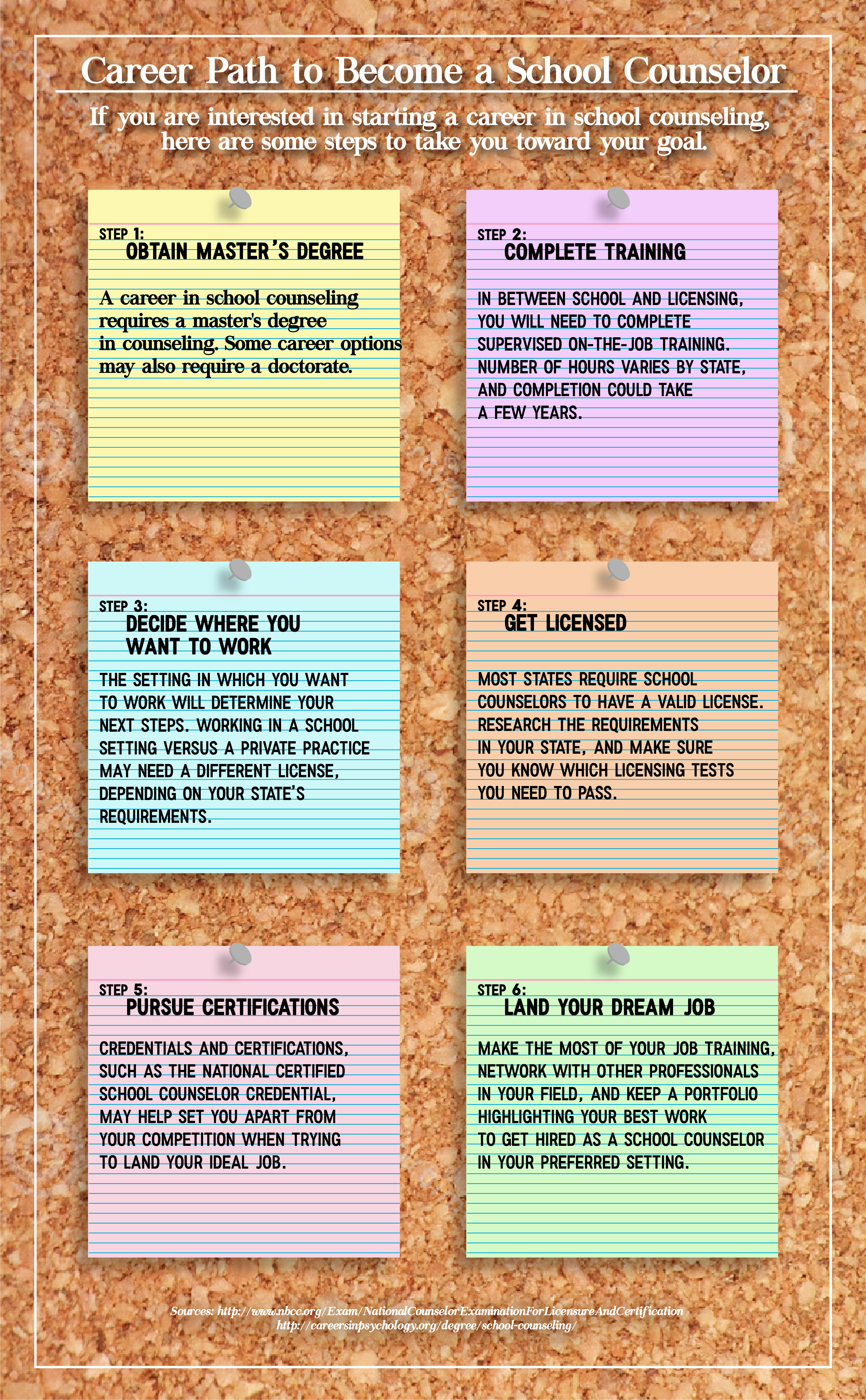 Infographic by Hannah Johnson
3. Work Under Supervision After Graduation
During or after your study program, you can intern or complete a practicum as part of your course requirements. Many programs set a certain number of these hours for you to complete, either as a graduation requirement or part of your future doctorate studies, if you decide to pursue that course. For example, one school counselor program might require 100 practicum hours, 40 of which are in direct contact with K-12 students. Additionally, to take the licensing exam to become a school counselor, you must have completed hundreds of hours of practicum or internship work.
Get familiar with the day-to-day workings of your site and don’t be afraid to ask your supervisor for any tips or important things to know while working there—it is better to ask more questions than less, especially when you are still in a learning environment.
During your school counseling internship or practicum, you will get hands-on experience in the field, generally at a school site you have chosen. You will perform most of the duties associated with your field under the direct supervision of both an on-site supervisor and your instructor or supervisor on campus. Get familiar with the day-to-day workings of your site, and don’t be afraid to ask your supervisor for any tips or important things to know while working there—it is better to ask more questions than not enough, especially when you are still in a learning environment.
4. Get Licensed as a School Counselor
After completing your educational and working hour requirements, it is time to become a board certified school counselor. First, you will need to know your state’s requirements, as they vary. The National Counselor Examination (NCE) is a 200-item exam you might sit for, as it is required to become licensed in most states. It may also be required for a national license or any potential military work you are interested in doing. The NCE website lists all the requirements for the exam and provides information on where to take it in your state. It’s a good idea to study and prepare for this exam like you would for other important, long-term tests. Find example questions from past exams and consider borrowing or ordering an NCE test prep book, which will contain helpful strategies and tips for passing your NCE successfully.
5. Optional Credentials for School Counselors
Before hiring you, most schools will prefer that you have one to two years of hands-on classroom experience. You may also need to get a teaching certificate or license. Research your state’s teaching certificate requirements, as these can differ depending on the education system. Additionally, you can pursue specializations such as career counseling or an emphasis in students experiencing addiction.
6. Get Hired as a School Counselor
The field of school counseling has many opportunities and benefits: more than 200,000 school counselors are employed every year as of 2014, and the profession has a median salary of $50,000 a year. Most educational institutions, whether K-12 schools or colleges, need counselors. Openings for these positions are generally posted through school districts or university careers sites for internal positions. You might begin your job search by researching where you would like to work and begin looking for school counseling postings in that location or ask your own college counselor for help finding a placement. Sometimes the connections you make during your internship or practicum hours can lead to future employment opportunities.
References:
- Danzinger, P. & Newman, H. (2011). School counseling concentration practicum/internship handbook. William Patterson University College of Education. Retrieved from https://www.wpunj.edu/dotAsset/315254.pdf
- National counselor examination for licensure and certification. (n.d.). National Board for Certified Counselors. Retrieved from http://www.nbcc.org/Exams/NCE
- School and career counselors: Summary. (2017, October 24). Bureau of Labor Statistics. Retrieved from http://www.bls.gov/ooh/community-and-social-service/school-and-career-counselors.htm#tab-1
- School counseling degree programs & schools. (n.d.). Retrieved from http://careersinpsychology.org/degree/school-counseling
- State certification requirements. (n.d.). American School Counselor Association. Retrieved from https://www.schoolcounselor.org/school-counselors-members/careers-roles/state-certification-requirements