Starting therapy can feel overwhelming, especially when you’re not quite sure what to expect or where to begin. For Anna Aslanian, a licensed therapist at GoodTherapy, helping clients navigate that uncertainty is at the heart of her practice. With extensive training in evidence-based modalities including Gottman Method couples therapy, Emotionally Focused Therapy (EFT), and attachment-focused EMDR, Anna brings both expertise and compassion to her work with adults seeking support for anxiety, depression, relationship challenges, and trauma.
In this Member Spotlight, Anna shares valuable insights on what makes therapy successful, from finding the right therapeutic fit to understanding that you don’t need to have all the answers before you start. Whether you’re considering therapy for the first time or looking to deepen your understanding of the process, her perspective offers reassurance that healing is possible when you find a therapist who truly gets you.
LIVE INTERVIEW: Watch the Conversation with Anna Aslanian
Table of Contents
Click a question to jump to it.
Q: For those who have never been to therapy, what should they know about starting their first session?
Anna:
I think it can be nerve-wracking to start therapy, and a lot of people have different ideas of what therapy is… It’s very different. If you’re looking for a therapist and it’s your first time, I have two tips that I think would make this successful.
Number one, look for someone who is specializing in what you’re looking for. So if you’re looking for therapy for, let’s say, depression, or you’re looking for couples therapy, or for your anxiety, or you’re trying to heal from childhood trauma, then look for that specific therapist who…mentions that they work with that specialty.
Don’t shy away from asking questions in terms of their experience, [including] what trainings they have.
Number two is your comfort level. I think therapy is different in that it’s very relational. So if you’re not clicking or connecting, or this person is not really making you feel safe to really be yourself and share, you might need a different fit. It doesn’t mean that a therapist is bad or you’re not doing a good job. It’s just really about connecting with one human being.
Just be as open as you can. Most of us therapists have heard all sorts of things. So there is nothing you can tell me that I will be shocked [to hear]. The more open you are and more you share, the better I can help you.
Back to top
Q: How can therapy help someone gain clarity if they feel like something is off with themself?
Anna:
It’s not your job to do detective work to figure out what’s happening…The best thing to do is just be honest with the therapist, and you can just share what you know…I have these thoughts, I have these feelings, I have these body sensations. Based on that, your therapist should be trained enough to ask follow-up questions to narrow down what is happening and give you insight and psychoeducation so you can connect the dots.
So don’t feel like it’s your job to know the whole thing…Your therapist is there to really guide you and figure out why you’re feeling, what you’re feeling, what it ties to, and what tools you need to move past that.
Back to top
Q: Why is it so important for people to find therapists who truly understand them, their background, or their identity?
Anna:
If you don’t feel safe with another person in the room, emotionally safe, it’s hard to open up and to share your deepest wounds and your thoughts. [Maybe] we’ve never shared that with somebody else before, or there is shame associated with what we’re going to share.
It’s really about the connection with the therapist and [if] you feel comfortable. You can also [tell] the therapist, “Hey, this is what would make me feel more comfortable,” just so that they can help you the best they can. But even then, sometimes you may feel like we’re not clicking, and that’s okay. There are so many therapists out there.
This is why so many therapists, including myself, provide free phone consultations before meeting. So that way you can have that 15-20 minute conversation on the phone…[and discuss] what you want to work on and see what they say. And if that really feels like, I’m excited to start this journey with this therapist and I feel comfortable, or it just feels like, I’m uneasy about this, then just follow your intuition on that.
Back to top
Q: What makes your practice unique, and how do you know if you’re a good fit for a client?
Anna:
So with adults, it’s kind of two branches: couples and individual therapy. For couples, I have done many additional trainings on top of just getting your degree. For example, I’m certified in Gottman Method couples therapy, and that’s all research-based…So I’m not just listening to their problems and being a witness to it. I’m giving them research-based tools.
But I’m also trained in Emotionally Focused Couples Therapy, which is all about the attachment styles and how you relate to another human being. And that really stems from childhood stuff. So I can really bring that into my work when people feel stuck and know how to get them out of that.
Within these years that I’ve been practicing, I’ve had a lot of both work experience as well as additional trainings to work with subcategories of couples therapy. So it’s not just a general approach. You have couples who come in when there is infidelity…or couples who are new parents…or premarital counseling, [or] addiction and couples therapy. All of those factors really change the dynamic and what interventions will be helpful.
For individual therapy,…I’ve worked in different populations, in different clinics, in different settings, …as well as had many certifications that really continue this growth as a therapist. I think that’s very important. We don’t just get our degrees and say that’s it or do an online course and that’s it. It’s…the schooling, the additional trainings, the practice in different settings to know how to actually utilize that in real-life situations.
I am certified in attachment-focused EMDR, as well as the traditional protocol of EMDR. I’m trained in polyvagal theory, which is all about nervous system regulating, in ACT, which is acceptance commitment therapy that’s super helpful for anxiety or just life transitions…Because I’m trained in all these different modalities, but also have the work experience and years of doing the actual work with clients, I can tailor that to what the client needs.
Back to top
Q: Why is it important for therapists to have varied certifications, experiences, and educational backgrounds?
Anna:
If you’re only trained in one modality or you’re just generally trained, there are only a handful of techniques you might know how to do. That’s why it’s important to go to a specialist, or as a therapist, it’s important to continue your growth, because not every person heals and learns or unlearns the same way. There are different methods that work for different people, and one isn’t better than the other.
You need to have a really rich toolkit as a therapist to know, Okay, this client is processing things like this, so this approach is going to be better for them, instead of trying to fit them into the way you think.
Back to top
Q: What’s one tip or mindset shift that you can share that helps people start feeling better?
Anna:
Get curious and compassionate about what’s happening instead of judgmental or solution-focused. Sometimes we can be very solution-focused, which isn’t a bad thing in itself. We have a problem, we want to fix it…But there may be a lot of judgment with that too, and pressure to change…
We [should be] compassionate with ourselves…[and] kind to ourselves the way we would be kind towards someone we love that’s going through a hard time. That’s number one. That would help you have less of that judgment and negativity around what you’re experiencing…
Whether you’re experiencing anxiety, depression, you’re stressed, or you’re feeling feelings that you think are shameful, the first thing that you can do is just allow all of that to be present in a room with you and know that it’s human and it’s normal. So you can be kind towards that aspect of yourself struggling, and then get curious: Where can I get my answers? Who can help me here? What do I need right now to take care of myself? I think those are the two fundamentals that will help you in this process of healing.
Back to top
Finding Your Path Forward
Anna’s approach to therapy reminds us that seeking help doesn’t mean you need to have everything figured out. In fact, uncertainty is often what brings us to therapy in the first place. Whether you’re navigating relationship challenges, processing past trauma, or simply feeling like something is off, the right therapeutic relationship can provide the safety and tools you need to move forward.
If you’re ready to take that first step, look for a therapist with expertise in your specific concerns, trust your gut about whether you feel comfortable, and remember that it’s okay to ask questions during a consultation. Therapy is a collaborative process, and finding a therapist who understands your unique needs can make all the difference.
To learn more about Anna Aslanian’s approach and see if she might be the right fit for you, visit her profile on GoodTherapy. If you’re interested in exploring more about the therapy process, check out GoodTherapy’s resources on how to find a therapist, what to expect in your first therapy session, and tips for getting the most out of therapy.
Back to top.
Relationship Loneliness Emotional Intimacy Attachment
There is a specific kind of ache that comes from feeling lonely in a relationship. It comes from sitting next to someone you love and realizing you haven’t really felt them in a while. You still talk, share a home, manage routines, but something underneath feels… out of reach.
You tell yourself it’s just a phase, or that every relationship has ups and downs. And that’s true, but this kind of disconnection can quietly wear at you. It’s subtle, the way emotional distance builds. You start to sense the gap but don’t know how to name it without it sounding like blame. You can love someone deeply and still miss how it used to feel.
What you feel
Lonely with someone you love
What it is
Emotional disconnection, not a flaw in you
First step
Notice and name the loneliness with care
Health organizations such as Harvard Health and the National Institute on Aging describe loneliness as a serious health concern, not just a mood. People can feel profoundly lonely even when they live with a partner. Emotional connection matters more than how many people are physically around you, which is why feeling lonely in a relationship can hurt so much.
Quick reassurance: If you are feeling lonely in a relationship you care about, you are not too needy. Your nervous system is signalling a basic human need for safe, consistent connection. That is a healthy need, not a flaw.
Feeling Lonely In A Relationship: The Hidden Cost
Emotional disconnection rarely starts with one big fight. It usually builds through missed moments, chronic stress, unresolved hurts, and unspoken needs. One partner pulls away a little to avoid conflict. The other leans in harder to reconnect. Over time, both start protecting themselves more than they reach for each other, and feeling lonely in a relationship becomes the new normal.
What it looks like on the outside
- You coordinate schedules, bills, and tasks smoothly.
- You attend events and keep the household running.
- Friends might describe you as a “solid couple”.
What it feels like on the inside
- You miss how you used to laugh or talk late into the night.
- You feel oddly alone in big moments that should feel shared.
- You are not sure how to say “I am feeling lonely in this relationship” without sounding like you are blaming.
The protest and withdraw cycle at a glance:
Partner A
Protests the distance, asks more questions, criticizes, or pleads for closeness.
Partner B
Feels overwhelmed and pulls away, goes quiet, or disappears into work or screens.
Result
Both feel alone. Neither is the villain. Both are trying to stay emotionally safe.
Over time, that safety can start to feel like silence. Touch becomes less spontaneous. Conversations shorten. It is easier to say “we are fine” than to explain the quiet ache that comes with feeling lonely in a relationship you want to protect.
“Sometimes loneliness in a relationship is not the absence of love. It is the absence of feeling truly known.”
When loneliness feels heavy or hopeless:
Long term loneliness is linked with increased risks for depression, anxiety, and physical health problems. If your mood is sliding or daily life feels harder, reaching out for support from a physician, a mental health professional, or the GoodTherapy therapist directory can be an important step.
How Emotional Disconnection In Relationships Shows Up
Emotional disconnection and relationship loneliness can show up in both quiet and loud ways. If you are feeling lonely in a relationship, this overview can help you see your experience more clearly.
Everyday signs
- Most talks are about logistics, not feelings or dreams.
- You feel unseen or unheard, even when you spend a lot of time together.
- Sex or affection feels rushed, routine, or emotionally flat.
- Conflicts loop without resolving the deeper hurt.
Inner experience
- You wonder if you are “too much” or “not enough”.
- You feel more emotionally safe with friends, kids, or your phone than with your partner.
- You grieve the version of your relationship that used to feel alive.
These reactions are understandable responses to unmet attachment needs, not evidence that you are broken.
Relationship connection meter (how does this feel for you lately)
If emotional connection feels low while stress feels high, your relationship is carrying a lot. You do not have to carry that weight alone.
Research from the National Institutes of Health on attachment theory demonstrates that these patterns often trace back to our earliest relationships and how we learned to regulate emotions. According to research on attachment and emotion regulation, insecure attachment styles can make it harder for partners to effectively communicate their needs and respond to each other’s distress.
Feeling like your partner is emotionally available, responsive, and engaged is strongly linked to satisfaction and mental health. When that sense of emotional safety erodes, feeling lonely in a relationship is a common and understandable result.
Why You Can Love Someone And Still Feel Lonely In The Relationship
Emotional disconnection is less about how much you love each other and more about the patterns that have formed between you. Here is a simple roadmap of how couples can drift apart and end up feeling lonely in a relationship that once felt safe.
Emotional disconnection timeline
1
Stress builds and the relationship shifts into task mode instead of connection mode.
2
Small hurts go unresolved, so both partners start walking on emotional eggshells.
3
Protest and withdraw cycles form, and deeper needs stay hidden under criticism or shutdown.
4
Loneliness settles in, even though the love and history between you are still there.
1. Stress and survival mode
When life is packed with work, caregiving, money worries, or health issues, many couples slide into survival mode. You become excellent at running a household together and less practiced at sharing feelings. Chronic stress makes it harder for the nervous system to stay open, curious, and playful, which are key ingredients of emotional intimacy.
2. Different emotional and “love” languages
Some people feel close through deep conversation. Others feel loved through practical help, time together, shared humor, spiritual connection, or physical touch. When partners have different emotional or cultural languages, they can both be loving in their own way and still feel unseen or lonely in the relationship.
Attachment informed approaches such as Emotionally Focused Therapy (EFT) help couples understand and respond to each other in ways that actually land as love, rather than missed signals.

3. Protest and withdraw cycles
When one partner feels disconnected, they may protest the distance by asking for talks, pushing for reassurance, or criticizing. The other may respond by withdrawing, going quiet, or losing themselves in work or screens. The more one protests, the more the other withdraws, and the more alone both partners feel.
Underneath this pattern, people often carry fear such as “Will you leave me”, shame such as “Am I failing you”, or grief such as “We are losing something precious”. Therapies rooted in attachment science help couples slow down this dance so those tender feelings can be shared more safely and so that feeling lonely in a relationship is no longer the default setting.
4. Attachment wounds and past experiences
Our earliest relationships shape how safe closeness feels now. If you learned that emotions were dangerous, that you had to be the “strong one”, or that your feelings did not matter, then being emotionally open with a partner can feel risky, even when you love them. That history can make feeling lonely in a relationship more likely, especially under stress.
5. Neurodiversity, culture, and other differences
Some couples navigate differences in neurotype, culture, language, gender roles, or trauma history. For example, in some neurodiverse relationships one partner may need more quiet time or structure while the other longs for spontaneous emotional check ins. Without a shared understanding of these differences, both can end up feeling misunderstood and alone in the relationship.
Loneliness is a health issue too:
U.S. Department of Health & Human Services describe loneliness and social disconnection as serious health risks, comparable to other major risk factors. Taking your relationship loneliness seriously is not overreacting. It is one way to care for both your emotional and physical wellbeing.
First Steps When You Are Feeling Lonely In A Relationship
Rebuilding emotional intimacy rarely happens through one big conversation or a perfect date night. More often, it comes from small, consistent acts of presence that slowly change the emotional climate between you. You do not have to fix everything at once. You can start with a few gentle shifts, even while you are still feeling lonely in a relationship that matters to you.
1. Get clear on your own experience
Before you bring this up with your partner, it helps to know what the loneliness actually feels like for you. You might journal or reflect on questions such as:
- When do I feel the most lonely in this relationship, and when do I feel more connected.
- What kind of connection do I miss most, such as deeper talks, more touch, shared fun, or spiritual or creative time.
- What am I afraid might happen if I say “I feel lonely with you” out loud.
Growing your own emotional awareness is part of emotional intelligence, which can reduce loneliness and support healthier relationships.
Body based mini check in:
When you think about your partner, notice:
- Where does the loneliness sit, for example chest, throat, or stomach.
- Does your body feel tight, numb, or a bit softer when you imagine more closeness.
- What happens in your body when you imagine talking about feeling lonely in the relationship.
These sensations are information, not verdicts. They can guide the pace at which you move and whether extra support would help.
2. Lead with gentle honesty, not blame
Many people avoid talking about feeling lonely in a relationship because they do not want their partner to feel attacked. It can help to center your feelings and hopes instead of their flaws. For example:
-
“I have been feeling lonely in our relationship, even though I really love you, and I do not want it to stay this way.”
-
“I miss feeling close to you. Could we set aside some time to talk about that when we both have energy.”
-
“We are great at getting things done, and I would love us to have more time where we talk about us too.”
Try to choose a calmer moment if possible, not the middle of a fight or while someone is rushing out the door. It is completely normal if the first few conversations feel awkward. You are practicing a new way of being together.
Need help finding the words:
A therapist can help you practice what you want to say, or even support a first conversation in session. You can explore options through the
GoodTherapy Find a Therapist directory.
3. Learn each other’s emotional languages
You might try a curiosity based mini interview with each other:
-
“When do you feel most emotionally close to me.”
-
“What do I already do that helps you feel loved, even if I do not notice it.”
-
“What tends to shut you down or make you want to pull back.”
-
“If we had ten extra minutes a day just for us, what would you want to do with them.“
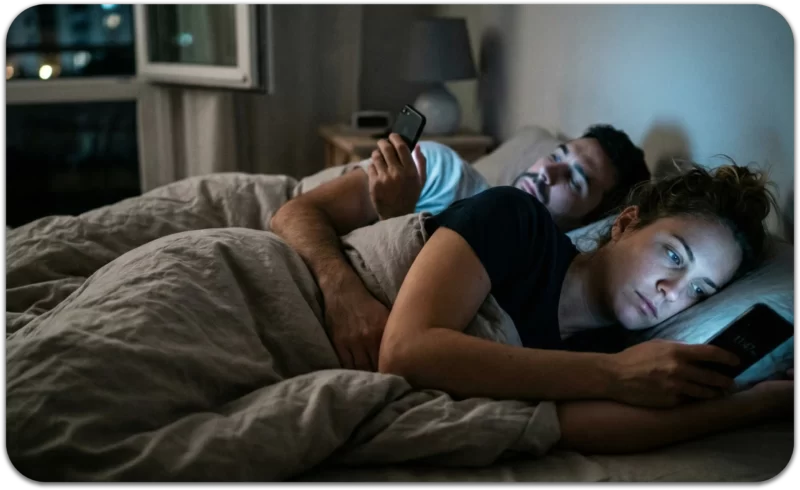
Even small daily habits matter, such as putting phones away for a few minutes, offering a longer hug, or saying thank you for everyday things. Responding to these small “bids” for connection can slowly soften the feeling of being lonely in a relationship.
Click to see examples of “bids” for connection
-
Your partner sighs and says “Today was a lot”.
-
They send a meme or reel and wait to see if you smile.
-
They ask “Did you see that” about something they care about.
-
They move a little closer on the couch or reach for your hand.
Turning toward these small bids with attention, even briefly, can start to soften relationship loneliness.
4. Create tiny rituals of connection
Emotional intimacy is easier to maintain when it has a place in your routine. A few possibilities:
-
A 10 to 15 minute “phones away” check in in the evening.
-
A weekly walk or coffee where you talk about how you are really doing, not just logistics.
-
A simple repair ritual after conflict, such as “What felt hard, and what might help next time.”
-
Naming one small thing you appreciate about each other each day.
If these rituals feel stressful, forced, or impossible to maintain, that does not mean you are failing. It may mean your nervous systems are still in high alert and that more support would help before emotional closeness feels accessible again.
You do not have to fix this alone:
Couples therapy, especially attachment based work like EFT, can give you a safer space to experiment with new patterns. You can read more about EFT on GoodTherapy or search for a couples therapist in the GoodTherapy directory.
When You Are Not Sure What You Want Yet
Sometimes feeling lonely in a relationship brings up bigger questions. You might find yourself wondering:
“Is this fixable”
You might notice moments of warmth or effort from your partner that remind you why you chose each other. You might also notice patterns that feel stuck. Both can be true at the same time.
“Should I stay”
There is usually no quick, one size fits all answer. Your safety, values, history, support system, and options all matter. These questions deserve time, not pressure.
A Grounded, Gentle Reminder
If you have been feeling lonely in a relationship, you are not broken and neither is your love. You’re human. You’ve both been navigating stress, routines, and life’s noise.
You deserve to feel emotionally seen- not just partnered, but known. Reconnection doesn’t start with grand gestures; it starts with gentle honesty, patience, and a willingness to be curious again.
Sometimes love asks you to stay; other times, it asks you to reach differently. Either way, you get to honor your need for closeness. You get to ask for softness again.
Frequently Asked Questions:
Here are some common questions people ask when they feel lonely in a relationship they still care about.
Q: Is it normal to feel lonely in a relationship you love?
A: Yes. Many people report periods of feeling lonely in a relationship, even in long term, loving partnerships, especially during life transitions or high stress seasons. Feeling lonely in a relationship does not automatically mean the relationship is unhealthy or hopeless. It does mean that emotional connection needs attention and care.
Q: How do I know if this relationship loneliness means we should break up?
A: Loneliness alone does not give the full answer. It helps to look at patterns over time. Are both of you willing to talk about the distance, even imperfectly. Do you see at least some efforts to respond when you reach out. Are there patterns of emotional or physical harm, severe contempt, or ongoing betrayal that make the relationship unsafe. These are complex questions that a therapist can help you sort through at a pace that feels manageable.
Q: Can couples therapy really help us feel emotionally close again?
A: Many couples do experience more safety and closeness through approaches like Emotionally Focused Therapy and other attachment based models. These therapies focus on understanding your emotional dance, slowing down reactive patterns, and helping you practice new ways of reaching for each other, not just learning communication tips. While there are no guarantees, research supports these approaches as effective for many couples.
Q: How can I tell my partner I am feeling lonely without hurting them?
A: You might begin by naming your care and your hope before naming the pain. For example, “I love you and I want us to feel closer. Lately I have been feeling lonely in our relationship and I do not want to keep that inside.” Focus on your feelings and needs instead of listing your partner’s flaws, and choose a calmer moment to talk, not the middle of an argument. If this still feels overwhelming, you can ask a therapist to help you prepare or to have this conversation together in a session. You can search for support through GoodTherapy’s therapist directory.

Key Takeaway: Falling out of love isn’t just emotional, it’s biological. When dopamine fades and stress hormones rise, relationships suffer. But here’s the hopeful part: through neuroplasticity and couples therapy, your brain can literally rewire itself to feel love again. This article explores the science behind why we fall out of love and the proven therapeutic approaches that can help you reconnect.
Ah, love, that magical mix of butterflies, late-night texts, and pretending you actually like their favorite band. At first, everything feels cinematic. But somewhere between “I can’t stop thinking about you” and “Why do you breathe so loud?” something shifts. You might find yourself falling out of love, and it can feel confusing and painful.
It’s not that you suddenly stop caring, it’s that your brain chemistry changes. Falling out of love isn’t just an emotional story; it’s also a biological one rooted in neuroscience and attachment patterns.
The Brain on Love: Nature’s Most Addictive Drug
When you first fall in love, your brain throws a full-blown chemical party. Dopamine (the “pleasure” chemical) lights up your reward system every time you see or hear from your partner. Add a dash of norepinephrine (the excitement hormone) and a heavy pour of oxytocin (the cuddle chemical), and suddenly you’re in the throes of what scientists call “romantic love”, and what your friends call “being obsessed.”
Research published in the journal Brain Sciences confirms that the coordination of oxytocinergic and vasopressinergic pathways, coupled with the dopaminergic reward system, contribute to the formation and maintenance of both maternal and passionate love. Basically, early love is the brain’s version of a chemical binge, all thrill, no chill.
The Science Behind the Spark
The ventral tegmental area (VTA) and nucleus accumbens; key regions in your brain’s reward circuit, become hyperactive during early love. Georgetown University neuroscience research shows this activation is similar to what happens with highly rewarding stimuli, explaining why new love feels so intoxicating.
The Come-Down: When the High Wears Off and You Start Falling Out of Love
Unfortunately, the brain can’t keep partying forever. Over time, it adapts, dopamine receptors stop firing at full blast, and that rush of excitement begins to fade. This is called hedonic adaptation, which is science’s polite way of saying, “you got used to it.”
What once made your heart skip now just… exists. You start noticing little annoyances (why do they breathe so loud again?) because your brain isn’t running on pure dopamine anymore. This biological shift is a primary reason why people experience falling out of love, even when they still care deeply about their partner.
Stress Enters the Chat: Cortisol Crashes the Party
As the honeymoon glow fades, real life rolls in, bills, chores, emotional baggage, and along with it comes cortisol, the stress hormone. When stress rises, oxytocin (your bonding hormone) drops. The brain’s alarm system, the amygdala, becomes more active, and suddenly your partner’s quirks start feeling like personal attacks.
This isn’t because love disappeared, it’s because stress hijacked the chemistry that keeps you connected. Studies suggest that chronic stress (via cortisol) may disrupt oxytocin and bonding pathways, weakening emotional closeness.
Serotonin and the End of Obsession
When you first fall in love, serotonin levels drop, making you think about your partner constantly. (Yes, love makes you a little obsessive, it’s biology, not madness.) But as the relationship settles, serotonin balances out. The fixation fades, and you start noticing other things: your needs, your goals, your sleep schedule.
That shift can feel like falling out of love, but in many cases, it’s your brain just finding balance again. Understanding this biological reality can help couples normalize what they’re experiencing rather than interpreting it as relationship failure.
Quick Science Fact:
A study by Marazziti et al. found that people in early romantic love had reduced platelet serotonin transporter density, levels similar to those seen in unmedicated OCD patients
Withdrawal: When Love Ends (and It Feels Like You’re Dying)
Breakups, or even emotional distance, can feel physically painful because your brain goes through withdrawal. Those same dopamine and oxytocin pathways that once fired with joy suddenly go quiet. It’s why we crave contact, even when we know it’s not healthy.
But here’s the hopeful part: your brain heals. Through neuroplasticity, the brain’s ability to rewire, new sources of connection and joy eventually form. Research on neuroplasticity demonstrates that you really can feel that spark again, sometimes even with the same person.

How Therapy Can Help When You’re Falling Out of Love
Here’s the part many people don’t realize: therapy isn’t just for breakups, it’s for makeups. When you’re experiencing falling out of love, professional support can be transformative.
A good couples therapist can act like a guide for your nervous systems, helping you both learn to connect again instead of defaulting to old defenses. Emotionally Focused Therapy (EFT), which is grounded in attachment theory, has been shown to be highly effective for couples experiencing emotional disconnection.
How Therapy Rewires Your Brain for Love
-
Creates emotional safety: When you feel heard instead of blamed, the brain naturally shifts from defense mode to connection mode
-
Reduces cortisol (stress): Learning better communication and emotional regulation skills lowers stress hormones
-
Boosts oxytocin: Small moments of eye contact, shared laughter, or vulnerability can reignite bonding hormones
-
Activates neuroplasticity: Therapeutic relationships can help form new neural pathways over time, as shown in neuroimaging studies of psychotherapy.
In therapy, partners experience emotional safety, and that’s when oxytocin (the bonding hormone) starts flowing again. Therapy also helps reduce cortisol (stress) by teaching better communication and emotional regulation skills. Small moments of eye contact, shared laughter, or even vulnerability can reignite dopamine, reminding your brain why you fell in love in the first place.
The Role of Attachment in Falling Out of Love
Research shows that early caregiving experiences shape adult romantic attachment styles (secure, anxious, avoidant, disorganized), which influence how people think, feel, and relate in relationships.
Therapy helps couples move from insecure attachment patterns toward earned secure attachment, where both partners feel safe expressing vulnerability and responding to each other’s needs. This transformation doesn’t just improve feelings, it literally changes brain structure through repeated positive interactions.
The Takeaway: Falling Out of Love Doesn’t Mean Failure
Falling out of love doesn’t mean you’ve failed, it means your brain is doing what it’s designed to do: adapt and seek balance. But just as the brain can unlearn closeness, it can relearn it, too.
With care, curiosity, and sometimes the guidance of a good therapist, the chemistry of love can evolve, not back to the dizzying early rush, but toward something deeper, calmer, and more real. Couples counseling offers multiple pathways to rebuild connection, from improving communication to addressing underlying trauma.
Signs You Might Benefit from Couples Therapy:
-
You feel emotionally disconnected from your partner
-
Arguments escalate quickly or lead nowhere
-
You’re considering separation but still have hope
-
Life stressors are straining your relationship
-
You want to prevent small issues from becoming major problems
-
You’re ready to invest in your relationship’s future
Because love isn’t just a feeling, it’s a relationship between two nervous systems learning to feel safe again. And with the right support, that safety can be rebuilt, one moment of connection at a time.
Frequently Asked Questions About Falling Out of Love
Common questions about the brain science of love and relationship recovery:
Q: Is falling out of love permanent?
A: No, falling out of love is not necessarily permanent. Thanks to neuroplasticity, the brain’s ability to form new neural connections, you can rebuild emotional intimacy with your partner. Research shows that with consistent effort, emotional safety, and often professional support through couples therapy, partners can reconnect and experience renewed feelings of love. The key is addressing the underlying issues (stress, poor communication, unmet needs) that contributed to the disconnection.
Q: How long does it take to fall back in love?
A: There’s no set timeline for falling back in love, as it depends on many factors including the severity of disconnection, both partners’ commitment to change, and whether professional help is involved. Some couples notice positive shifts within weeks of starting therapy, while others may need several months of consistent effort. What matters most is creating new positive experiences together that trigger oxytocin and dopamine release, gradually rebuilding the neural pathways associated with love and attachment.
Q: What causes the brain chemistry to change in relationships?
A: Brain chemistry changes in relationships are natural and inevitable. Initially, dopamine and norepinephrine create the intense euphoria of new love. Over time, the brain adapts through hedonic adaptation, essentially becoming “used to” the stimulus. Additionally, life stressors increase cortisol (the stress hormone), which can suppress oxytocin and reduce feelings of closeness. These changes aren’t relationship failures but biological adaptations that require conscious effort to manage.
Q: Can therapy really change how my brain responds to my partner?
A: Yes! Research on neuroplasticity confirms that therapy can literally rewire your brain’s response patterns. When couples therapy creates emotional safety, it activates the brain’s reward centers and reduces activity in threat-detection areas. Repeated positive interactions in therapy strengthen new neural pathways while weakening old defensive patterns. Studies from the National Institutes of Health demonstrate that therapeutic relationships facilitate neuroplastic changes throughout the lifespan.
Q: What’s the difference between falling out of love and growing apart?
A: Falling out of love typically refers to the fading of romantic and emotional connection, often driven by brain chemistry changes and decreased intimacy. Growing apart suggests a divergence in life paths, values, or interests. However, these experiences often overlap. The good news is that both can be addressed through intentional reconnection efforts. Couples therapy can help you identify whether the core issue is emotional disconnection, incompatibility, or both, and provide appropriate interventions.
Q: What are the first signs of falling out of love?
A: Early signs include decreased physical affection, less interest in spending quality time together, feeling like roommates rather than partners, increased irritation with habits that never bothered you before, and emotional withdrawal during conflicts. You might also notice reduced excitement about your partner’s achievements or a general sense of apathy toward the relationship. These signs don’t mean the relationship is doomed, they’re signals that the relationship needs attention and possibly professional support to reverse course.
Ready to Reconnect and Rebuild Your Love?
You don’t have to navigate falling out of love alone. Professional couples therapy can help you understand the neuroscience behind your disconnection and provide practical strategies to rebuild emotional intimacy.
 If you’ve tried active listening, “I” statements, and communication workshops but still struggle with your partner, you’re not alone. Many couples discover that communication skills alone can’t fix deeper relationship issues.
While the belief that “communication is the key to a successful relationship” is widely accepted, this view oversimplifies the complexity of romantic partnerships. Poor communication is often a symptom of deeper, unresolved issues such as insecure attachment styles, unmet emotional needs, trauma, and misaligned values.
This article argues that focusing solely on communication techniques can mislead couples and therapists alike. Instead, the foundation of healthy relationships lies in emotional safety, value alignment, and mutual trust. Drawing on empirical research, attachment theory, and clinical insights, this article explores the underlying dynamics that frequently masquerade as communication problems.
The Communication Myth: Why “Better Talking” Doesn’t Always Work
Dr. John Gottman’s decades of research into marital stability challenges the notion that poor communication is the leading cause of divorce. Gottman and Silver (1999) found that many couples who ultimately divorce actually communicate in similar patterns to those who stay together. What separates the two is not how well they speak, but how deeply they remain emotionally connected.
Effective communication is often seen as the cure-all for relationship conflict. But communication devoid of emotional safety or trust becomes performative rather than healing. When partners feel disconnected, threatened, or unseen, even skillful dialogue can result in misunderstanding or defensiveness.
Moreover, it’s possible to communicate “well” while still engaging in harmful dynamics like manipulation, gaslighting, or passive aggression. Thus, the content of communication matters far less than the emotional intent and context in which it occurs.
The Real Root Causes of Relationship Problems
Attachment Wounds: How Your Past Shapes Your Present
Attachment theory, developed by Bowlby (1982) and extended to adult relationships by Hazan and Shaver (1987), provides a valuable lens for understanding relational conflict. People with different attachment styles express needs and process emotions in vastly different ways.
For example, individuals with an anxious attachment style may engage in protest behavior—over-texting, emotional outbursts, or accusations—not because they are poor communicators, but because they fear abandonment. Conversely, avoidantly attached individuals may withdraw or shut down during emotional conversations, not due to a lack of interest, but due to fear of engulfment.
Simpson and Rholes (2015) assert that insecure attachment styles are a leading cause of communication breakdowns in romantic relationships. The words used may be clear, but the intent and emotion behind them are filtered through layers of personal insecurity and unresolved wounds.
In this context, improving communication skills without addressing attachment needs is like repainting a house with a cracked foundation—it may look better temporarily, but the underlying problems will resurface.
Unmet Emotional Needs: The Hidden Language of Conflict
All human beings have core emotional needs: to feel loved, respected, secure, and significant. In romantic relationships, these needs often become amplified. When partners do not feel their needs are acknowledged or met, frustration builds—and is frequently expressed as a communication issue.
For instance, a partner may say, “You never spend time with me,” when what they mean is, “I feel lonely and unimportant.” Without understanding the emotional layer beneath the words, the receiving partner may respond defensively, triggering a cycle of argument rather than connection.
Johnson (2008), in her development of Emotionally Focused Therapy (EFT), emphasizes that emotional responsiveness is more important than verbal clarity. She argues that the goal of healthy communication is not merely the exchange of information, but the reassurance of emotional connection.
Values and Belief Systems: The Hidden Divide
Even when couples are emotionally attuned and capable of effective conversation, persistent conflict may arise from fundamental differences in values. Topics like parenting, religion, career ambition, and finances reflect deeply held beliefs that are not easily negotiated.
Perel (2006) points out that many couples clash not because they cannot talk to one another, but because they are “speaking different dialects”—shaped by culture, upbringing, and personal philosophy. For example, a partner raised in a family that prized individual success may struggle to connect with a partner raised in a communal, family-centered environment.
When partners’ values are misaligned, communication becomes strained—not because of delivery, but because of conflicting worldviews. No amount of communication technique can reconcile opposing core values without mutual understanding, compromise, or acceptance.
Emotional Safety: The Foundation for Real Dialogue
One of the most under-discussed but critical factors in communication is emotional safety—the sense that one can speak openly without fear of judgment, punishment, or ridicule. Emotional safety enables vulnerability, which is essential for intimacy and conflict resolution.
Zilcha-Mano and Errázuriz (2020) found that emotional safety is a better predictor of relationship satisfaction than communication frequency or skill. Partners who feel safe are more likely to speak openly, listen non-defensively, and repair conflict effectively.
Without emotional safety, even well-intentioned messages are often misinterpreted as attacks. Safety allows space for mistakes, learning, and emotional risk-taking. Communication thrives in its presence and deteriorates in its absence.
When Communication Problems Are Really Symptoms
From a clinical perspective, what presents as a communication problem is often rooted in:
- Unprocessed trauma: Unhealed past wounds that color current interactions
- Power struggles: Efforts to control, dominate, or resist perceived control
- Resentment: Built-up emotional pain from unmet expectations
- Fear of vulnerability: Avoidance of emotional openness due to fear of rejection or hurt
Therapists often observe that once these core issues are addressed, communication naturally improves—even without explicit training. In this way, communication is not a primary intervention but a byproduct of relational healing.
A Better Approach: Therapy That Goes Deeper
What Effective Couples Therapy Actually Does
Therapists should resist the temptation to begin treatment with communication skills training. While helpful, such skills can be superficial if not grounded in emotional attunement and psychological safety.
Instead, the therapeutic process should include:
- Attachment repair: Understanding how each partner’s attachment history shapes their behavior
- Emotional attunement: Teaching partners to recognize and respond to one another’s core emotional states
- Trauma-informed care: Addressing past relational wounds that impair present-day connection
- Values clarification: Exploring compatibility around life goals and beliefs
Only after this foundation is laid should traditional communication techniques—such as reflective listening or structured dialogue—be introduced.
The EFT Difference
Emotionally Focused Therapy has shown remarkable success because it addresses the emotional bonds that drive communication patterns. Research shows that 70-75% of couples move from distress to recovery using EFT, with 90% showing significant improvements.
EFT works by helping couples:
- Identify negative interaction cycles
- Access underlying emotions and attachment needs
- Create new positive interactions based on emotional connection
- Consolidate new patterns of bonding
5 Signs Your Relationship Problems Run Deeper Than Communication
- You’ve tried communication techniques but keep having the same fights
- One partner shuts down or becomes defensive when difficult topics arise
- Past hurts keep resurfacing despite “talking them through”
- You feel like you’re speaking different languages even when using the same words
- There’s an underlying feeling of emotional unsafety or walking on eggshells
If these patterns sound familiar, it may be time to look beyond communication skills and address the deeper emotional dynamics at play. If you and your partner feel stuck in recurring arguments, consider exploring the emotional roots of your communication. Find a qualified couples therapist near you on GoodTherapy.
Frequently Asked Questions
Is communication important in relationships?
Yes, communication is important, but it’s not the root cause of most relationship problems. Effective communication naturally improves when underlying issues like attachment wounds, emotional safety, and value misalignment are addressed first.
What are the real causes of relationship problems?
The deeper causes include insecure attachment styles, unprocessed trauma, lack of emotional safety, conflicting core values, and unmet emotional needs that manifest as communication difficulties.
How can therapy help beyond communication skills?
Effective therapy addresses attachment repair, emotional attunement, trauma-informed care, and values clarification before introducing traditional communication techniques. This creates lasting change rather than surface-level improvements.
When should couples seek professional help?
Consider therapy when communication techniques haven’t worked, when the same conflicts keep recurring, or when there’s emotional withdrawal, defensiveness, or a sense of walking on eggshells in the relationship.
Can relationships improve without focusing on communication?
Absolutely. When couples address emotional safety, attachment needs, and core compatibility issues, communication often improves naturally as a byproduct of deeper healing and connection.
Key Takeaways: Beyond Communication to Real Connection
Communication plays a vital role in relationships, but it is not the most important element. Focusing on communication without addressing emotional safety, attachment dynamics, trauma, and values can be both misleading and ineffective. These deeper forces often drive what appears on the surface as a communication breakdown.
For lasting relational health, individuals and couples must look beneath the words and examine the emotional frameworks that shape them. When emotional connection, mutual respect, and personal healing are prioritized, communication naturally becomes clearer, more honest, and more effective.
The bottom line: If you’re struggling with relationship communication, the problem likely runs deeper than speaking and listening skills. Consider working with a therapist trained in attachment-based approaches like EFT to address the root causes of your relationship distress.
Additional Resources
References
Bowlby, J. (1982). Attachment and loss: Vol. 1. Attachment (2nd ed.). Basic Books.
Gottman, J. M., & Silver, N. (1999). The seven principles for making marriage work. Crown Publishers.
Hazan, C., & Shaver, P. R. (1987). Romantic love conceptualized as an attachment process. Journal of Personality and Social Psychology, 52(3), 511–524. https://doi.org/10.1037/0022-3514.52.3.511
Johnson, S. M. (2008). Hold me tight: Seven conversations for a lifetime of love. Little, Brown and Company.
Perel, E. (2006). Mating in captivity: Unlocking erotic intelligence. Harper.
Simpson, J. A., & Rholes, W. S. (2015). Attachment theory and research: New directions and emerging themes. Guilford Press.
Zilcha-Mano, S., & Errázuriz, P. (2020). Emotional safety in romantic relationships: How it predicts relationship outcomes. Couple and Family Psychology: Research and Practice, 9(1), 21–34. https://doi.org/10.1037/cfp0000125

By Dr. Jocelyn Markowicz, PhD, Psychologist
Attachment Hope for Couples: How to Improve Your Security Odds
You walk into the room and lock eyes with the most gorgeous human being you have ever seen. This individual locks eyes with you as well. You begin talking and realize that the chemistry between you is intense. You plan a date. You have several great dates. You fall in love and begin to talk about spending the rest of your lives together. You have the wedding. You go on the honeymoon. You begin to live your day-to-day lives together. (Perhaps not quite in that order.) But then, as you settle into shared lives, you notice that something is changing. The arguments are more frequent. The emotions are not all positive. Why does your partner leave when there is conflict? Why does your partner walk away when you need soothing? Why are they sometimes exhaustingly clingy and other times too independent? John Bowlby and Mary Ainsworth offered an answer rooted in attachment styles to these questions. Several researchers after them offered solutions. I’d like to share them with you.Â
The Evolution of a Relationship
It is important to acknowledge that it takes time for interpersonal patterns to emerge within a romantic relationship. A perception bias occurs when you first fall in love that naturally heightens your connection to your partner’s strengths and limits your awareness of their weaknesses. Thus, it is in day-to-day living that you develop more accurate perceptions of patterns that are problematic.Â
Why You Relate the Way You Do
In the 1960s, John Bowlby asserted that we learn positive and negative ways of relating based on our parent-child experiences. Our ways of relating are designed to strengthen our bond with our attachment figures (parents/caregivers) growing up. They help us survive. An attachment behavioral system gradually emerges wherein we attempt to regulate our emotions and behaviors toward an attachment figure. To do this, Bowlby (1980) asserted that the attachment system essentially asks the following fundamental question: Is the attachment figure nearby, accessible, and attentive? According to Bowlby (1980), an individual who has experienced a secure attachment is likely to view attachment figures as available, responsive, and helpful. An insecurely attached individual would view attachment figures as inaccessible, untrustworthy, and unreliable.
Different Attachment Styles
Ainsworth expanded on Bowlby’s attachment behavioral system and introduced specific attachment styles that explain our attachment behaviors. She outlined three specific attachment styles: (1) secure attachment and two insecure attachment styles: (1) anxious-resistant, and (2) avoidant (Ainsworth, 1979). In adult romantic relationships, the insecurely attached adult who is anxious-resistant would be dependent on their partner and yet reject their soothing attempts. The insecurely attached adult who is avoidant would not seek emotional or physical comfort from their partner when experiencing emotional distress.Â
Bowlby and Ainsworth helped us to understand that our way of relating to others is guided by our early attachment experiences, but do we indeed exhibit the same attachment behaviors in our adult romantic relationships?
Further Research into Attachment StylesÂ
Hazen and Shaver (1987) evaluated Bowlby’s theoretical premise that early attachment behaviors extend to adulthood and are relatively stable. They conducted research and found that adults also reported the three attachment categories that Ainsworth determined (secure, anxious-resistant, and avoidant). Their research identified that romantic relationships are attachment bonds and share similar attachment behaviors that characterize parent-child interactions. In essence, Bowlby and Ainsworth were right to suggest that we can look at our adult relationships and evaluate our partner’s attachment behaviors based on their childhood attachment experiences.Â
Are People Stuck Forever in Patterns from Childhood?Â
What happens if you partner with someone with an insecure attachment style? Can their attachment style become secure?Â
Researchers had the same questions about whether or not early attachment behaviors could be changed in adulthood. Findings across several studies did indicate that while early attachment style is relatively stable (Kim, Baek, & Park, 2021), attachment behaviors can change (Tmej, AMA et al., 2020;Â Sims, 2000;Â Rimane, Steil, Renneberg, & Rosner’s, 2020; Overall, Simpson, & Struthers, 2013;Â Gazder & Stranton, 2010; Park, Johnson, MacDonald, & Impett, 2019). Therein lies the hope for the couple. So, back to the question, what happens if you partner with an insecurely attached individual? How can you increase your secure attachment odds in your relationship?
Distress in romantic relationships is the leading cause for adults to seek psychological services (Bradbury, 1998). There are specific interventions that increase attachment security or reduce the negative impact of insecure attachment behaviors in romantic relationships. The following interventions are supported by empirical examination.
Transference-Focused Therapy
Transference-focused therapy (TFT) is a therapeutic intervention that aims to reduce impulsivity, stabilize mood, and improve interpersonal and occupational functioning. The intervention is specifically designed for individuals who struggle with borderline personality disorder. Trauma can impact the internalized representations of personality. It is not uncommon for individuals to develop maladaptive personality traits in response to trauma. Trauma impacts attachment bonds. TFT is a great choice for an individual partner in a couple dyad who may also struggle with borderline personality. A recent study found that individuals who participated in TFT moved towards securely attached with some preoccupied behaviors away from insecurely attached with preoccupied behaviors (Tmej, AMA et al., 2020)
Emotionally Focused Therapy
Emotionally focused therapy (EFT) for couples focuses on reshaping distressed couples’ structured, repetitive interactions and the emotional responses that evoke partners and foster the development of a secure emotional bond (Jonson, 1996; Jonson, 1999). The EFT model assumes that the negative emotions and interactional cycles typical of distressed couples represent a struggle for secure attachment (Bowlby, 1969). Sims (2000) randomized 26 couples in which at least one partner had been rated as insecurely attached to EFT or a waitlist control group. Couples in the EFT treatment condition increased their attachment security (and decreased attachment-related avoidance) more than the control couples.Â
Trauma-Focused Cognitive Processing Therapy
Trauma-focused cognitive processing therapy (CPT) focuses on changing the dysfunctional beliefs associated with trauma. Trauma during our early attachment years impacts our attachment functioning, thereby shaping how we related to others in romantic relationships. CPT offers hope for couples in that an insecurely attached partner, who has been the victim of trauma, can participate in this mode of treatment to improve functioning. In Rimane, Steil, Renneberg, and Rosner’s (2020) study, individuals who participated in CPT experienced reduced avoidance attachment (insecure) behaviors when assessed post-treatment.
Dyadic Regulation Processes
Dyadic regulation processing occurs in couples therapy and is designed to improve attachment-relevant dyadic interactions between them. Applying the Dyadic Regulation Processing Model, researchers evaluated how partners can buffer the impact of their partner’s anxious resistant or avoidant behaviors due to their insecure attachments. Overall, Simpson and Struthers (2013) videotaped romantic couples discussing relationship problems identified by one partner who wanted changes in the other partner. Results indicated that insecurely attached partners whose partners displayed more softening exhibited less anger and withdrawal, and their discussions were more successful. These partners buffered their insecurely attached partner’s responses by learning to be sensitive to their autonomy needs, validating their viewpoint, and acknowledging their constructive efforts and good qualities.
Partner Relationship Mindfulness
General mindfulness is defined as the awareness of what is happening in the moment. In their study, Gazder and Stranton (2010) defined relationship mindfulness (RM) as open or receptive attention to and awareness of what is taking place internally and externally in a current relationship. They found that an individual’s own daily relationship mindfulness did not buffer the effects of their own insecure attachment on same-day relationship behaviors, but their partner’s daily relationship mindfulness did. In essence, you can buffer the impact of your partner’s insecure attachment behaviors by increasing your own relationship mindfulness. Therapy is a great place to learn how to practice relationship mindfulness techniques.
Partner with Someone with a Secure Attachment Style
As outlined, various treatment interventions can move an individual and couple towards more secure attachment relating. At this point, you may be thinking that hope is only achieved within a therapeutic setting. I have good news for you. If you are a securely attached individual, you play an important role in your relationship with an insecurely attached partner. Experiencing secure behaviors within romantic relationships can reduce representations of insecure attachment style (Park, Johnson, MacDonald, & Impett, 2019). How romantic! Your secure attachment behaviors can provide a secure base for your insecurely attached partner to grow. In the context of your relationship, you and your partner will experience many life events together. In their most recent study, Fraley, Gillath, and Deboek (2020) found that life events could change attachment style presentations in adulthood, with some changes yielding an enduring pattern. Â
What Lies within Our Power?
We cannot go back to our childhood and choose caregivers that would prevent us from developing an insecure attachment style. We, therefore, cannot prevent the impact of any dysfunctional early childhood attachment experiences on who we are, interpersonally, as adults. However, there is hope. We can increase our secure attachment odds by choosing partners who are securely attached. We can participate in couples therapy interventions. We can also offer a secure attachment base for our insecurely attached partner. Attachment styles do not equate to fixed potential in your relationship – there is always room for growth.Â
If you’re ready to explore how therapy can help you and your relationship, click through to find a couples therapist near you.
References
Ainsworth, M. D. S. (1979). Attachment as related to mother-infant interaction. In Advances in the study of behavior (Vol. 9, pp. 1-51). Academic Press.
Bowlby, J. (1969). Attachment and loss: Vol. 1. Attachment. New York: Basic Books.
Bowlby, J. (1980). Loss: Sadness & depression. Attachment and Loss (vol. 3); (International psycho-analytical library no.109). London: Hogarth Press.
Bradbury, T. N. (1998). The developmental course of marital dysfunction. New York: Cambridge University Press.
Gazder, T. & Stanton, S. C.E (2020). Partners’ Relationship Mindfulness Promotes Better Daily Relationship Behaviors for Insecurely Attached Individuals. Int J Environ Res Public Health. 5;17(19):7267.
Hazen, C., & Shaver, P.R. (1987). Romantic love conceptualized as an attachment process. Journal of Personality and Social Psychology, 52, 511-524.
Johnson, S. (1996). The practice of emotionally focused marital therapy: Creating connection. New York. Brunner/Mazel.
Johnson, S. (1999). Emotionally focused couples therapy: Straight to the heart.Â
In J. Donovan (Ed.), Short term couple therapy (pp. 14-42). New York Guilford Press.
Fraley, R.C., Gillath, O. & Deboeck,P.R.(2020, August13).Do Life Events Lead to Changes in Adult Attachment Styles? A Naturalistic Longitudinal Investigation. Journal of Personality and Social Psychology.Â
Kim, S.â€H., Baek, M., & Park, S. (2021). Association of parent–child experiences with insecure attachment in adulthood: A systematic review and metaâ€analysis. Journal of Family Theory & Review.
Overall, N.C., & Simpson J. A.( 2013) Regulation processes in close relationships. In: Simpson JA, Campbell L, editors. The Oxford handbook of close relationships. New York: Oxford University Press; 2013. pp. 427–451.
Park, Y., Johnson, M. D., MacDonald, G., & Impett, E. A. (2019). Perceiving gratitude from a romantic partner predicts decreases in attachment anxiety. Developmental Psychology, 55(12), 2692–2700.
Rimane, E., Steil, R., Renneberg, B. & Rosner, R. (2020). Get secure soon: attachment in abused adolescents and young adults before and after trauma-focused cognitive processing therapy. European Child and Adolescent Psychiatry.
Sims A. Unpublished doctoral dissertation. University of Ottawa; Canada: 2000. Working models of attachment: The impact of emotionally focused marital therapy.
Tmej, A., Fischer-Kern, M., Doering, S., Hörz-Sagstetter, S., Rentrop, M., & Buchheim, A. (2021). Borderline patients before and after one year of transference-focused psychotherapy (TFP): A detailed analysis of change of attachment representations. Psychoanalytic Psychology, 38(1), 12–21.
 Domestic abuse/violence, also known as intimate partner abuse/violence, is not a new phenomenon. We’ve studied families whose relationships include verbal abuse, emotional abuse, and/or physical aggressiveness, and those where factors such as addiction, alcoholism, and other struggles are also present.
While some people may be under the impression that urban living and low socioeconomic status are the sources of domestic violence, or that IPV only occurs among certain populations, the truth is that domestic violence occurs across the entire spectrum of wealth and social status.
When we see wealthy families in the media, on television shows such as Lifestyles of the Rich and Famous or Keeping up with the Kardashians, we may come away envying their wealth and possessions. Many of those families, and others not portrayed on television, may, however, often feel at odds with how they can have an internal experience that matches their outside environment. They may feel pressure to maintain a public face of contentment with their position and wealth, no matter the turmoil they experience privately. Wealth does not solve all of a person’s problems, and no matter a person’s means (or lack thereof), they may still experience mental health concerns, emotional struggles, family troubles, and any number of other life challenges.
Consider the following statistics about domestic violence:
- 1 in 3 women and 1 in 4 men have experienced some type of violence from an intimate partner. [fat_widget_right]
- 1 in 4 women and 1 in 7 men have experienced severe violence from an intimate partner.
- More than 20,000 phone calls about domestic abuse are made to crisis hotlines in the United States each day.
- The presence of a gun in an instance of IPV increases the likelihood of homicide by 500%.
- 19% of all incidents involve a weapon.
- 1 in 3 victims of IPV are male.
Challenges to Seeking Help in Affluent Populations
Highly educated, high-income individuals may experience additional barriers when attempting to seek help for domestic violence within their partnership or family. Affluent individuals may be more likely to have power and influence, maintain their privacy, and live in isolated or remote locations, though of course this is not always the case. While these may be considered protective factors in some instances, they can also make it more difficult for victims (partners or children) to seek help. When a partner who is abusive has the means to keep a partner, children, or other family members isolated, as well as power and influence, the victim may feel powerless to seek help and fear they will not be believed if they report abuse. They may fear further emotional or physical abuse, or, when children are involved, the possibility of losing their children. If the partner who is abusive fears ruin should the abuse come to light, there may be the potential for greater harm.
Among women who have been highly educated and women who earn high incomes, there is also often a great deal of self-judgment and self-blame for becoming victims. Many women may feel they somehow should have known better than to put themselves into an abusive situation and may be reluctant to seek help out of embarrassment or shame. This is another barrier to obtaining help and support. Some individuals may find it easier to deny the abuse in order to better cope with it. The thought of leaving, of seeing an attorney and ending the marriage, may be frightening, and some may find it too overwhelming or difficult to contemplate.
For many people, the words “domestic violence” bring to mind a situation in which a man abuses a woman. But abuse also occurs in LGBTQ+ families and relationships, and individuals of any gender may be abusive or experience abuse. In situations where a man experiences abuse, he may feel ashamed or fear losing his credibility and status, due to heteronormative ideals and gender role stereotypes. Some men may feel greatly ashamed of being victimized and avoid disclosing abuse and seeking help as a result.
While it bears repeating that abuse occurs in families of all income levels, it is also true that abusive individuals who wield a great deal of influence and power may readily go to great lengths to make it difficult for a person to leave. A situation also becomes infinitely more complex when children are involved.
Domestic violence in affluent families often extends beyond an emotional component and revolves around financial control and power, which can be utilized to hurt and control a partner and children. Domestic violence in affluent families often extends beyond an emotional component and revolves around financial control and power, which can be utilized to hurt and control a partner and children. If those experiencing the abuse were to bring it to light, the abusive partner could potentially lose their political, corporate, social, or financial status, as well as their family. Because a partner who is abusive is not likely to desire any of these outcomes, they may do whatever possible to keep their family under their control.
The fear of losing everything may go both ways, though. A partner who takes steps to escape abuse and an abusive partner also stands to lose in all those areas. For some, the risk may be too great, and they may remain in an abusive relationship, hoping their partner will eventually improve, change, or stop the cycle of abuse altogether.
Getting Help After Intimate Partner Abuse
When a partnership or family relationship is characterized by violence, battery, or other assault, the first concern should always be the safety of those who have experienced abuse. CPS, police, and other authorities may need to be involved to help survivors safely leave the home. Mental health professionals who have been informed about intimate partner abuse should take steps to assist the survivor in formulating an exit strategy and plans to get to safety with their children. This process must be confidential and anonymous, as statistics show 75% of IPV victims killed by an abusive partner are killed after they leave the abusive environment.
It may be hard to ask for help if you have experienced, or are currently experiencing, abuse from your partner. The first step is to tell someone. Whether you call a crisis hotline and share details of your situation anonymously, or confide in a parent, spiritual leader, mentor, or trusted coworker or friend, this step helps break down the barrier of silence many survivors of abuse feel trapped behind. By calling a crisis hotline, you can also learn about resources available to you. If you are injured or have a medical emergency, it may be best to call 911 or local law enforcement.
If you feel a friend or family member may be experiencing abuse, or you see something, I encourage you to say something. It may be best to let them know, privately, that you are there to listen if they need support or help. A simple show of support may help the person experiencing abuse feel safe enough to share. Nobody should have to live with this trauma and fear, but it may take you letting your loved one know you support them unconditionally to break the silence.
Is It Possible to Treat Intimate Partner Abuse?
I believe, in some cases, when a person who is abusive or controlling recognizes this fact and wants to change, it is possible for that individual to learn to address what has led them to be abusive and overcome it. Even if it is not possible for the relationship in which the abuse has occurred to continue, a person who was abusive may learn to avoid acts of abuse or violence in the future.
There are many factors that lead a person to commit acts of abuse, though none of these ever excuse the fact of the abuse occurring. Some people who abuse their partners may, as a result of childhood experiences, other history, or some other reason, may feel frustration and fear over the idea of losing their partner and so attempt to exert control. Individuals who come from abusive families may have learned abuse growing up. When they realize the source, they may be able to address it and learn to address their feelings and frustrations in loving, caring ways.
The fact that abuse is so often hidden and goes undiscussed among affluent individuals can make it harder to address and treat the causes of abuse. Those who are wealthy or have high social status may find it harder to access resources, or fear being met with disbelief if they attempt to seek help.
But I believe it is possible for some relationships that have been characterized by abuse to experience some level of healing and growth through therapy—though this does not always lead to a continuation of the relationship. Emotionally focused therapy, a therapeutic intervention designed to address distress in adult relationships, offers techniques for couples to learn how to address relationship conflict. Violence, however, is a contraindication for this approach—the tools utilized are considered to be ineffective when violence is present because the aggression and violence must be addressed first.
When I work with couples, I try to help them identify the loving feelings they have for one another and teach them to see their partner as a person they have chosen and want to be close to, a person whose happiness is important to them. I believe it is possible for people who have engaged in acts of abuse in the past to learn to work with their partner in healthy ways by learning how to communicate their attachment needs and how to heal and repair any damage or trauma in their past that may have led to the development of abusive or violent tendencies.
However, even when a partner who has been abusive is able to stop being abusive, under no circumstances should a partner who has been abused be encouraged to return to that relationship if they choose not to do so. Safety is the primary consideration, and those who have experienced abuse may never feel safe with a partner who has acted in abusive or violent ways. This decision must always be respected by all involved.Â
If both partners feel safe and wish to work to repair a relationship in which abuse has occurred, relationship counselors can work with both partners, individually and together, to develop tools for safety, communication, and conflict resolution. Some individuals may find feelings of violence and aggression dissolve, significantly or even entirely, once they address past traumatic experiences. Others may experience the same effect when they work through concerns over losing a partner. However, this is not true for all situations, and moving forward in therapy may be at the discretion of the couple and the therapist working with them. Many therapists do not advise relationship counseling in some instances of IPV or domestic abuse but instead strongly encourage the partner who experienced the abuse to seek help and formulate a safety plan.
Therapy may progress slowly, as the therapist works to help the couple understand the basis of the abuse or the fear of losing one’s partner, and that abusive acts can be extreme manifestations of this fear and emotion. Some people who have not developed helpful or productive ways of addressing these emotions may resort to aggressive or violent tactics, simply out of being unable to deal with their feelings. I believe that most people do not truly want to hurt those they love, and that when a person is willing to change, they are able to do so, through extensive work on a personal level and in therapy.
Discussion about domestic violence has increased in recent years. In fact, October is dedicated to the awareness of domestic violence and intimate partner abuse. As a couples counselor, I work to address issues that may not be as readily discussed, such as abuse among affluent individuals. If you live in an abusive situation, I encourage you to reach out for help, even if you fear you may not be believed. A compassionate and qualified counselor will offer empathy and support and help you locate resources and assistance, no matter your status or situation.
References:Â
- Domestic violence in affluent marriages. (2016, March 9). Retrieved from https://www.domesticshelters.org/domestic-violence-articles-information/domestic-violence-in-affluent-marriages#.Wfje-2hSzIU
- King, J. (n.d.). 5 challenges of wealthy abused women. Retrieved from http://www.preventabusiverelationships.com/articles/tiffanys_abuse_264.php
- National Coalition Against Domestic Violence. (2015). Domestic violence national statistics. Retrieved from https://ncadv.org/assets/2497/domestic_violence.pdf
- What is domestic violence? (2016). Domestic Violence Roundtable. Retrieved from http://www.domesticviolenceroundtable.org
 Emotional connection, a bond that holds partners together in a relationship, is one of the most important strengths for couples to have. Without a strong emotional connection, relationships can easily drift apart.
Many couples come in for counseling because they have become emotionally disconnected. This doesn’t just happen; it’s typically a gradual process. For many couples, it may take years before they recognize that they have become emotionally disconnected.
[fat_widget_relationships_right]
Many reasons exist for emotional disconnection. Attachment theory sheds light on how some couples may disconnect. It teaches us that our loved one should be a source of comfort, security, and refuge. When our partner becomes emotionally disconnected or unresponsive, we can be left feeling lonely, sad, hurt, and even helpless.
When we feel emotionally disconnected, our sense of security can feel like it is in jeopardy, causing us to feel fearful. The amygdala, the almond-shaped region in our midbrain, acts as a built-in alarm system. It triggers an automatic response when a threat occurs. When we feel disconnected, alone, and afraid, it can feel threatening. The amygdala responds and a sense of panic can set in.
Every relationship encounters disagreements or conflict at times. When we have a secure emotional connection with our loved one, this temporary feeling is experienced as nonthreatening. We realize there is no actual threat or long-term concern. For those who have a weaker emotional connection, the fear can feel devastating, leaving some with a sense of panic. These feelings often occur on an unconscious level. It is not until we bring them into our awareness that things can begin to change.
Attachment injuries are generally linked to family of origin and are a result of an insecure attachment. The way we were modeled love and experienced attachment in our early years created an internal imprint. If we experienced a secure attachment with our primary caregivers, the likelihood we will have secure attachments in future relationships is strong. If we didn’t have secure attachments growing up, it is more likely this will be problematic in our adult relationships.
When life gets full of things like growing careers, rearing children, balancing home life and work, and mounting stressors, our emotional connection can become compromised. This can rattle our attachment injuries, contributing to less emotional connection and more drifting.
In a new relationship, detecting how our attachment styles will impact our relationship is not always easy. Generally, in the beginning, we are happy and in love. Life tends to be more carefree. Emotional connection is generally strong. When life gets full of things like growing careers, rearing children, balancing home life and work, and mounting stressors, our emotional connection can become compromised. This can rattle our attachment injuries, contributing to less emotional connection and more drifting.
Over time, couples can begin to drift as the escalating responsibilities of life take over. The mounting pressures and duties of life can deplete our emotional reserves, leaving less for our partner. If left unchecked, emotional disconnection can establish negative patterns that take hold. Often, these negative patterns can go on for years.
Here are three steps to get you back on the track to emotional connection:
1. Awareness
The first step is to recognize a problem exists. Becoming aware of the signs of emotional disconnect is beneficial. Here are some common ones:
- You and your partner are not spending as much time together as you used to.
- You are not communicating like you once did.
- You are not feeling safe when talking together.
- Your needs are not being met.
- You feel lonely in your relationship.
These are just some of the telltale signs that emotional disconnect may be an issue.
2. Communicate the Issue
When you detect a problem exists, make time to have a conversation with your partner. Start by asking if it’s a good time to talk. If not, ask when a good time would be.
Let your partner know that you have recognized you are both emotionally disconnecting. Express that you would like to begin the process of reconnecting on a deeper level. See if your partner feels the same way.
3. Be Intentional About Emotionally Connecting
Make a plan for being intentional about talking about your emotions and what you are feeling. Setting a time when you both feel safe to talk about your feelings is vital. Talk honestly about the state of your relationship.
Dr. Sue Johnson, psychologist and primary developer of Emotionally Focused Therapy, describes three components and questions that are helpful in the process of emotionally connecting. She uses the acronym ARE, which stands for accessibility, responsiveness, and engagement.
- Accessibility: Can I reach you? This question asks if you are open to your partner, even if you have doubts or insecurities. Are you willing to investigate your own feelings to see how they are influencing your relationship? Are you willing to tune in to your partner to see what their feelings or attachment injuries may be revealing?
- Responsiveness: Can I rely on you to respond to me emotionally? This question implores you to make room for your partner’s emotions, attachment needs, and fears. Are you willing to examine how they may be affecting you and your behavior? Are you paying attention to your partner’s needs for comfort, all the while behaving with sensitivity and compassion?
- Engagement: Do I know you value me and stay close? This question asks that you be emotionally present for your partner. Are you paying attention to their emotions, thoughts, and needs in a deep and loving way? In like regard, your partner should also be present and engaged.
Awareness, communication, and intentionality are good places to begin if your relationship is lacking the emotional connection you yearn for. If you feel you are having difficulty with any of these steps, it could be advantageous to have a psychologist or therapist guide you in the process. Sometimes couples become so emotionally disconnected and stuck in negative patterns that it is difficult to have conversations about emotions. If this feels like you, then reaching out to a professional could be a great step toward getting your relationship back on course.
In conclusion, this beautiful quote by Thomas Merton conveys the richness found in a good relationship: “Love is our true destiny. We do not find the meaning of life by ourselves alone—we find it with another.†One of the most precious relationships we have is with our partner. When that relationship is healthy and thriving, it is like a treasure, comparable to none.
Reference:
Johnson, S., & Sanderfer, K. (2016). Created for connection. New York, NY: Little, Brown and Company.
 You might have heard that “love is the glue†that holds us together. I’d like to make a case for mindfulness as a similar connecting agent. In thinking of the work I am passionate about offering at Counseling on Capitol Hill, I’ve discovered that the various offerings have a common theme. What is it that couples counseling, Positive Discipline parent education, individual therapy, mindfulness coaching, and Family Therapy have in common?
Each of these offerings are about relationships, with ourselves, partners, kids, spirituality, and community. All of these relationships or domains depend on capacity and resilience.
When a child breaks a treasured dish, or tracks mud onto a newly-cleaned floor, it takes resilience to remember our compassionate self. If we see the experience of what is happening as larger than our capacity to tolerate, we send ourselves into crisis mode. In fight or flight mode, we don’t have access to clear thinking, empathy, or compassion. It is a good bet that if we are not prepared to handle this common occurrence, we will say or do something that we will regret.
[fat_widget_right]
What helps us develop capacity and resilience? The practice of mindfulness—with regard to our thoughts, emotions, sensations, and more—allows us to develop these abilities. Take the basic practice of awareness and counting of the breath, where we sit and bring attention to our normal breathing (available in most introductory books and articles, and demonstrated on my website’s mindfulness page). We set a timer for five minutes. During that time we note our “out breath†and our “in breath.†As with most attempts at concentration, we soon notice distracting noises, thoughts, and smells. We become aware of what is distracting us and then return to the simple focus on breath. Although it is a simple act, it is a very powerful way to develop resilience and capacity over time.
One wonderful and commonly-reported experience is that after meditating daily for a few weeks, we discover humor around the troubling eddies of thought that our minds often get stuck in. When my mind takes me back down familiar routes of thinking during mindfulness practice, I often chuckle at myself, noticing the dogged and familiar tendency before returning to my chosen focus. Humor is a sign that the door to resilience and greater capacity has been cracked open. What once took up my whole mind and started a heated reaction of frustration is now a bit smaller and doesn’t take up all the space.
I have seen similar developments in capacity with couples when they become familiar with their old patterns of disconnection. Once that pattern is named, it is easier to recognize. Sometimes a funny name helps too: we don’t want to go down that “toilet bowl†again! Another way of talking about capacity is how we say that we gain “distance†from things. Mindfulness practice and emotionally focused couples therapy both help create a bit of distance from and awareness of troubling patterns of disconnection.
Positive Discipline parent education (PD) also calls on us to maintain the space between ourselves as adults and the children and teens who we care about. PD is based on the observation that most negative behavior is based on a child’s mistaken belief about themselves or a mistaken attempt at getting a need met. For example, a child’s persistence might become annoying when they are acting on the mistake belief, “I don’t matter unless I am the center of attention.†Again, our work of developing capacity and resilience leads us to recognize the pattern and not get pulled into reacting to it.
Mindfulness coaching, individual, and family therapy also offer us the opportunity to recognize patterns and respond to ourselves and our loved ones with greater capacity. Greater capacity—knowing that we are not defined by a particular thought, behavior, or experience—allows us to have greater compassion. We’ve come full circle, as it is clear that our increased resilience is based on seeing who we are in relationship to our experience, rather than what happens. With increase capacity and resilience, it is a short leap to the belief that we are all trying to connect with others and our desires, and that sometimes we forget that others are good people in the same game.
Though it takes practice to entertain and maintain this perspective, through it we are able to approach and find balance in all five domains of relationship: personal, partnership, parenting, community, and spirituality. Instead of having to practice and maintain five things at once like a circus performer, we can intentionally choose to be in a few of our experiences each day. No matter how many times we get pulled off center, we can always choose to pull out one of the practices that helps us reground, relax, and relate. Whether you do mindfulness practice, therapy, playtime, tai chi, dancing, yoga, walking, cooking, or more as a way to feel better and reintegrate your five domains, your loving attention to yourself is developing more resilience and capacity in yourself and in the world. Keep up the good work!
I recently stumbled across a new blog called Infinite Daze where the author poignantly writes about her daily struggles with Fibromyalgia and Chronic Fatigue Syndrome (CFS). In a recent post titled Should I Stay or Should I Go Now, she has this to say about her marriage:
“I had a revelation today. During my son’s graduation ceremony at his high school, my husband came up to me and squatted down next to my wheelchair to share a story with me. Without thinking I ran my hand over his hair and down his arm. I’m still in love with this guy. He can be very nice. He can be very sweet. I married him because of this. This is why I find his behavior so baffling. I’ve known this guy just shy of 25 years. That is a long time. The meanness, the temper tantrums, the spitefulness is all new. I’ve never seen this in him before. Living with someone for 25 years means this isn’t behavior that has been hidden away. It is brand spanking new. It is why I’ve been blindsided with it. I so didn’t see this coming. It also makes the whole idea of divorce so messy. If he was always nasty this would be a no-brainer. I would up and leave in a heartbeat. But he swings hot and cold. One day he is super nice to me; takes good care of me and even gives me hugs. The next day he is slamming doors and telling me he wants out. I am so very confused.â€
Ever feel like you’re living with Dr. Jekyll and Mr. Hyde? Your partner is warm, loving and compassionate one moment and angry, silent or indifferent the next. What’s up with that? You’ve most likely rubbed your partner’s “raw spot.”
We all struggle with vulnerable feelings in love whether we want to admit it or not. It’s inevitable that we will hurt each other with careless words or selfish actions. While these occasions sting, the pain is often fleeting and we get over it quickly. But according to Dr. Sue Johnson, founder of Emotionally Focused Therapy, almost all of us have at least one hypersensitivity – a raw spot in our emotional skin– that is tender to the touch, easily rubbed, and deeply painful. When this spot gets rubbed often enough, it can bleed all over our relationship.
For those of us in chronic marriages, this hypersensitivity can emerge seemingly out of nowhere at the onset of our illness when the need for support from our partner is particularly intense, but it doesn’t come. When our need for attachment and connection is repeatedly neglected, ignored or dismissed, it results in two potential raw spots: feeling emotionally deprived or deserted/abandoned.
I know my raw spot rather well. When I hear a tone of impatience in my husband’s voice (chronic illness-related or not), I get angry and defensive. It sends me back to days when my father would dismiss me as not being important or worthy enough of his time. My father’s impatience was his way of disconnecting from the relationship. This experience made me hypersensitive – impatience signals emotional abandonment to me.
Many of us have no idea what our own raw spots are, let alone our partners’. We simply get caught up in the same old vicious cycle of petty squabbles and conflicts when in actuality they are symptoms of a raw and tender spot on our emotional skin.
So how do you identify your raw spot?
Think about a time in your marriage when you got suddenly thrown off balance, when a small response or lack of response suddenly seemed to change your sense of safety or connection with your spouse, or when you got totally caught up in reacting in a way that you knew would spiral you into your usual dysfunctional pattern of relating. Maybe you are aware of a moment when you found yourself reacting very angrily or numbing out.
Let’s unpack this incident:
- What was happening in the relationship? What was the trigger that created a sense of emotional disconnection for you? What was your general feeling in the split second before you reacted and got mad or numb? What did your spouse specifically do or say that sparked this response?
- As you think of a moment when your own raw spot is rubbed, what happens to your body? You might feel spacey, detached, hot, breathless, tight in the chest, very small, empty, shaky, tearful, cold, on fire.
- What does your brain decide about the meaning of all this? What do you say to yourself when this happens?
- What did you do then? How do you move into action?
- See if you can tie in all these elements together by filling in the blanks below:
In this incident, the trigger for my raw feeling was _________. On the surface, I probably showed _____________. But deep down, I just felt (pick one of the basic negative emotions, sadness, anger, shame, fear). What I longed for was ___________. The main message I got about our bond, about me or my love was _________________.
Here are some common scenarios:
You experience a flare-up and it’s worse than usual. You are really struggling and looking for support and empathy from your husband. He begins to suggest ways you can get your flare-up under control. You hear his suggestions as him lecturing you. In your head you say to yourself, “He’s judging me. He’s not with me in this. I have to do this all on my own. My need for support doesn’t matter. This is scaryâ€. What happens next? You start yelling and tell him he’s a jerk and you don’t need his help anyway.
Or how about this scenario?
Your husband asks you to watch a movie with him on the couch after dinner. Your head is pounding from a migraine and you tell him you’re tired and going to bed. The next morning you ask him if a certain outfit looks good on you. He says “it’s OK but since when does my opinion really make a difference here? Wear what you want. What I want is irrelevant.â€Â Still stuck in feelings of rejection from the previous night, his sadness over lack of connection with you force him into withdrawal and giving you the silent treatment.
In both scenarios, rage and withdrawal mask the emotions that are central in vulnerability: sadness, shame, and most of all, fear.
If you find yourself continually stuck in an unhealthy pattern of relating with your spouse, you can bet it is being sparked by attempts to deal with the pain of a sore spot, or more likely, sore spots in both of you. And unfortunately, your raw spots almost inevitably rub against your spouse’s. Rub one in your spouse, and his or her reaction often irritates one in you.
What’s the dead giveaway that tells you your raw spot or your spouse’s raw spot has been hit?
First, there is a sudden and radical shift in the emotional tone of the conversation. You and your spouse were joking just a minute ago, but now one of you is upset or angry, or, conversely, aloof and cold. You are thrown off balance. It’s as if the rules changed and no one told you.
Second, your spouse’s reaction to a perceived offense seems way out of proportion.
These signs are all about attachment needs and fears popping up. They are all about our deepest and most powerful emotions suddenly taking over. We get set to move in a particular way, toward, away from, or against our spouse. This readiness to act is wired into every emotion. Anger tells us to approach and fight. Shame tells us to withdraw and hide. Fear tells us to flee or freeze, or in real extremes to turn back and attack back. Sadness tells us to grieve and let go.
All this happens in a nanosecond.
Stopping these destructive patterns depends not only on identifying and stopping our unhealthy ways of relating but also on finding and soothing our raw spots and helping our spouse to do the same.
Here’s how you do just that:
- Stop the Game – one or both of you has to say “Can we stop this? This is the place we always go. We get trapped here and we end up totally exhausted and defeated.â€
- Claim Your Own Moves – together come up with a short summary of your moves. e.g. you lose it while your spouse pretends not to be affected; you get louder and threaten; your spouse sees you as impossible and withdraws.
- Claim Your Own Feelings – talk about your own feelings rather than focusing on your spouse and blaming everything on him/her.
- Own How You Shape Your Partner’s Feelings – Recognize how your usual way of dealing with your emotions pulls your spouse off balance and turns on deeper attachment fears.
- Ask About Your Partner’s Deeper Emotions – Look at the big picture and slow down a little. Begin to be curious about your spouse’s softer, underlying emotions, rather than just listening to your own hurts and fears and assuming the worst about your spouse.
- Share Your Own Deeper, Softer Emotions – Although voicing your deepest emotions, especially fears around not being connected or attached to your spouse, may be the most difficult step for you, it is also the most rewarding. Let your spouse see what’s really at stake when you argue.
- Stand Together – Take the above steps and forge a renewed and true partnership. You now have a common ground and cause. You no longer see each other as enemies but allies. You can take control of escalating negative conversations that feed your insecurities and face those insecurities together.
Content for this article has been adapted from the book Hold Me Tight by Dr. Sue Johnson.