 Sophia Dembling wrote, “One of the risks of being quiet is that the other people can fill your silence with their own interpretation: You’re bored. You’re depressed. You’re shy. You’re stuck up. You’re judgmental. When others can’t read us, they write their own story—not always one we choose or that’s true to who we are.â€
But sometimes even when others could choose to “read†us—by being curious, asking questions, and collaborating with us and honoring what we value—they choose to write over us instead. This is particularly true when one person has more social power or when their values are already maintained by external forces. They have more permissions already; they have more of a voice. In these situations, we might not be quiet by nature so much as silenced.
Asserting Experience and Identity
Some aspects of our lives come more pre-packaged and scripted than others—namely, our stories about gender. And we haven’t got a fighting chance to tell our own gender story if it’s been decided for us before we are even able to speak or choose our own adornments—for most of us, this takes place before we are even born. Ideally, babies would come into a home where love can be flexibly provided for many variations of expression—but many of us will be subconsciously “shaped†into something “More Appropriate†if we deviate from culturally-sanctioned ideals. [fat_widget_right]
If you are cisgender, this may not feel oppressive. If your community affords men and women (and your gender is one or the other) a great deal of fluidity, flexibility, and freedoms, this may not feel so bad.
But even if this is your experience, it is not everyone’s—or even most people’s—experience. Keeping this in mind, listen for stories that differ from your own.
Transgender and gender non-conforming folks claim the permission of asserting (not choosing) their gender identity and sense of self rather than accepting what has been assigned to them. This becomes increasingly necessary if what has been given to them (“prescribed†gender, typically based on the sex category assigned to a person at or before birth) never fit that person, no longer fits that person, or sometimes doesn’t fit that person. Transgender and gender non-conforming people are claiming their own power over their bodies and voice.
It is here I want to assert my position: unless a person is directly harming another person, how they want to speak or adorn themselves is not for us to decide—unless we are that person’s parent. When we take on a parental role with a person we are not parenting, we are indicating we have decided we are not equals with the person, that we cling to a sense of power over them. (For instance, when we become the “gender police.â€)
Narrative Therapy: Co-Creating Meaning
The following description of narrative therapy comes from the Dulwich Centre in Adelaide, Australia: “Narrative therapy seeks to be a respectful, non-blaming approach to counselling and community work, which centres people as the experts in their own lives.†I distinguish here between therapy styles that give people expertise over their own lives vs. the power our mental health system has traditionally exerted over those who come for help. Narrative therapists co-create meaning with the people they are treating; traditional therapy prescribes meaning onto the experiences of the person in therapy.
Narrative therapy acknowledges the power discrepancies between therapist and person in therapy but seeks to minimize them as much as possible. This modality is a collaborative, democratic style of therapy where what something means to the person in treatment is equally or more valuable than what something means to the therapist.
(I don’t want to pretend a truly democratic relationship can exist between therapist and person in therapy. Not only is there a transaction of money, but—in the case of individuals advocating for their own gender transition and especially in the case of those desiring hormone therapy—therapists are also in a position to determine whether or not the individuals they are treating are “of sound mind.†Thus they are the gatekeepers of access to desired medical treatments.)
Narrative therapy acknowledges the power discrepancies between therapist and person in therapy but seeks to minimize them as much as possible. This modality is a collaborative, democratic style of therapy where what something means to the person in treatment is equally or more valuable than what something means to the therapist. It involves listening to the words of the person receiving therapy, tracking the themes relevant to their life, and determining which stories were authored authentically by the individual and what stories were told to them and enforced by the Powers That Be.
Tactics Used in Narrative Therapy
In an attempt to subvert some of the gatekeeping power that has existed within my profession since its origin, I wanted to write about some narrative therapy tactics that can be self-taught and used by the chosen family and communities of transgender and gender non-conforming individuals in order to support and enrich their loved ones’ sense of self! Chances are, you are already using some of them.
- The “Constitutionalist Self.†This term refers to a view of the self as malleable and continuously de-constructed and re-constructed through interactions. Who we are is largely determined through relationships and dialogue. Before engaging in the process of “deconstruction,†explained below, this sense of self is often derived from experiences fitting into the dominant narrative. Others—parents, teachers, etc.— often inadvertently “guide” this sense of self without even realizing it.
- The Dominant Story. This is a name for the story with the most influence and power, often uncritically accepted as “true.†It tends to reflect societal values and might feel oppressive in nature, telling us what “should” be true but often isn’t. For example, girls should be quiet and submissive; boys should be aggressive and assertive.
- Subjugated story/stories. This term refers to stories obscured by The Dominant Story, such as when someone cannot see the ways in which they are hard-working and supportive because they are bombarded with messages that they have failed in some other way (by being handicapped, by being unemployed). Another example might be someone who wants to view and present themselves as feminine, maternal, and nurturing but keeps focusing on (and being reminded of) their “mannish hands†and “broad shoulders.” These traits, often associated with manhood and masculine posturing, serve as distraction from the stereotypically “feminine†traits they are attempting to story. Somehow, certain stories are allowed and valued while others are not. Exceptions to normative stories are discouraged, often in subtle ways.
- Deconstruction. This term refers to the postmodern process of constructing new meanings by examining hidden (often cultural/political) agendas and assumptions. Deconstruction begins when someone is able to tell their story in a context where the dominant cultural story can be viewed as a highly influential text the person did not totally author.)
- Building Leagues. Narrative therapists assist the people they work with in the linking of resources and community—groups of people facing similar problems, sometimes called “Leagues†or “Communities of Concernâ€â€”to develop a sense of solidarity and power in numbers. League members learn from one another as peers rather than experts. For many, joining a gender support group or having other friends who are trans or gender non-conforming eliminates some pressures to educate and sometimes allows people to let down their guard in different ways than they might with a cisgender peer.
- Identifying “Outsider Witnesses.†Narrative therapists assist people in identifying those who will affirm and support their new story. Which people in a person’s life are interested in learning their correct pronouns, their own unique style, the origin of their chosen name? Who values them for their chosen values and the ways in which they express them? It is a beautiful moment when our loved ones can see us in the ways we want to be seen.
- Re-authoring. When we re-author our lives, we are choosing which elements are important and which are not. When we practice this narrative, we live our preferred story “as if†it were true. Over time, with enough traction and support, it becomes true. (This is different from being disconnected or living in delusion; we don’t fail to account for others’ experiences of reality. Rather, we seek out ways of living that are conscientious, critical, and authentic to what we value.)
In Practice
How can we do this? One of my favorite exercises to facilitate with multiple people in therapy is to ask them to think of a time they felt confident and tease this out. I have them name what they valued about that version of themselves and what made it possible. The other person (or people) is/are assigned to “track†instances of when they caught that person exhibiting those traits in their present life, in their present interactions. This can be effective for people battling depression, when they feel the “old†them is lost, as this can serve to remind them their “true” self still exists—but this exercise can also be of great benefit in affirming the gender expressions of those we love!
If your friend or loved one is transitioning, find out the values of the gender identity they are looking to embody and affirm them! If your friend’s experience of self exists outside of the language surrounding gender, don’t praise them for being “rational and fair†or for being “so pretty and thin.†Instead, figure out what matters to them and make an effort to witness them living these values authentically in the world. See them in the ways they need to be witnessed and affirmed.
References:
- Blakeslee Salkil, S. E., & Goff, J. D. (2014). LMFT Exam Preparation Workshop [Powerpoint]. Self-Published: Family Education Resources, LLC.
- Dembling, S. (2012). The introvert’s way: Living a quiet life in a noisy world. New York, New York: Perigee Books.
- Dulwich Centre. (n.d.). What is narrative therapy? Retrieved from: http://dulwichcentre.com.au/what-is-narrative-therapy
- Family Solutions Institute. (2011). Marriage and family therapy national licensing examination preparation: MFT glossary. Jamaica Plain, MA: Self-published.
 Some of us grow up in families where we are not emotionally free to express our desires and needs and feel compelled to be compliant in social relationships (especially with significant others). As a result, the process of becoming a person who knows what they want and how to get it is foreclosed. Instead, motivated by expectations of others, there is little room to develop an identity along with feelings of self-worth and self-acceptance.
Nancy, a married high school teacher with a 19-year-old son, came to see me when her anxiety was becoming overwhelming and her family relationships were increasingly irritating:
“I don’t know what’s going on with me,†she said. “I don’t recognize myself. I’m sniping at my husband and son all the time; I’m always in my head worried about something. Everyone annoys me. I don’t return my friends’ calls or emails; I even got irritated with my mom on the phone last week. It really upset me when I did that.â€
[fat_widget_right]
I asked Nancy to tell me more about what she didn’t recognize about herself and if she had any hunches about what was influencing these behavioral changes. She began to describe increasing feelings of annoyance:
“The past few months, I feel like I’ve been in a constant state of irritation with everyone. This is not me. I never get angry at people. I’ve always prided myself on having a mellow and understanding temperament. I can get along with anybody. My husband always praises me about how I’m such a good listener and that I’m so agreeable and easygoing. I’ve always thought of myself that way. Lately, I guess, especially with my son Tony and my mother, I find myself feeling disagreeable. It’s probably related to my son wanting to go away to France next year for his junior year abroad.â€
Nancy continued:
“The world feels like it’s becoming such a dangerous place and I really worry about his going. My husband is ambivalent, so it feels like it’s up to me. I can’t stand the idea of him being so far away with everything that’s happening. I talked to my mom, who I was sure would understand because when I thought about taking a junior semester abroad she was really against it. She was anxious, and I didn’t go. So I thought she’d support me with Tony. But she didn’t, and I was shocked and angry. I never get angry at my mother. Now I’m this angry person and I feel so anxious. It’s scary not to recognize myself. I don’t like this new me. She’s unacceptable.â€
Nancy described her new unknown self as a person who felt out of control with her feelings and at risk for getting into conflicts. She was clearly uncomfortable with her unfamiliar “not me†feelings and behaviors.
As we explored her relationship to the familiar agreeable, compliant, and understanding Nancy, we began to discover the old accommodating Nancy had also created some difficulties for her life:
“It’s hard to admit to myself that I depend so much on positive responses from my family and sometimes my friends. I always look outside of myself for reassurance that I’m doing the right thing or have the right idea. It’s the only way I can feel good about myself. It’s getting more difficult to always be so pleasing. But it’s terrifying to displease. I feel like such a bad person for not being in agreement with my mom and my son. But I have this new feeling of resentment—like I don’t want to give in. I really don’t want my son to go to France and I’m just not used to having different ideas from my family. It’s very confusing and I don’t feel like a good person.”
While Nancy was accustomed to always pleasing her family, it was frequently at the expense of allowing herself to be in contact with her own needs and wishes:
“I guess I haven’t had much experience allowing myself to know what I want or where I stand on most things. I suppose you could say I don’t have a mind of my own. Now it seems like all of a sudden I let myself have a wish for my son’s safety and then when I allowed myself to express it, I couldn’t stand that there was opposition. I felt horrible that I got angry, especially with my mother, who gets instantly hurt around anger. My son is also upset with me, and we usually manage to not be at odds with each other. He’s a good kid, so I don’t have to set a lot of rules for him. He’s like me. He doesn’t get angry and he does what his father and I say. He’s not really pushing back that much on the France thing, but it’s awful to disappoint him.â€
Nancy and I have work to do. As we explore her memories from childhood through the present, she is seeing how her behavior and thinking is motivated by her desire to meet expectations of how she should be and to avoid disapproval:
“I can remember when I was a little girl, maybe as young as 4 or 5, I would get very scared when my mom seemed worried or annoyed. I somehow must have learned that I could change her feelings and make her happy. When I would see the look on her face that gave me that ‘uh oh’ feeling, I would hug her or start to sing You Are My Sunshine and she’d hug me back and then the look would go away.â€
From earliest development, children develop feelings of security and connection when the mother’s responses are attuned and positive. If those responses, which ideally convey feelings of recognition, love, and positive attachment, are dependent on the child being in compliance with parental expectations, the child doesn’t feel safe and secure and can develop a fragile sense of self.
As we further explored how this dynamic played out in Nancy’s past and present, it became clear that, growing up, Nancy’s experiences of her mother and her “look” were a serious influence on Nancy’s emotional development. Moreover, Nancy’s sense of self was impacted by her mother’s need to have Nancy regulate her feelings when she became upset (angry, hurt, etc.). Nancy’s sense of self and her own feeling states became dependent on her mother’s affect remaining calm.
I asked Nancy to tell me more about how the “look†made her feel and why she thought she needed to make it go away. She told me:
“It’s probably the same now as when I was a kid. When that look spreads over her face, it seems that she disappears from me. When I think of it, even if I know it has nothing to do with me, it still feels as if I made it happen and I have to do something to make her feel better so she’ll come back to me. Even if it’s something else that upsets or hurts her, I can still feel like it’s my fault, that I’ve done something wrong to make her abandon me. I end up feeling like a worthless, horrible person.”
Nancy is not accustomed to finding herself in disagreement with her family members. This makes her confused and she questions her ideas and feelings that are different and/or in opposition to the opinions and desires of her significant others. At the same time, she increasingly understands her sense of self-worth and self-acceptance have been strongly tied to being fully in agreement with her family and that her compliance and surrender of her mind has been to avoid feelings of disapproval, guilt, shame, anxiety, anger, etc.
Now Nancy is increasingly feeling these feelings. In one session, her voice rose in anger:
“I want to have a mind of my own. I don’t want to feel at the mercy of others to determine what I think and feel. I don’t want to have to please others to avoid all those awful bad and intolerable feelings.â€
From earliest development, children develop feelings of security and connection when the mother’s responses are attuned and positive. If those responses, which ideally convey feelings of recognition, love, and positive attachment, are dependent on the child being in compliance with parental expectations, the child doesn’t feel safe and secure and can develop a fragile sense of self. Without positive responses and feelings of value conveyed to the child by the parent, the development of self-acceptance and self-worth are impaired. This leaves the child in an anxious, unprotected state of not knowing what they want, who they are, and how to be in the world. It leaves the child dependent on the parent to define what they think and how they feel. When Nancy considered that she doesn’t have a mind of her own, she was expressing her awareness she has not developed an autonomous sense of who she is.
‘I’m Beginning to Have a Me’
Nancy has been working hard to overcome her resistance to tolerating those bad-person feeling states. She is better able to sit with disappointing or angering her significant others, and her guilt and shame are diminishing. As she feels and expresses more true self-feelings, she can see that while her mother and son aren’t always pleased with her and might withdraw their good feelings in the moment, they do emotionally return to the relationship able to express positive and loving feelings.
Nancy’s efforts are enabling her to develop a mind that knows what she wants. She is learning to tolerate negative responses from others and not take disapproval to mean her thoughts and feelings are unacceptable or that she has done something wrong. Smiling, Nancy told me:
“I am really beginning to know that it’s okay to want what I want no matter what anyone says. It’s getting easier to face opposition without being scared or feeling like a horrible person. I keep reminding myself: it’s just my ideas; no one can control my thoughts. I really like that they’re mine. I’m beginning to have a me.â€
Note:Â To protect privacy, names in the preceding article have been changed and the dialogues described are a composite.
 Some people have difficulty comfortably accepting qualities and capacities about themselves that are notable. They feel anxiety and shame if they even consider they might be special in any way. Fears of being criticized or seen as egotistical or arrogant and worries about being humiliated or made to feel small function to keep these people in check. Risks of competition and the dread of envy can stifle good self-feelings and inhibit relationships. It is too dangerous to come out in the world as anything other than unexceptional and unremarkable.
“I have the idea you didn’t believe me when I just said how smart you are,†I said to Jason as I responded to his skeptical look and apparent discomfort. Still looking uncomfortable, he replied, “You’re sort of right. It’s not that I think that you’re lying, but I think you’re wrong. I know I’m intelligent, but you seem to be implying that I’m especially smart and that’s just not so. I’m not the kind of smart that warrants any special mention.â€
Jason and I began to look at his feelings and his need to not be seen as out of the ordinary. I asked about his associations or memories to feeling anxious when thinking he might be special. He immediately responded with a story of when he was 10 years old and came home from school excited about making the soccer team:
[fat_widget_right]
“I remember being at dinner with my family and feeling excited and describing how I tried out for the team and made a goal. I was beside myself with joy. My father told me, ‘Calm down, it’s not like you’re a star athlete. Better not be so full of yourself, your teammates won’t like it.’ I tried to hold back my tears. Even now, when I remember this I think about what a fool I made of myself, thinking I was such a big deal.â€
I wondered aloud to Jason: “Perhaps the message you heard was not only that you were not remarkable for not making the team, but that if you acted as if you were, peers would react badly.â€
Jason responded: “Yes, I remember feeling proud and that I was special and then I got scared my friends could think I was conceited. It made me anxious. I suppose I got a lot of messages that made me feel the things I did weren’t special, that there was nothing about me that was special and I shouldn’t feel special. It was confusing because sometimes I did feel like I did special things. I won a math medal in high school and was a straight-A student in math. But neither of my parents said much about it other than something like, ‘That’s nice.’ I wish I was really smart, but if I let myself believe that for even an instant, I feel ashamed and conceited and would never want anyone to think I could have such high-and-mighty thoughts about myself. I tell myself to stop fooling myself, but I’m never clear about what’s true about me.â€
Jason and I worked on his anxiety and his underdeveloped ability to reliably have a sense of himself. He learned to use the world as a mirror to see all the ways in which he is responded to: positively, negatively, and even superlatively. As we worked, it became apparent Jason was frightened to engage competitively in the world. He acknowledged:
“It’s dangerous to do too well. I picked a career in technology where I work pretty much as a loner. I don’t have to put myself out there where others can compare themselves to me. I don’t want to feel their judgments that I don’t measure up. Worse would be if they saw me as very successful and envied me or wanted to tear me down and be better than me.â€
When Jason’s father implied his teammates might not like it if Jason was a star on the team, he may have been (consciously or unconsciously) communicating it was dangerous to engage competitively and to be envied. While I don’t know if this was the case, Jason seems to have internalized the idea he is not a person who is remarkable or who does outstanding things. This idea may have developed as a defense against becoming a target of destructive envy and/or of being humiliated.
Lily, like Jason, is a person who suppresses herself by swallowing good self-feelings and by silencing herself in order to avoid anxiety, humiliation, envy, and/or a wide range of bad-person feelings. Lily is in serious conflict about who she is. Not only does she feel clueless about her abilities and talents, but she is especially uncertain about her physical appearance: is she pretty, attractive, fat, sexy? Or is she unattractive, plain, and unappealing? To keep herself safe from unwanted and intolerable feelings (her own and others’), Lily needs to remain ignorant about what she looks like, who she is, and what she feels.
I have been working with Lily for three years. The first time she walked into my office, I recall thinking how perfect she looked: a pretty, 45-year-old woman, beautifully dressed, with a perfectly made-up face and a stylish haircut flawlessly in place. However, underneath this façade was an intense degree of anxiety which she attempted to manage by her powerful drive to be in control of herself and her environment. What became clear early in our work was that Lily’s anxieties were connected with her strong fears about how she is perceived in the world:
Many of us carry messages from childhood that interfere with developing clarity about our identity and with having feelings of self-worth. Fears of self-aggrandizement, competition, and envy arouse feelings of ordinariness and impede emotional growth. The more we can recognize what these messages communicate and reality test their accuracy, the more of an ability we will have to know who we are and grow our multidimensional selves.
“I just don’t know how to think about myself. I want desperately to be liked, to be seen as beautiful and smart. I’m afraid this is going to sound crazy, but I know I’m pretty and smart and I’m also totally sure I’m unattractive and stupid. I can’t trust if I’m likable. It doesn’t take much—a funny glance or an unreturned email—to make me think the worst. One minute I think I’m amazing, and the next minute I feel like a nut case for thinking I could be so great and then I feel even worse for wishing it. My worst fear is everyone will find out I’m a narcissist and an egomaniac. I’ll be humiliated and feel destroyed when I’m reminded of the truth. It has to be a secret. Who the hell am I?â€
Lily and I explored what might contribute to how she became a person who is so uncertain about who she is. As I got to know her, it was clear she was not only a classically attractive woman, but she also was smart and charming and quite likable. Why hadn’t she been able to internalize an accurate and positive sense of who she was? Why was it so anxiety-producing to acknowledge her good stuff to herself and to the world? Lily’s thoughts about these questions led to her memories of her relationship with her mother:
“Whenever I think about my mother, I hear her voice saying, ‘Why don’t you put more makeup on,’ or ‘You can’t go to school dressed like that,’ or she’d tell me I should go on a diet or how I should never act as if I knew more than boys. She told me people, especially boys, don’t like conceited girls who think they’re ‘so much.’ I was pretty sure she was telling me I wasn’t ‘so much.’ I believed and listened to every word she said.â€
Lily continued:
“My parents divorced when I was 2, and my mother dated a lot but never remarried. I was very close to her. She was beautiful and always interested in her looks. She could spend hours trying on clothes or jewelry. I always got the feeling I couldn’t compete with her. Mostly it was all about appearance. But she never made me feel smart. I remember she once told me I didn’t have to be smart and I needed to work on my looks. I kept working on my looks, but I never got the feeling I got her approval for my mind or my body.â€
Lily took on her mother’s view of how she should be and didn’t allow herself to consider what her own thoughts, feelings, and needs were. She learned to dismiss many of her positive self-feelings and think of them as conceit or unfounded. Lily’s need for her mother’s approval had been a powerful influence on Lily’s development. Now she was trying to become aware of her own sense of self so she could form an identity separate from her mother’s definitions. One day, Lily came to her session with great excitement:
“I kept wondering what was in it for my mother to have me think about myself so negatively and believe I should never feel or express good things about myself. I have this new idea maybe she was competitive with me! I think it is true. I was looking at pictures of me. I was pretty—a pretty little girl and a pretty teenager! Unbelievable! I don’t think she wanted me to know that. As long as I thought I wasn’t a pretty or desirable young girl, I didn’t feel like one and couldn’t act like one. I think she might have envied me.â€
Lily and Jason are working on noticing the positive and appreciated ways in which they are seen. Experiences such as compliments, salary increases, smiles, and invitations are registering with new meanings. The anxieties of “being full of myself†are diminishing as Lily and Jason are better able to tolerate discomfort while developing an acceptance of their more-than-ordinary selves. As they continue to grow their unique and valued selves, issues of competition and envy continue to be addressed.
Many of us carry messages from childhood that interfere with developing clarity about our identity and with having feelings of self-worth. Fears of self-aggrandizement, competition, and envy arouse feelings of ordinariness and impede emotional growth. The more we can recognize what these messages communicate and reality test their accuracy, the more of an ability we will have to know who we are and grow our multidimensional selves.
Note:Â To protect privacy, names in the preceding article have been changed and the dialogues described are a composite.
 As we grow and develop from children to young adults, we listen and learn from the world and others around us. When others listen to and learn from us, we learn that our needs are valid and that we are valuable. We learn that we are individuals with our own identities and our own ideas and sets of behaviors. When our environment is healthy, we grow into adults with a healthy sense of self. We learn that our opinions and thoughts are important. We know who we are.
Those who do not grow up in a healthy environment—perhaps one scarred by emotional or physical abuse, neglect, or over-parenting—may not develop a sense of self in the same way. Their identities may have been minimally acknowledged, if at all. When feelings and thoughts are ignored in childhood, children may grow up not recognizing that they have their own ideas and sets of behaviors. If children are forced to yield to others’ thoughts, wants, and needs continually over time, the development of their identity may suffer. As they grow into adults, they may question, “Who am I?â€
[fat_widget_right]
Adults who do not have a solid sense of self at times may rely on the opinions, feelings, and thoughts of others. They may yield to their friends’ sense of fashion, buy a car that is deemed “popular,†or participate in activities they do not truly enjoy. They may allow others to make decisions for them. As this pattern continues, it can leave a person feeling depressed or anxious about choices they make and what their lives have become. They may feel helpless or even hopeless at times. Unfortunately, as this pattern continues, their sense of self may further deteriorate, leaving them feeling less and less connected to themselves.
When we have our own sense of identity, we are better able to make decisions and navigate life with more ease. We are able to include friends and partners in our lives who are emotionally healthy and with whom we can share ourselves in a healthy way. Learning about ourselves and developing a solid sense of identity can help us feel more fulfilled and happy because we are better able to guide our lives to what we desire.
The following tips can help you develop a better sense of who you are and increase self-awareness:
1. Get to Know Yourself
Begin making a list of things about you. This may feel intimidating at first, so start small. For example, make a list of five to seven easy “favorites,†such as your favorite color, favorite ice cream flavor, favorite movie, favorite flower, and favorite food. Create a new list once or twice per week and aim to include five to seven items per list. Make a list of smells you enjoy, such as warm cookies or freshly cut grass. List books you enjoyed reading or would like to read in the future. Make a list of your favorite video games or board games as a child. List states and countries you’d like to visit. Over time, expand and grow your lists to thoughts about political views, hobbies, career choices, and any other items that pique your interest. If you feel stuck, ask friends and family for suggestions about new topics.
Over time, not only will you get to know yourself better and slowly recognize your individuality, but you may begin feeling more confident in your ability to do so.
2. Listen to Your Mind and Body
If you pay attention to them, feelings and physical cues can help you develop awareness of your likes and dislikes.
Your feelings and body can tell you a lot about your thoughts and interests. When you participate in activities such as drawing, sports, or social events, how do you feel? Do you laugh and feel happy? Are you tense or relaxed? During what types of movies do you laugh or cry?
If you pay attention to them, feelings and physical cues can help you develop awareness of your likes and dislikes.
3. Begin Making Decisions
Decision-making is a skill built over time. Like a muscle, this behavior needs to be flexed to develop and stay fit.
When making decisions with friends about the next dinner get-together, be sure to cast your vote about the location and meeting time. Discuss with your partner your opinions about the remodeling of the bathroom. When grocery shopping for the family, don’t forget to pick up food you personally enjoy. Buy that new sweater you want even if you’re not sure anyone else will like it. When your friend or partner asks if you’d like to see the 7:30 or 9:30 show, state a preference instead of deferring. Have a voice and let it be heard.
4. Take Charge
As you begin to develop a sense of your interests, begin planning activities once or twice a week that engage your senses. Call a friend and invite them to participate in an activity you enjoy, or make a date with yourself and plan a fun day. Take a walk in the park, go to the market, see a new movie, sign up for the company softball event, or all of the above.
Most importantly, get out there and have fun doing what you love.
 Editor’s note: This article is meant to provide information about gender transition and why a transgender person may choose to transition. It does not attempt to speak for trans people. We recognize everyone has a different experience, and we welcome you to share yours in the comment section below.
“So, when are you getting surgery?”
“Are you taking hormones yet?”
“Why would you want to go to all that trouble?”
These are just a few of the questions people in the process of coming out as transgender might face. Friends and family members who may have little to no understanding of gender transition or of what it means to be trans may ask invasive questions, make inappropriate inquiries, or say things that are invalidating or hurtful, regardless of intention.
[fat_widget_right]
Transition—the process by which an individual begins to live as a member of another gender—can be complex. It may involve many steps for some and fewer for others. These steps might include changes to legal documents, gender confirmation surgery, alterations to physical appearance, name and pronoun changes, and hormone replacement therapy, among others.
A person’s reason for choosing to transition, and the goals they have regarding transition, are personal and unique. Some individuals may not pursue certain aspects of transition, whether through personal choice, lack of resources, or lack of access. There is no single “right” way to transition. A person’s gender identity does not depend on whether they have had surgery or if they are taking hormones.
Why Do People Transition?
A person might realize they are trans (that their gender identity does not align with their birth sex designation) at any point in life. Some people may first experience an internal sense of identity that does not match their external characteristics in early childhood. Others report realizing this in puberty or later. Societal gender norms and expectations may contribute to a person’s realization of their true gender identity. These assumptions can also contribute to dysphoria, as a person might first attempt to conform to societal expectations by expressing a gender identity they do not have.
Gender dysphoria, which is believed to result from a mismatch between the brain’s internal map of the body and the actual physical body, is experienced by many trans people. The feelings of distress frequently associated with this condition may have a negative impact on a person’s quality of life.
Transition, whether social, through hormone therapy, through surgery, or through some combination, often improves feelings of dysphoria, though it may not relieve them completely. The goal of many is for their gender to be perceived correctly by others, which is often referred to as “passing.” Typically, people transition to align their physical appearance and characteristics with their gender identity. Many people begin the process after years of dysphoria and distress, and transitioning may help them feel as if they are finally able to be their true selves.
Understanding Transition
Family members and friends may find a person’s true gender difficult to accept. “You’ll always be ____ to me,” a mother might say, without the intention of harm. But this type of remark may be invalidating and cause distress in individuals who no more chose their gender identity than they chose to be born with blue eyes or brown hair. Participating in therapy or counseling sessions can help family members accept a person’s gender identity. In counseling, they may be able to ask questions, come to a better understanding of what it means to be transgender, and learn more about what transition entails.
According to Kimber Shelton, PhD, a licensed psychologist in Duncanville, Texas, transitioning can have significant psychological, social, and physical benefits: “In my experience, individuals who transition express that the desired effects of hormones and surgery outweigh the potential risks (such as increased acne or balding from hormone replacement therapy).”
Anxiety and depression caused by gender dysphoria may diminish as dysphoria improves. Individuals who no longer have to make uncomfortable adjustments—such as hiding unwanted physical characteristics—may not only feel better physically but may have greater confidence and self-esteem, Shelton also said.
Social Transition
People generally begin the transition process on their own before seeing a therapist or doctor. Even if a person has decided on medical transition, it may not be possible to begin immediately. Social transition is the first step for many, and some people may transition only socially.
Socially transitioning means a person makes changes in appearance and social situations to reflect their gender. This may include changes to hairstyle and clothing, name and pronoun changes, and use of different bathrooms/gendered facilities. When a trans person first comes out as trans, they often share their correct pronouns and their chosen name. They might share this widely—at home, school, or work—or they might disclose these changes only to family and close friends. Using the correct pronouns and the name a person has chosen shows support and acceptance of that person’s identity, but using an incorrect name and pronouns, beyond invalidating that person, could place them in danger or subject them to discrimination, harassment, or abuse in some situations.
Legal Transition
The legal process of gender transition typically requires several steps, and in America, the process varies widely between states. All states allow name changes, but birth certificates issued in the states of Idaho, Kansas, Ohio, and Tennessee cannot currently be changed. This restriction can prevent trans people who desire to change their gender marker from being able to fully transition. Many trans people do not wish to disclose the fact they are trans, but being unable to change their gender marker may force them to do so and can prevent them from changing other documents.
Seeking education about the issues and concerns trans people face and offering acceptance and support can be of great benefit not only to a trans friend or family member but to the trans community.
Some states or individual treatment agencies require the completion of certain aspects of transition before providing others. For example, several states require gender confirmation surgery before issuing a birth certificate bearing the correct gender marker. Because this surgery is expensive and often not covered by insurance, it may be out of reach for some who desire it. Individuals who choose to transition without surgery but want their legal documents to reflect the correct gender may also be prevented from achieving this goal.
Steps for legal transition might include:
- Changing name (may require a court order)
- Updating Social Security card (often necessary for an updated driver’s license)
- Updating license/other identification (may require an amended birth certificate). A U.S. passport or passport card reflecting a person’s correct gender can be obtained with a letter from a physician, regardless of the requirements in that person’s state of residence.
- Changing gender marker on birth certificate
- Updating other documents such as wills, transcripts, or diplomas
Hormone Therapy
Some people choose to take hormones as part of their transition process. Hormone therapy, which helps people develop secondary physical characteristics that reflect their true gender, can greatly impact those who are transitioning. People who choose to take hormones may see changes right away, but it can take years before the changes are complete. Some changes are not reversible, but others are, and hormone therapy will typically continue for the rest of a person’s life, unless that person chooses to stop taking hormones. The effects of hormones may vary, and changes cannot be predicted or controlled. They may take effect more quickly in some individuals than in others.
In most states, individuals seeking hormone therapy need a letter from a mental health professional confirming the presence of gender dysphoria and recommending hormone therapy to treat it.
Male to Female (MtF) Hormone Therapy
People assigned male at birth who choose to take hormones will generally take estrogen and anti-androgens, also known as androgen blockers. Estrogen both feminizes features and helps to suppress testosterone, while anti-androgens block the effects of testosterone. Effects may include:
- Breast development
- Redistribution of body fat and loss of muscle mass
- Changes in thickness to body hair
- Increased skin sensitivity and softness
- Changes in feelings and mood
- Decreased libido and fertility, as well as other sexual side effects. The testes will shrink, as may the penis.
MtF hormone therapy does not have an effect on beard hair or voice. Voice therapy can help women reach the desired pitch and modulation, while laser hair removal and other treatments may be necessary for lasting facial hair removal.
Female to Male (FtM) Hormone Therapy
Testosterone is taken people who were assigned female at birth. Effects of testosterone may include:Â 
- Development of acne due to thicker, oilier skin
- Increased libido
- Clitoral growth
- Stopped periods
- Redistribution of body fat and increased muscle mass
- Deepening voice
- Possible hair loss, change in hair growth pattern
- Body hair growth
- Changes in feelings and mood
Testosterone does not cause breast size to decrease, though the redistribution of body fat may make them less firm, and it cannot change the size of a person’s hands or feet. Anecdotal evidence suggests some men may experience a small growth spurt, but a slight increase in height might also be attributed to change in posture.
Nonbinary Hormone Therapy
Society has traditionally adhered to a gender binary that recognizes male and female identities. Many trans people do transition from female to male or male to female, but those who have a nonbinary, genderqueer, or other identity may also transition (though some nonbinary people do not identify as transgender). Though in the past the Standards of Care for the Health of Transexual, Transgender, and Gender-Nonconforming People reflected a gender binary rather than a wider spectrum of gender, the current edition uses language reflecting the acceptance of nonbinary and genderqueer people.
Though society is beginning to recognize and accept the existence of nonbinary identities, some people may find it difficult to accept other genders or understand why nonbinary individuals want to transition. It may be helpful to remember nonbinary individuals are no less transgender than those who have a gender that may be more familiar. They can still experience dysphoria, be misgendered, and desire to pass in society as a member of their gender, and hormone therapy can benefit them in the same way it benefits other trans people.
Hormone Therapy for Adolescents
Some youth may know they are transgender and want to begin transition, but their parents or doctors may want them to wait until they are more “certain†of their gender identity. However, waiting can be harmful, as changes that occur in puberty may induce dysphoria, which can have an effect on mental health. Trans teens often experience high levels of depression and substance abuse and have a high risk of suicide. Those who are able to transition typically report significant improvements in mental health and emotional well-being.
Health care professionals often prescribe puberty blockers, which delay the development of physical characteristics associated with sex assigned at birth, to trans youth until they are considered old enough to begin hormones. Some researchers suggest waiting until age 16, as the effects of hormone therapy on developing bodies are not entirely known.
Gender Confirmation Surgery (GCS)
Previously known as gender reassignment surgery or sex reassignment surgery, GCS alters a person’s genitalia and/or chest in order to reflect their gender. Calling these procedures “gender confirmation surgery” may help reinforce the fact gender identity is not a choice.
 In the past, GCS was typically considered cosmetic, and trans people could expect little to no help from insurance companies. Today, many of these surgeries are known to be medically necessary for trans people, as aligning the physical body with internal identity can greatly relieve distress, mental health symptoms, and suicidality. All major psychological, psychiatric, and medical organizations in the U.S. have made statements to this effect, and many insurance companies now cover some GCS procedures, including mastectomy, gonadectomy, and genital reconstructive surgery.
Surgery to alter facial features, contour the body, modify the voice, increase breast size, or change nose shape or size may assist in the masculinization or feminization of physical characteristics. However, most insurance companies still consider these procedures cosmetic.
To receive gender confirmation surgery, individuals typically need to provide one or two letters of referral from a qualified mental health professional. Some providers require the individual to have had hormone therapy and lived as their gender for a period of time before receiving surgery (though this requirement may be waived in some cases).
Adults who do not have sufficient insurance may have to pay for medical procedures out-of-pocket, which may not be feasible for some. Shelton points out the ability to transition through surgery or hormone therapy is a privilege not everyone has. Some trans people do not have access to any health care resources at all and are unable to pursue any type of medical transition.
How to Offer Support
Some people believe trans people are confused, that they want to transition to be “different,” or that the surgery and hormones they need are nonessential. However, research has shown transgender people are not confused; hormone therapy and GCS can greatly increase quality of life; and the potential risks of hormone therapy and surgery are often far outweighed by the positive effects of transition. Seeking education about the issues and concerns trans people face and offering acceptance and support can be of great benefit not only to a trans friend or family member but to the trans community as a whole.
Immediately referring to a person by the correct pronouns and their chosen name, when that person has shared that information, is one way to show support. If a mistake is made with a person’s name or pronouns, apologizing, correcting the mistake, and moving on is often the best way to handle it.
Avoiding questions that could be considered invasive is also a way to show support. Being expected to provide information about “all things trans” can place the burden of being an educator on people who may not want or be able to take on this role and may lead to them experiencing emotional distress. This expectation may also be colored with the assumption that every trans person will take the same approach toward transition.
Some people may willingly discuss their transition, but it is important to respect their boundaries by allowing them to begin the conversation, direct it, and end it when they no longer feel comfortable.
Simply offering acceptance can be a significant mark of support, and doing so is likely to help an individual transition with greater ease.
- American Counseling Association. (2010). American Counseling Association Competencies for Counseling with Transgender Clients. Journal of LGBT Issues in Counseling, 4(3), 135-159.
- American Psychological Association. (2015). Psychological practice guidelines with transgender and gender nonconforming clients. American Psychologist, 70(9), 832-864.
- Ashbee, O., & Goldberg, J. M. (2006). Hormones: A guide for MTFs. Vancouver: Canadian Rainbow Health Coalition and Vancouver Coastal Health.
- Changing birth certificate sex designations: State-by-state guidelines. (2015, February 23). Retrieved from http://www.lambdalegal.org/know-your-rights/transgender/changing-birth-certificate-sex-designations
- Chen, A. (2015, July 22). Health effects of transitioning in teen years remain unknown. NPR. Retrieved from http://www.npr.org/sections/health-shots/2015/07/22/424996915/health-effects-of-transitioning-in-teen-years-remain-unknown
- Coleman, E., Bockting, W., Botzer, M., Cohen-Kettenis, P., DeCuypere, G., Feldman, J., Fraser, L. … Zucker, K. (2011). Standards of care for the health of transsexual, transgender, and gender non-conforming people, version 7. International Journal of Transgenderism, 13:165-232. Retrieved from https://www.researchgate.net/publication/254366000_Standards_of_Care_for_the_Health_of_Transsexual_Transgender_and_Gender_Non-Conforming_People
- FAQ on access to transition-related care. (n.d.). Retrieved from http://www.lambdalegal.org/know-your-rights/transgender/transition-related-care-faq
- Gender Identity Research and Education Society. (2007). A guide to hormone therapy for trans people. London: DH Publications. Retrieved from http://www.teni.ie/attachments/9ea50d6e-1148-4c26-be0d-9def980047db.PDF
- Gender reassignment surgery. (2015, October 23). Retrieved from http://www.aetna.com/cpb/medical/data/600_699/0615.html
- Grant, J. M., Mottet, L. A., Tanis, J., Harrison, J. Herman, J. L., & Keisling, M. (2011). Injustice at every turn: A report of the national transgender discrimination survey, executive summary. National Center for Transgender Equality and National Gay and Lesbian Task Force. Retrieved from http://www.thetaskforce.org/injustice-every-turn-report-national-transgender-discrimination-survey-executive-summary/
- Hoffman-Fox, D. (2014, May 7). Ask a gender therapist: Can I transition if I’m non-binary or genderfluid? Retrieved from http://darahoffmanfox.com/ask-gender-therapist-can-transition-im-non-binary-genderfluid
- Information on transitioning and transgender health. (n.d.) Retrieved from http://www.revelandriot.com/resources/trans-health
- James, A. (2015, May 31). Legal issues for transgender people. Retrieved from http://www.tsroadmap.com/reality/legalindex.html
- Medical/Hormonal: Typical Results. (n.d.). Retrieved from http://www.transgendercare.com/medical/resources/tmf_program/tmf_program_6.asp
- The rights of transgender people in Washington state. (2016, May 27). Retrieved from https://aclu-wa.org/docs/rights-transgender-people-washington-state
- Schechter, L. S. (2012, April 20). ‘Gender confirmation surgery’: What’s in a name? The Huffington Post. Retrieved from http://www.huffingtonpost.com/loren-s-schechter-md-facs/gender-confirmation-surgery_b_1442262.html
- Segal, C. (2015, June 9). What hormone therapy means for transgender people. PBS NewsHour. Retrieved from http://www.pbs.org/newshour/rundown/hormone-therapy-means-transgender-people
- Social affirmation (transition). (2015). Retrieved from http://www.ftmaustralia.org/transition/social-transition
-
Tannehill, B. (2014, October 11). 16 myths about gender confirmation surgery. Retrieved from http://everydayfeminism.com/2014/10/gender-confirmation-surgery
- Transition. (n.d.). Retrieved from http://transwhat.org/transition
- Understanding the passport gender change policy. (2014). Retrieved from http://www.transequality.org/sites/default/files/docs/kyr/passports_2014.pdf
 A majority of Americans likely give little thought to using a public restroom beyond where the nearest one is located (and perhaps a fervent wish that the soap dispensers and toilet paper will be stocked). Most people consider the process a simple one: find the facilities, use the facilities, and leave. A bill passed in North Carolina in March, however, along with legislation currently being pursued in Tennessee, South Carolina, Minnesota, and Kansas, is making the process far less simple—and likely distressing—for many.
The North Carolina law, which requires state residents to use bathrooms and locker rooms corresponding to the sex on their birth certificate, was passed in response to a February ruling in Charlotte that protected the rights of people to use the bathroom matching their gender identity. In February, a similar bill was narrowly defeated in Washington state. The Washington bill would have repealed a December ruling affirming a person’s right to use public facilities correlating to gender identity. For transgender people—individuals whose gender identity does not align with sex assigned at birth—this law creates several challenges.
How Do the ‘Bathroom Laws’ Discriminate?
These new laws—and proposed changes to existing laws—effectively bar trans individuals who have not been able to obtain the documentation necessary to change their gender marker from using the facilities that fit their gender identity. Trans people who have not legally changed their gender marker must break the law—and face fines and/or imprisonment—every time they use the restroom.
[fat_widget_right]
Not every trans person will change their gender marker. Some do not choose to, and some are unable to: as of 2015, four states—Tennessee, Ohio, Kansas, and Idaho—did not allow a birth certificate to be changed. Where it is possible to change one’s gender marker, the process is often lengthy, costly, and not easily pursued by some. Many states require gender confirmation surgery before they will issue an updated birth certificate. In some states, individuals who wish to change their gender marker may first be required to socially transition, or live as their gender for a period of time (commonly one year). Living as one’s gender requires using the correct bathroom. North Carolina’s law not only places hardship on trans people by denying them equal rights, it may also prevent them from being able to transition.
Supporters of the law, who claim their intention is not to deny trans people equal rights, appear to be largely united under one argument: Allowing trans people to use the correct bathroom may encourage sexual predators to pretend to be transgender in order to prey on women and girls. This argument is not currently statistically supported, and it discounts the reality that sexual predators who prey on women and girls are not likely to be deterred by a law that, at best, will be difficult to enforce. It also does not consider the experience of trans people, who face extremely high rates of violence and sexual assault: Approximately half of all transgender individuals will experience sexual assault at some point in their lives.Â
Statistics gathered from national surveys show the perpetrators of sexual assault are predominantly male. Some female supporters of these “bathroom laws,” many of whom have survived a rape or other sexual assault, support the laws for this reason, saying they do not feel comfortable sharing a bathroom with men. While these feelings are certainly valid, they serve as a sweeping misgender of all trans people: Trans women are not men, regardless of the anatomy they were born with, and the trans men who will be forced to use women’s bathrooms are men. According to the National Coalition of Anti-Violence Programs (NCAVP), trans women are almost twice as likely to experience sexual violence as any other group of people, trans or otherwise, and thus may also feel uncomfortable sharing a bathroom with men.
When in public spaces, trans people frequently face discrimination, stigma, and harassment. They might be misgendered or otherwise invalidated. All of these can contribute to feelings of shame, gender dysphoria, low self-esteem, depression, or anxiety.Cisgender women (women who are not trans) greatly outnumber the entire trans population, and many people have argued cis women, as the majority, should not be placed in a position that makes them uncomfortable to accommodate relatively few trans people. (According to estimates based on survey data, roughly 0.5% of the population is trans, though the actual number is likely higher.) Yet many people may have already shared a bathroom with a trans person without realizing it. Others who shared a bathroom with a person they thought was trans and felt uncomfortable might consider asking themselves why they felt that way and whether the other person’s gender really matters.
Most people, trans, cis, intersex, or otherwise identified, have no desire to remain in a public bathroom any longer than necessary, and the National Task Force to End Sexual and Domestic Violence Against Women reports no increase in sexual violence or public safety issues in jurisdictions that have nondiscrimination laws. People who feel uncomfortable may wish to examine whether their discomfort (which is not the same as being in danger) is linked to rational fears of sexual assault or to the fear of something they do not understand and whether eliminating those moments of discomfort come at the cost of protecting the safety of another human being.
Many supporters of the bill maintain they do not view transgender people as potential sexual predators. Regardless, excluding trans people from the correct bathrooms is still likely to send the message that their identity is invalid, that they are not welcome as part of the community. These laws, which may suggest the safety and comfort of trans people is not as important as that of cis people, could be seen as discriminatory toward a minority group at risk while also failing to address the root cause for concern: sexual assault is common and might occur anywhere, among any population.
Trans People Often Face Adversity in Public Spaces
When in public spaces, trans people frequently face discrimination, stigma, and harassment. They might be misgendered or otherwise invalidated. All of these can contribute to feelings of shame, gender dysphoria, low self-esteem, depression, or anxiety. Many trans people may dread going out in public, especially alone. When public spaces cannot be avoided, they might instead avoid situations where they could be challenged, such as using public restrooms.
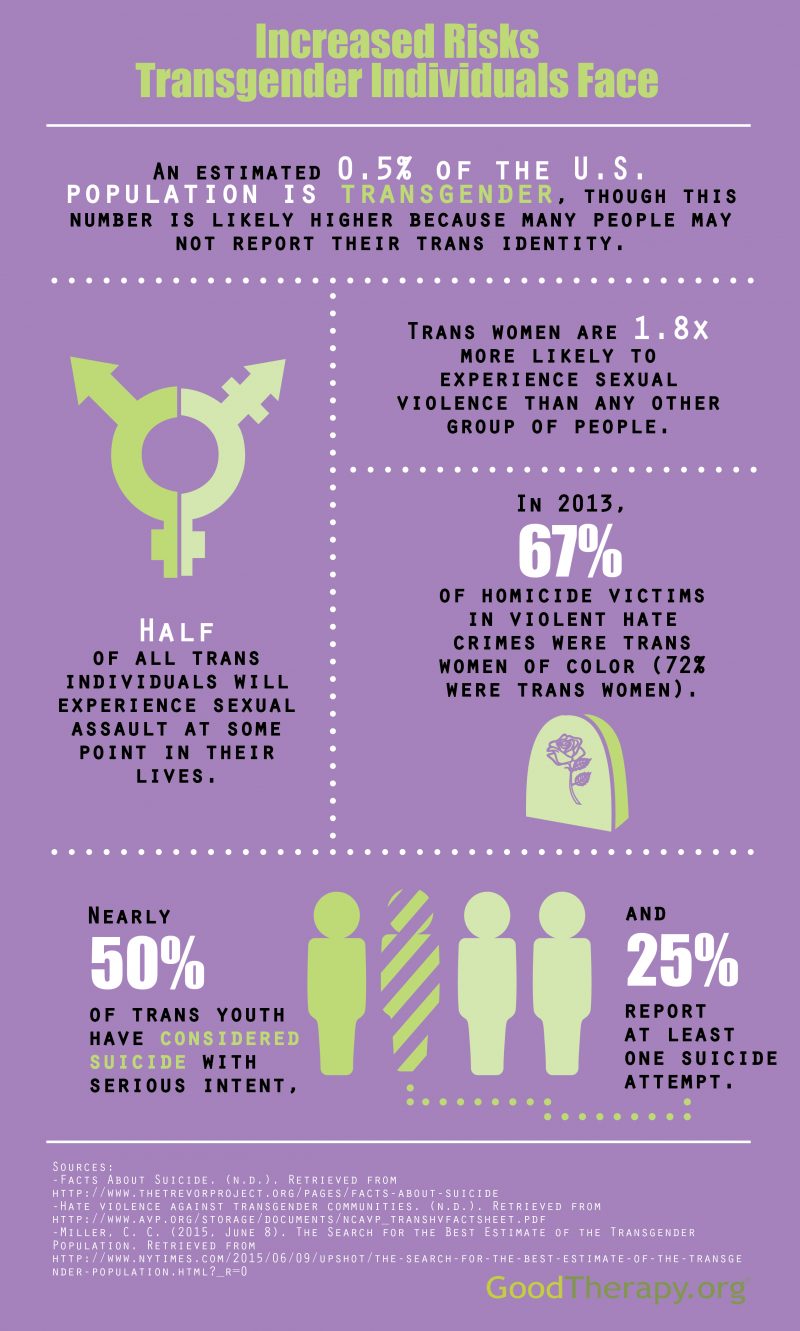
All people deserve a restroom they can use safely, without fear of harassment or violence. According to the NCAVP and Rape Response Services National Statistics, trans people face high rates of homicide, sexual assault, and violence. Trans people of color are at even higher risk: in 2013, 67% of hate violence homicide victims were trans women of color. Preventing trans people from using the facilities they feel most comfortable in may make it necessary for them to put themselves at greater risk (and also possibly out themselves as trans) in order to use the restroom.
The backlash to these rulings, and other similar rulings across the country, has been considerable, especially as transgender students across the country fight similar discriminatory measures for equal access to bathrooms and locker rooms in public schools. Critics point out not only are these laws likely to cause humiliation and distress, they clearly violate the Civil Rights Act.
Several entertainers and organizations have boycotted trips to North Carolina in support of transgender rights, and the Obama administration issued a decree in May 2016 ordering all public schools to allow trans students access to facilities corresponding to their gender identity rather than sex assigned at birth. A number of school districts across the country have refused to accept the decree, citing concerns about boys in girls’ locker rooms and the discomfort of female students.
What these school districts do not seem to address is the discomfort and distress of the transgender students who are required to either use the wrong facilities or change alone in the nurse’s office or other designated facility. In either outcome, these students may face prejudice, harassment, and abuse from other students as well as feelings of shame and isolation, among other issues. Many trans students report avoiding the restrooms entirely, an action that may affect emotional well-being as well as physical health.
Proposed Solutions to Discriminatory Bathroom Policies
Awareness of trans issues is increasing across the nation, and many young trans people have the support and encouragement of their families, but many still do not. Along with the likelihood of discrimination and ostracism at the hands of peers or family members, trans teens and preteens also face the onset of puberty and the emergence of physical features and bodily changes that may lead to gender dysphoria or exacerbate existing feelings. Many teens who wish to take hormones and begin transitioning cannot start this process without parental support. Some have the support of a mental health professional, but many lack even that.
School-level legislation that further denies the identity and existence of transgender youth may contribute to depression, anxiety, and other mental health concerns. It may also increase the risk of suicide in this population, which is already high. Among trans youth, nearly 50% have considered suicide with serious intent, and 25% report at least one attempt. The rates of suicide and other mental health concerns experienced by transgender youth are shown to decrease when they receive acceptance and support.
All-gender restrooms, already prevalent in many countries, may be the logical destination of progress, as gender becomes more understood and the male-female binary is recognized to be an outdated concept.Some point to all-gender or family bathrooms as a solution. While some trans individuals might use these restrooms when they are available, as any other person might, being allowed to only use these restrooms can still be exclusionary and may contribute to feelings of dysphoria. Others say creating bathrooms exclusively for transgender people to use would be an ideal solution, but as Attorney General Loretta Lynch pointed out in a statement announcing a federal lawsuit against North Carolina, “Not so long ago … states had signs about restrooms … keeping people out based upon a distinction without a difference.” Others have similarly drawn comparisons from the bathroom debate to the Jim Crow laws segregating people of color.
Some organizations and companies, such as Target, have responded to these laws by vocalizing their support of trans people with inclusive policies encouraging customers and employees alike to use the restroom that aligns with their gender identity. At Cooper Union College in New York, student activists removed all gendered signs on the bathroom. New placards read “restroom with urinal and stalls” and “restroom with only stalls.” Other colleges have similarly implemented all-gender restrooms with the goal of making public spaces safe and accommodating for everyone. All-gender restrooms also serve to welcome non-binary individuals, who might not feel comfortable in either men’s or women’s restrooms.
Everyone Has the Right to Safety
Many trans people across the nation still cannot use the restroom without facing threats to their personal safety. A woman in Washington, D.C. was assaulted by a security guard when she tried to use the restroom at a grocery store, and students in one North Carolina school district are now allowed to bring pepper spray to campus, which one board member claims may be a “valuable tool” for females who use the restroom on campus. Other schools encourage students to report their transgender classmates if they use the “wrong” bathroom.
Such instances of harassment and prejudice against trans people are likely to do little for the community other than foster fear and transphobia. Even if legislators and others who do not support bathroom use according to gender identity claim they are not targeting transgender people, these measures may invalidate the identity of trans people and perpetuate stigma. They also do not address the high rates of assault and violence trans people experience. Safe public restrooms are a necessity for all, and trans individuals prevented from using the correct restroom may not only face threats to their bodily safety, but also diminished mental and emotional well-being due to stress, anxiety, shame, and dysphoria.
All-gender restrooms, already prevalent in many countries, may be the most logical destination of progress, as gender becomes more understood and the male-female binary is recognized to be an outdated concept. Until then, allowing individuals to choose a restroom based on their gender—and perhaps caring a bit less about who is using what restroom—may be the best solution to an issue that was never really a problem.
References:
- Banchiri, B. (2016, February 23). Charlotte passes transgender rights law: Will North Carolina let it stand? Retrieved from http://www.csmonitor.com/USA/Politics/2016/0223/Charlotte-passes-transgender-rights-law-Will-North-Carolina-let-it-stand
- Bellware, K. (2014, July 18). Gender-neutral bathrooms are quietly becoming the new thing at colleges. Retrieved from http://www.huffingtonpost.com/2014/07/18/gender-neutral-bathrooms-colleges_n_5597362.html
- Borrello, S. (2016, April 22). Sexual assault and domestic violence organizations debunk ‘bathroom predor myth.’ Retrieved from http://abcnews.go.com/US/sexual-assault-domestic-violence-organizations-debunk-bathroom-predator/story?id=38604019
- Carollo, L. (2016, April 25). What happened when I tried to comply with North Carolina’s new bathroom law. Retrieved from http://www.vox.com/2016/4/25/11490498/north-carolina-bathroom-law-transgender
- Changing birth certificate sex designations: State-by-state guidelines. (2015, February 03). Retrieved from http://www.lambdalegal.org/know-your-rights/transgender/changing-birth-certificate-sex-designations
- Cobb, J. (2016, May 30). Opening doors. The New Yorker. Retrieved from http://www.newyorker.com/magazine/2016/05/30/north-carolinas-retrograde-step
- Connelly, J. (2016, February 10). ‘Bathroom bill’ aimed at transgender persons fails in state Senate. Retrieved from http://www.seattlepi.com/local/politics/article/The-bathroom-bill-blocking-toilet-use-by-the-6821841.php
- Facts about suicide. (n.d.). Retrieved from http://www.thetrevorproject.org/pages/facts-about-suicide
Hate violence against transgender communities. (n.d.). Retrieved from http://www.avp.org/storage/documents/ncavp_transhvfactsheet.pdf - Levin, S. (2016, May 12). Obama orders public schools to allow transgender students access to restrooms. Retrieved from http://www.theguardian.com/society/2016/may/13/obama-public-schools-transgender-access-restrooms
- Lopez, G. (2016, April 18). 9 questions about gender identity and being transgender you were too embarrased. Retrieved from http://www.vox.com/2015/4/24/8483561/transgender-gender-identity-expression
- Lowder, J. B. (2016, April 27). Breitbart proves what we already knew: Trans women are not bathroom predators. Retrieved from http://www.slate.com/blogs/outward/2016/04/27/breitbart_helpfully_shows_trans_women_are_not_bathroom_predators_cis_men.html
- Miller, C. C. (2015, June 08). The search for the best estimate of the transgender population. The New York Times. Retrieved from http://www.nytimes.com/2015/06/09/upshot/the-search-for-the-best-estimate-of-the-transgender-population.html?_r=0
- Ng, A. (2016, May 11). North Carolina schools let students bring pepper spray to class–in case transgender students use bathrooms. Retrieved from http://www.nydailynews.com/news/national/n-schools-students-bring-pepper-spray-class-article-1.2633430
- Pearson, M. (2016, May 10). AG Loretta Lynch moves into spotlight with NC bathroom law speech. CNN. Retrieved from http://www.cnn.com/2016/05/10/politics/loretta-lynch-north-carolina
- Rape Response Services National Statistics. (n.d.). Retrieved from http://www.rrsonline.org/?page_id=944
- Redden, M. (2016, March 29). New York college moves to strip gender markings from all bathrooms. The Guardian. Retrieved from http://www.theguardian.com/world/2016/mar/29/gender-bathrooms-cooper-union-college-new-york
- Tan, A. (2016, May 19). Security guard arrested after allegedly assaulting transgender woman trying to use women’s bathroom. ABC News. Retrieved from http://abcnews.go.com/US/security-guard-arrested-allegedly-assaulting-transgender-woman-womens/story?id=39227006
- Transgender Bathroom Hysteria, Cont’d. (2016, April 18). Retrieved from http://www.nytimes.com/2016/04/18/opinion/transgender-bathroom-hysteria-contd.html?_r=4&mtrref=undefined&gwh=459A290B6C63807CACCEAADDE4A5626A&gwt=pay&assetType=opinion
- Understanding the Perpetrator. (n.d.). Retrieved from https://sapac.umich.edu/article/196
 Rachel Dolezal, a Caucasian woman, has dominated recent news with her assertion that she identifies as black. Like many people, I was initially perplexed about why someone would choose to identify with an oppressed culture. What benefit is there to choosing to belong to a group of people who have been marginalized?
When people have difficult and character-forming experiences, they generally want them to be witnessed, honored, and respected. People with visible identities, as race typically is, naturally have this validating experience. For many people, parts of their identities and the way they understand themselves come from the struggles and challenges they have endured.
Poverty is a prime example. Though we may not consciously consider poverty an identity, for many people it is one. Many people who experience poverty have a shared experience of not having enough, being judged, and being marginalized. Poverty informs how people experience and interpret the world.
I worked with a 48-year-old woman—I’ll call her Nina—who consistently spoke of “being poor.†For most of her childhood, her family struggled financially and did not have their basic needs of food, shelter, and clothing met on a regular basis. When she was 14, her family’s situation changed. Her mother got a well-paying job, they bought a home, and they had financial security, as is true to this day.
[fat_widget_right]
As a grown woman, Nina continued to refer to herself as poor, though she factually had not experienced poverty for 34 years. Nina’s earlier experience of living in poverty was so defining that it became part of her identity.
This phenomenon is also true for internal experiences. Consider people who have experienced, say, addiction or depression. “I’m an addict†and “I’m a depressed person†are phrases that I have heard many times. People often define their entire being by a challenging part of themselves, when in reality it is one of many aspects and identities that comprise who they are.
As human beings, we are wired to connect to others and to be recognized and understood by others. Tightly gripping an “old†identity is a way to keep that part of you visible—to keep the struggle of addiction or depression or trauma or poverty as a real and acknowledged part of your existence.
Being depressed is not all of a person. It is an experience, albeit it an unpleasant one. People who are depressed are also parents and friends and colleagues. There are many other pieces to who they are in addition to their depression. However, unlike depression, being a parent is visible. Being a colleague is visible. People see and understand these roles and identities and, in turn, validate them.
What happens when life circumstances shift and their current experiences no longer fit their description of themselves? Though Nina no longer lives in poverty and has not for more time than she has, she still very strongly identifies with being “poor.†When someone is no longer depressed, does he or she still say, “I’m a depressed person� Many people do. They become so used to understanding themselves one way that it becomes the dominant narrative of their life, even when it no longer fits the circumstances.
As human beings, we are wired to connect to others and to be recognized and understood by others. Tightly gripping an “old†identity is a way to keep that part of you visible—to keep the struggle of addiction or depression or trauma or poverty as a real and acknowledged part of your existence.
But you can release parts and identities that no longer fit while still having them as part of you and your story.
Narrative therapy is a technique that allows people to share and tell the stories of their lives. It makes visible what is invisible. The struggles, challenges, and resilience that you have developed during your lifetime are part of your story. The ways we self-identify at one point in our lives may be different than at another point, and both identities can be true. Narrative therapy helps to weave together these many different aspects of life into a multifaceted story. It gives us the richness and fullness of our experiences as people rather than limiting us to one way of being. It helps us understand that we are not only our race or gender or depression or addiction. Instead, those aspects are pieces of a changing, evolving, and larger picture of who we are.
 When a friend or family member tells you they are transgender, or trans, it can be hard to figure out the best way to show support. Trans issues have recently become part of the mainstream conversation in the United States, from  Caitlyn Jenner’s widely publicized transition to Laverne Cox’s appearance on the cover of Time. As more trans people feel comfortable sharing their stories, their friends and families are growing and changing with them.
The word “transgender†describes a gender identity that is different than the one someone is born into. Gender identity is the internal experience that we all have of our maleness or femaleness (or both, or neither). For most people, this experience is aligned with their biological sex. People who identify as trans have a different experience.
Many allies feel confused about how they can best support a friend or family member who tells them they are trans. Such conflict can come about for any number of reasons, including feelings of embarrassment talking about trans issues, not knowing what language or terminology to use, or not wanting to offend. With that in mind, here are five ways to support someone you love who identifies as trans:
[fat_widget_right]
1. Listen Closely and Trust Their Experience
Every trans person has a different experience of gender and their transition. When a trans person shares their story with you, it’s a gift. It means they trust you enough to share something so fundamentally important to them. And their experience might not be what you expect.
There is no “right way†to be trans and no “right way†to transition. Each story is unique.
2. Use Their Language
Language is personal, and the only way to know how someone identifies is to listen to how they talk about themselves. You don’t necessarily need to know all the terms related to transgender to be supportive; you just need to respect and try to use the ones your friend or loved one prefers. Some people have a word they closely identify with. For example, they might feel like the umbrella term trans describes them best. Other terms they might use include transgender, transsexual, trans man, trans woman, female-to-male (FTM), male-to-female (MTF), or genderqueer, among others.
There is no “right way†to be trans and no “right way†to transition. Each story is unique.
Trans people may also have a preferred pronoun. Possible pronoun choices may include he/him, she/her, ze/hir, and they/them. Ze/hir and they/them (used to refer to an individual, not a group) are gender-neutral pronouns and are being used by more and more people who don’t feel like he/him or she/her adequately describe them.
Your friend or family member might also choose a new name. They might even change it two or three times as they attempt to find a name that feels like a good fit. Using a trans person’s chosen name shows love and respect and is important, even when change feels hard.
3. Do Some Research
If you want to know more about trans identities in general, the best way is to learn is to do some simple research. Just like it’s not your job to tell others what it’s like to be ______ (fill in your own gender identity, sexual orientation, religious affiliation, race, etc.), your friend might not want to educate others about their experience.
Unless specifically invited to do so, it’s never appropriate to ask anyone (including a trans person) personal questions about their body or sexuality. This doesn’t mean it’s wrong to be curious or want to know more. Fortunately, we have a lot of great resources available at our fingertips. Many trans activists post video blogs on YouTube both about their personal experiences and to answer questions for people who just want to know more.
4. Get the Support You Need
Learning that someone you know is transgender can bring up a lot of feelings, especially if it’s a close family member such as a child or parent. It’s OK to have all of those feelings, and it’s important that you find the supports you need to sort through them and understand your own experience. Your family member or friend may not be able to be this support person for you.
Many family members I’ve worked with have found support through working with their own therapist or connecting with groups such as Parents, Families and Friends of Lesbians and Gays (PFLAG) and TransYouth Family Allies (TYFA). Connecting with a therapist is a great place to start.
5. Practice Active Allyship
Trans family members and friends are counting on you to help them make this a safe and friendly world for people of all gender identities. Trans people often face oppression and discrimination from their medical providers, schools, employers, housing, places of worship, and families.
Being an ally means consistently noticing and challenging transphobia and ignorance both in yourself and the world around you. This can mean telling someone that a joke isn’t funny, asking a trans friend what they need when someone uses the wrong name or pronoun, or participating in events and rallies in support of the rights of trans people.
What it looks like to support a trans family member or friend can vary greatly from person to person. In many ways, it looks exactly the same as being a good friend or support to anyone who is going through a significant life change. What are some ways you can support transgender people in your own life and community? Please share your thoughts in the comments section below.
 Bruce Jenner, former Olympic athlete and reality star, has made recent headlines. After months (or longer) of tabloid and entertainment news speculation, Jenner publicly came out in an April 2015 interview with ABC News‘ Diane Sawyer, identifying as transgender. No doubt the episode sparked public interest and a great deal of conversation. In fact, in the days immediately following the Jenner interview, Answers to Your Questions About Transgender People, Gender Identity, and Gender Expression was the most-viewed link on the American Psychological Association (APA) website. Considering the high number of hits, assumptions could be made that the general public is seeking more information on transgender identities and transitioning.
To better understand what transgender means, it is important to make the distinction between sexual orientation and gender identity, which are frequently and erroneously used interchangeably. Sexual orientation is our romantic, physical, emotional, and relational attraction to another, and includes labels such as gay, lesbian, bisexual, and heterosexual. Gender identity, on the other hand, refers to our internal sense of being male, female, or another gender identity.
Someone who identifies as transgender experiences a lack of conformity between their sense of gender and the societal standards of their assigned birth sex. Cisgender is the term used to describe someone whose sense of gender conforms to the societal standards associated with their assigned birth sex. What does “assigned birth sex” mean? In most cases, a doctor “assigns” our sex based on our visible anatomy appearing to be that of a boy or girl. Without undergoing extensive and expensive genetic, chromosomal, and hormonal testing, most people do not know what their true biological sex is.
[fat_widget_right]
Although Jenner is all over the news, transgender identities are not a new phenomenon. It is probably not a stretch to say that transgender individuals have always existed. Many accounts, such as those documented in the book Transgender Emergence (Lev, 2004), detail transgender individuals throughout historical and modern times and across a diversity of cultures.
If transgender identities have always been around, one could question why transgender individuals are often treated like second-class citizens. Well, in looking at history, before Western colonization, in some cultures, those with transgender identities enjoyed inclusion and reverence within their communities. For example, in Native American culture, individuals identifying as “two-spirit,” who are thought to encompass both male and female qualities, were once well revered within their culture. However, after Western colonization, social value and reverence were stripped from transgender identities.
And if you are still wondering why transgender individuals do not have full respect in society although transgender identities have existed for thousands of years, recognize that other groups, such as women and ethnic minorities, have been around for a long time too, but continue to endure less than equal treatment.
There is no one right way to come into our gender identity. Some transgender individuals comment on always feeling that their gender identity and assigned sex were incongruent. For others, it could be later in life that one recognizes their sense of gender identity. Safety is another reason that forces some individuals to transition later in life.
Jenner is 65 years old, a parent, and until recently was married to a woman. Some might wonder why it took Jenner so long to come out. There are several explanations for this. There is no one right way to come into our gender identity. Some transgender individuals comment on always feeling that their gender identity and assigned sex were incongruent. For others, it could be later in life that one recognizes their sense of gender identity. Safety is another reason that forces some individuals to transition later in life.
In general, the U.S. is more accepting of diverse identities today than at any other time in its history, yet transgender individuals encounter high rates of verbal, psychological, and physical victimization and violence. Now consider the atmosphere and attitude toward transgender individuals 20, 30, or 40 years ago; for many older adults, the threats to their physical and emotional safety were true barriers to transitioning at younger ages. Also, consider the financial costs. Would there have been endorsement deals and commercial shoots if Jenner came out in 1976?
Accessibility to information also impacts coming out. Today, there is greater transgender awareness and there are more transgender individuals in the media. Today’s youth have more access to information regarding gender identity and transitioning than their predecessors. Furthermore, transitioning can be an expensive endeavor that may not have been an affordable option when older transgender individuals were younger. All transgender-identifying individuals do not desire to pursue a physical transition. For those who do, depending on the transgender individual’s desire for transitioning, hormonal therapy, surgeries, and other costly procedures may have prevented them from making any physical transitions until later in life. Finally, in regard to parenting and marital status, gender identity has little to do with someone’s desire to parent or marry, making it very reasonable that someone may transition or come out as transgender after marrying and childrearing.
Jenner’s children were asked how they felt about their father’s transgender identity. Like other families in which a parent transitions, they acknowledged undergoing a transitional process themselves. The family has to adjust to appearance and gender expression changes, adopt new pronouns, and may have considerations regarding marital status. The families of transgender individuals are not immune from experiences of prejudice and discrimination that were previously unknown to them. Family members can be asked invasive questions, feel alienated by those who are not supportive of their family member’s transition, or experience the financial byproduct of discrimination. For example, many states do not include gender identity in housing and employment nondiscrimination policies. So if a parent is fired for being transgender, their child may no longer be able to afford to attend college.
Initial stages of a family’s transition may be challenging and confusing, but later stages in family transition may include acceptance of their loved one’s identity and providing a supportive and safe environment that is respectful to all gender identities. A safe environment allows space to grieve perceived loss and welcome mental wellness and gender affirmation. Fortunately, there are a growing number of resources to help families who have loved ones who are transitioning and to support the family’s transition.
Reference:
Lev, A. I. (2004). Transgender Emergence: Therapeutic Guidelines for Working with Gender-Variant People and Their Families. Binghamton, NY: Haworth Press.
 I recently overheard a young woman bemoaning that her 2-year-old was “too chubby” so she was going to put her on a diet. This started me thinking about people who are unaware of the negative consequences that result from anxieties about how their children appear to the world, especially their weight, body type, and demeanor.
“Teri†began therapy expressing anxiety and depression, mostly about her appearance: “I was an overweight kid, and everyone always made fun of me. I lost a lot of weight by high school, but it was only after I went away to college that I could reinvent myself and feel a little better about how I looked. But I kept on worrying if people liked me. Now I’m a 43-year-old woman and I’m still upset all the time about my weight and my looks. My doctor tells me that I’m not overweight, but I see all those thin, beautiful women out there, and that’s not me. I can’t lose the 15 pounds I keep trying to lose. My husband tells me that I have a great body. But how can that be when I’m not a size 2?â€
Over a number of months, Teri expressed many worries—not only about her physical appearance, but about what people thought of her. Then, about eight months into therapy, Teri began to sob: “The worst thing right now, maybe worse than my gaining two pounds, is … she hates me. My daughter Marni hates me. She should. I’m a terrible mother.â€
[fat_widget_right]
Teri hadn’t spoken much about her 15-year-old daughter. It certainly isn’t unusual for mothers and daughters to be fighting as daughters try to separate during adolescence. I wondered if this was typical mother-daughter separation dynamics, if this was more of Teri’s intense need for positive response, or if something else was going on. I asked Teri to tell me more about why she thought she was such a terrible mother.
“I can’t get it right,†Teri said. “I think Marni is depressed. She always looks unhappy. She’s alone on the computer or watching TV a lot. She goes to a great private school with really great kids from good families. But her friends are so nerdy. She doesn’t care about joining teams or clubs or about much of anything. I can’t believe my daughter doesn’t care at all about what she looks like or how other people think about her. We fight about everything: where she goes, her spending, her friends, what she eats, what she wears. She’s getting fat. I can’t stand it. I don’t like my feelings; mothers shouldn’t feel this way. But Marni isn’t the daughter I imagined I would have.â€
I responded to Teri’s distress: “This sounds so painful for you. I can see how difficult it is for you that Marni isn’t interested in what is so important to you: to have a particular appearance and to be well liked by everyone. Since childhood, nothing has been more vital to you than being thin and popular. Marni is rejecting this as having value for her.â€
Teri responded: “It’s true. It’s scary that she doesn’t understand the trouble she’ll have if she doesn’t make herself socially desirable. You know my family didn’t have much money. Thank goodness my husband and I do well enough. I thought that I could make my daughter happy if I bought her nice clothes, sent her to a prestigious school, and gave her advantages. But somehow it doesn’t matter. I think she’s miserable.”
It made sense to me that Marni, like her mother, hadn’t developed a positive sense of herself. I believed that she experienced Teri’s worries about her as statements about how she wasn’t measuring up to Teri’s standards. This could affect her self-esteem and self-confidence and make her anxious about asserting herself in the world. She was also probably struggling with separation and individuation, trying to be different from her socially anxious mother.
I was concerned about Marni, but I was also concerned for Teri, who loved her daughter and whose anxieties about her mothering were causing her to become more depressed. Knowing that Teri had been ridiculed and had a lot of social anxiety from elementary school on, I thought it would be helpful if she could connect her early experiences with the feelings she was having about herself and her relationship to Marni.
It certainly isn’t unusual for mothers and daughters to be fighting as daughters try to separate during adolescence. I wondered if this was typical mother-daughter separation dynamics, if this was more of Teri’s intense need for positive response, or if something else was going on.
We spent a great deal of time talking about her memories and associations to this time in her life. She spoke about how her mother was an anxious woman with no friends: “I was the center of her world. My father was away a lot, traveling for work. Mom had very little life of her own. She hardly ever left the house. She was always scared of people. I remember when I first went to school, I cried and cried. She told me I would be OK, but I have a very clear memory of her crying and looking scared.â€
“Did you eventually settle in and get comfortable?†I asked.
“No,†Teri said, “I was always scared and the other kids knew it. They tortured me. They would hide my books, call me ‘fatty’ and be mean. I would tell my mother about it, but it would upset her so much, so I eventually stopped talking to her about it.â€
“What would she say to you?†I wondered.
“I don’t exactly remember,†Teri said, “but I know she always told me that I had to smile, make friends, and be nice to people. She said I wasn’t fat and that I looked fine, but I knew I was fat and that I didn’t dress like the other kids.â€
Teri began to cry: “You have no idea what it was like. I was always left out of things. I never had the right look, never got chosen for the team until the end. I finally just became a loner. I was pretty miserable. I guess I was depressed. Wow, I so don’t want Marni to have to go through these things. I’ve never quite put it together before. Of course, I knew I didn’t want Marni to be fat or unpopular because people make fun of you. But as I’m remembering how terribly painful it was for me, maybe I have gotten crazy about how I don’t want it to be that way for her.â€
As I listened, I realized that I didn’t know what Teri actually knew about Marni’s experiences. I asked: “Do you think she has been ridiculed like you were?â€
“I suppose not,†Teri said. “She has more friends and isn’t really fat like I was, just a little overweight.â€
“Are there other differences that you can see between your childhood experiences?†I asked.
“You, know, I’ve never thought of this before,†Teri said, “but I complained to my mother all the time until I realized she couldn’t help me. But Marni never complains about how she is treated by her peers. Hmm … maybe she is having a very different experience than I did. She does seem more OK with her relationships at school than I was. I don’t think she gets mistreated, but I do think she’s depressed.â€
“If you had to guess, what do you think she is depressed about?†I asked.
“Well, I get depressed when I feel bad about myself,†Teri replied. “I suppose she could be feeling bad about herself.â€
“What do you think could be going on that she would have bad self feelings?â€
“I don’t know,†Teri said. “She never puts herself out there so she can receive special good attention or notice or recognition. She does get very good grades.â€
“What about negative attention?†I asked. “Does she ever feel criticized?”
Teri became silent and started to cry again: “Oh, no. It’s me. I’m her biggest critic! I’m always on her, telling her what’s wrong with her. I knew it; I have been a terrible mother.â€
Teri’s sobbing increased, and then, amid sighs, she asked, “What do we do now?”
This was a turning point in Teri’s therapy experience. She was becoming emotionally related to her traumatized child self. As she became increasingly able to emotionally remember her painful experiences, she could consider that the way she related to Marni was intended to protect her daughter from having similar traumatizing experiences. This realization allowed Teri to begin to let go of her “bad mother†feelings and accept that she had tried to be a good one.
Slowly, Teri began to feel less anxious for Marni and more able to see her daughter as someone with her own ways of being in the world. The more she could distinguish her own history and anxiety from Marni’s experiences and feelings, the less anxious each felt. Teri began to see Marni’s relationship with her friends differently. She noticed that, although Marni was alone, she was often on her cell phone or computer talking and laughing with friends. Now Teri could consider that being a good mother meant being attuned to her daughter’s life from her daughter’s point of view. When Teri could distinguish her own subjectivity from Marni’s, she had fewer critical thoughts and was more open to seeing Marni’s experiences as different rather than bad. This meant Teri was projecting less of herself and was beginning to see Marni as a more separate person with her own subjectivity.
Growing up, Teri’s family had not provided her with a view of herself that gave her the internal resources to develop a positive, confident sense of self. She needed to look to externals for positive reactions in order to feel good about herself. Recognizing this, Teri could appreciate how important it is to express positive feelings to Marni about whom she was and what she did in the world.
Teri understood that she had been projecting her standards for popularity and appearance on Marni, and now she had to give Marni the emotional space to develop her own thoughts about how she looked and appeared to the world. This facilitated Marni’s separation-individuation process, as the absence of her mother’s critical projections left more room for Marni to develop her identity, self-esteem, and confidence.
Note:Â To protect privacy, names in the preceding article have been changed and the dialogues described are a composite.