
by Joel Schmidt, MA, Licensed Mental Health Counselor, in Tampa, FL
Overcoming Health Anxiety: Things You Should Stop Doing (and Some You Should Start)
Are you constantly worried about your health? Does even the slightest new and unusual bodily sensation or symptom have you running to the doctor, sure that it must be something serious? Are you often worried that, even though you’re being told by medical professionals that everything is okay, something undetected and undiagnosed is growing inside of you and slowly killing you? Do you find yourself checking stuff a lot — such as your heart rate or different parts of your body — looking for reassurance that nothing is wrong? Are you spending a good deal of time googling symptoms and researching medical conditions that you may or may not have? If so, you’re probably dealing with disordered health anxiety: a health-focused anxiety that can cause a good deal of distress and an endless cycle of worry.
Although it’s never a bad idea to check in with the doctor every so often (get that annual physical!) or to do health screenings as recommended, excessive checking and reassurance-seeking may be making your anxiety worse instead of providing the much-desired comfort you’re hoping to gain from some of your behaviors.
What to Stop Doing
Here are four things you should stop doing (or at least do less of) if you have health anxiety, followed by some healthier ways of coping.
1. Stop googling symptoms.
We google symptoms to seek reassurance, not realizing that this kind of reassurance-seeking is actually increasing and reinforcing our anxiety.
2. Stop obsessing over your fitness watch.
If you have a Fitbit, Apple watch, or any other health tracking wrist device, ditch it if you find yourself constantly checking different measures such as your heart rate, heart rate variability, or ECG results. Like googling symptoms, this sort of behavior keeps us too internally focused and increases the anxiety surrounding health — and only provides very short-term comfort and reassurance.
3. Pay attention to your other checking and reassurance-seeking behaviors and limit them also.
Common checking behaviors include checking the mirror for discoloration of the skin or eyes, looking for new moles or bumps, weighing in or measuring different parts of the body, monitoring your pulse or blood pressure, asking family members or health professionals about your symptoms, and posting questions online for opinions about the health issues you have or suspect you have. Being aware of your body and checking for anything out of the ordinary can be smart and healthy when done as the medical community recommends, but the kind of checking that often comes along with health anxiety is generally excessive and unnecessary.
4. Stop interpreting every new and unusual bodily symptom as a sign of danger.
Our bodies do weird things. Everyone experiences odd pains and sensations every once in a while. It’s normal, and they usually come and go. The average person experiences these things as well but isn’t as internally focused and doesn’t pay the same level of attention to them.
It’s not easy to stop doing these things. It will be uncomfortable, especially at first. What you’ll likely find over time, though, is that stopping these things will liberate you from the prison that health anxiety can create that prevents you from living your life fully.
What to Start Doing
It’s best to replace old habits with new ones. Here are some things you should do instead of the four behaviors above.
1. Check in with your doctor every once in a while.
Get to the doctor to rule out any true medical concerns if you’ve been avoiding this, get your annual physical, do the recommended screenings, and follow through on your doctor’s recommendations. The key here, though, is to follow what your doctor recommends and not what your anxiety dictates. Certainly seek medical help if you suspect something serious, but try to recognize when what you’re doing is just looking for short-term relief and reassurance. The comfort is fleeting and soon enough you’ll be on to the next thing.
2. Talk to a therapist.
Find a therapist that specializes in anxiety disorders – specifically one with experience working with health anxiety. A therapist can help you better understand your health anxiety and teach you some healthier coping mechanisms for dealing with it. They’ll also help you gain insight about how you got here and help you better recognize the thoughts and behaviors that are contributing to your anxiety. Overcoming health anxiety takes work, but a therapist can help you make strides.
3. Recognize that some health anxiety is normal.
As humans, we all have some worry and concern surrounding our health and well-being. When we are struggling with health anxiety, though, our threat detection system is just a little more heightened than it needs to be. This can lead to nonstop false alarms.
4. Be open to the idea of tolerating and accepting a certain amount of uncertainty.
The only thing that would likely bring your health anxiety to zero would be knowing that your risk of experiencing future health-related issues is zero — and that’s just not going to happen. As you start to accept and tolerate some risk above zero, you’ll find that you also start to shift out of anxious thinking and into the kind of life you really want to live.
5. Remember how many times you’ve been wrong about your anxious thoughts.
“What ifs†are at the core of health anxiety — or any other anxiety for that matter. “What if this headache is a tumor growing in my brain?†“What if this stomachache is a sign of something really serious?†“What if this pain in my leg is a deadly blood clot?†How many times have you found yourself having these anxious thoughts and questions? And how many times have you been wrong about those worst-case assumptions? Since you’re reading this, you’ve probably been wrong about most, if not all of them. Let that fact sink in.
6. Shift your focus outward.
One of the hallmarks of health anxiety is an overly strong internal focus. When you notice yourself scanning your body or engaging with and entertaining anxious thoughts, try to shift from an internal to a more outward focus. Find something to do. Call a friend, go for a walk, read a book, and get engaged with the world.
Overcoming Health Anxiety
Living with health anxiety can feel like a rollercoaster. Following this advice will help you get off that ride and free you up to enjoy and make the most of your life. Connect with a therapist who understands what you’re dealing with and start making progress.

by Dr. Denise Renye, Licensed Clinical Psychologist and Sex Therapist, MEd, MA, PsyDÂ in San Francisco, CA
Working with Sex Workers
Sex workers (sworkers). They are arguably the crux of most cultures, offering a service that is uniquely intimate. They are a part of every sociocultural makeup, yet denied, sometimes as existing, and sometimes as deserving, especially as deserving basic worker rights. International Sex Workers’ Day, or International Whore’s Day, was on June 2. This day of recognition, established in 1975 by a group of French sex workers, brings attention to the inhumane working conditions for people in this profession. (Read more about the history of the fight for sex-worker rights.)
I’m defining sex workers as people who have sex for money, those who have private websites, work in porn stores, operate phone sex lines, do erotic bodywork and massage, do tantra work, work in sex clubs, provide girlfriend/boyfriend/friend experiences, work for porn companies on or off camera, and/or have figured out other creative means to work in this industry not listed here.
My Own Experience Working with Sex Workers
I’ve worked in a variety of capacities with sworkers over the past two decades. It’s been important, deeply transformative work ranging from outreach to counseling. The counseling was sometimes directly related to the job, just like with anyone else I’ve counseled. Sometimes the concern or issue will be work-related, and sometimes it won’t be in the same way that a doctor I may counsel doesn’t talk about her patients or co-workers all the time.
Voluntary Sex Work Shouldn’t Be Lumped in with Sex Trafficking
It would be remiss for me not to mention the complications with sex work: for some, it’s involuntary, and for others, it’s a chosen profession. There is a big difference between voluntary sex work and sex trafficking. Politically, the powers that be want to merge these two categories together to demonize sex workers along with the sex trafficking world. Some individuals are sex trafficked and induced by force, fraud, or coercion to engage in a commercial sexual act — a terrible problem we are facing in modern society. Sex trafficking is a product of the patriarchy just as much as the merging of it with sex work is. They are very different.
Laws Affecting Sex Workers — and Their Effects
A pair of laws were passed in 2018 to combat sex trafficking: The “Allow States and Victims to Fight Online Sex Trafficking Act†(FOSTA) and the “Stop Enabling Sex Traffickers Act†(SESTA). The bills were an attempt to shut down websites that facilitate sex trafficking, but also harmed at-will sworkers and their ability to work by hindering their online infrastructure. FOSTA-SESTA made websites legally liable for any content that helped facilitate sex trafficking or prostitution, even if it was consensual, according to a PBS/NPR article.
The American Civil Liberties Union (ACLU) notes human trafficking persists because workers employed in certain professions are excluded from some labor and employment laws, sex work included. International Sex Workers’ Day seeks to highlight the exploitative and risky elements of the industry and promote justice for these workers.
As a result of FOSTA-SESTA’s passage, not only has the financial stability of sworkers decreased, but also sex workers have been pushed back into the streets. This has pushed some back into the stronghold of pimps, patriarichal danger at its finest — the gaslighting promise of safety, but typically that safety from outsiders comes with an absence of safety from the pimp themself. Furthermore, there’s an increase in sworkers’ exposure to violence because prescreening clients could no longer occur.
Sex work has been thriving for all of time, and that’s not changing. People choose sex work as a job for as many different reasons as people choose to be plumbers, Wall Street execs, and teachers. There can be flexibility, ability to earn higher wages, and a creative edge to the work.
Providing Mental Health Services to Sex Workers
Having access to health services — physical and mental — are imperative for folx in this industry just like anyone else. I used to work at St. James Infirmary in San Francisco, a clinic where sex workers obtain health services, as well as social services and food and clothing as needed. I provided counseling and coordinated services and saw how essential such a place was to the well-being of many.
I also ran mindfulness groups and smoking cessation groups for sex workers through the Masoni Center in Philadelphia, teaching basic mindfulness skills that could be used on the job and in rest of life. Mindfulness provides a pause from automatic behaviors and thought patterns, offering space to pay attention to the present moment without judgment. The group continues to have an online meetup space.
Changing Our Perspective
The work of sworkers has mostly lived in the shadows. This socioculturally mirrors where we hold sexualness and the expression thereof — in the shadows. Giving basic and rightful support to sworkers is just the correct action to take (just as we give that support to nurses, therapists, and performance artists), but that will require people to take a look at and assimilate their own sexual needs, selves and proclivities. And we don’t live in a world that seems to be ready to own and celebrate that. Denying sworkers accessibility and rights denies the collective. There are very real issues specific to sex workers, and I don’t think the psychological community does a good job of addressing them. Empowerment by way of accessibility is essential.
If you’d like some more info about this and other topics such as somatics, psychology, spirituality, and psychedelic integration, let’s keep in touch.
If you’re a therapist who’d like to share what you’ve learned about practicing psychotherapy, know that GoodTherapy members are invited to submit articles for our blog! Instructions about submitting an article are available in your Member’s Area dashboard. Not a member yet? Check out our therapist membership options to get in on digital marketing, CE events, publishing opportunities, and so much more!
References
American Civil Liberties Union. (n.d.). Human Trafficking: Modern Enslavement of Immigrant Women in the United States. American Civil Liberties Union. https://www.aclu.org/other/human-trafficking-modern-enslavement-immigrant-women-united-states#:~:text=The%20International%20Labor%20Organization%20(ILO,as%20a%20result%20of%20trafficking.&text=The%20U.S.%20Department%20of%20State,the%20United%20States%20each%20year. Accessed June 2, 2021.
International Labor Organization. “A Global Alliance Against Forced Labour, 93rd Sess.,†Report I(B) at 10 (2005) [hereinafter ILO Global Alliance].
Tung, L. (2020, July 10). FOSTA-SESTA was supposed to thwart sex trafficking. Instead, it’s sparked a movement. WHYY. https://whyy.org/segments/fosta-sesta-was-supposed-to-thwart-sex-trafficking-instead-its-sparked-a-movement/. Accessed June 10, 2021.
 If you’ve ever sustained an injury and didn’t have access to immediate medical attention, you probably received some form of first aid. This temporary medical assistance likely helped treat the injury and kept it from getting worse until you could get to a hospital or see your doctor.
Like physical injuries, mental health concerns and substance misuse can have serious health effects. They can cause lasting harm and may even lead to death. But these emotional injuries tend to be less visible, and it’s not always easy to identify someone who’s struggling.
A mental health first aid training class is a public education program that aims to teach people how to identify risk factors and warning signs of these concerns. During this 8-hour training, you’ll learn to recognize a mental health crisis, provide immediate support, and help people access resources for longer-term care.
As with first aid for an injury, mental health first aid is not meant to be a long-term solution. The support of a trained mental health professional is essential for people living with mental health concerns or working to overcome substance misuse.
A mental health first aid training class is a public education program that aims to teach people how to identify risk factors and warning signs of these concerns.
In your mental health first aid training, you’ll learn the five-step action plan, ALGEE:
- Assess for suicide/harm risk
- Listen non-judgmentally
- Give information and reassurance
- Encourage seeking professional support
- Encourage self-help and coping methods
Read on to discover how this looks in practice.
1. How to de-escalate a tense situation
Remaining calm is an important part of effectively handling a crisis. It can be challenging to help someone experiencing panic, hallucinations or other psychotic symptoms, or acute trauma reach a calmer state of mind if your mood is also elevated.
Someone dealing with acute emotional distress may talk about hurting themselves, which can be frightening to hear. Fear can cause some people to react with judgment, anger, or confusion. But these reactions can worsen a situation.
Mental health first aid training provides an opportunity to develop communication skills—both nonverbal skills like body language and verbal skills like knowing what to say. Knowing how to communicate compassionately can make all the difference when trying to reach someone in a crisis. You’ll learn to offer reassurance and respect, with an attitude that normalizes what someone is going through without blaming them. Role play activities during training give you the chance to practice applying these skills in a variety of scenarios.
2. How to gauge risk of harming self or others
You might worry someone living with depression or another mental health condition has a high risk of hurting themselves. Symptoms of certain mental health conditions, like schizophrenia, bipolar, or borderline personality disorder, are also often associated with increased risk of hurting the self or others.
It’s important to recognize the following:
- Most people with mental health conditions never harm anyone.
- Many people who have thoughts of suicide don’t plan to attempt suicide.
- Many people who self-harm don’t plan to attempt suicide.
However, it’s still important to talk to a trained professional about self-harming behaviors or suicidal thoughts. Recognizing certain warning signs can help you become more informed about when someone might be dealing with these challenges so you can better assess the possibility of harm. This can help you direct someone to the right resources.
Some possible warning signs of suicide include:
- Talking about dying, hopelessness, or feeling like a burden
- Talking about wanting a way out
- Withdrawal or isolation
- Rapid, dramatic, or significant mood changes
- Sleeping a lot or not enough
- Behaving in risky or extreme ways
Supporting a person experiencing hopelessness and thoughts of suicide might involve finding and reaching out to a therapist who can help them work through the underlying causes. But a person with a clear plan for suicide needs immediate, urgent help. The 988 Suicide & Crisis Lifeline can offer guidance at 1-800-273-TALK (8255), but you can also call your nearest emergency room.
3. Coping techniques
Coping and self-care techniques can help anyone manage distress, not just people living with mental health issues. But these techniques usually benefit those who experience emotional challenges regularly, since they can increase resilience and promote calm. People who use coping tools can often address symptoms before they become overwhelming.
During mental health first aid training, you’ll learn more about some of the many coping methods you might suggest, such as:
- Relaxation techniques
- Meditation
- Exercise or movement therapy
- Pet therapy
- Journaling, art, or music
- Peer and social support
- Cognitive behavioral self-help techniques
4. Supporting next steps and follow up care
Training in mental health first aid enables you to support someone through a mental health crisis or period of substance misuse. It doesn’t train you to provide long-term care or support. A key part of mental health first aid is learning how to refer people to the professionals who can offer the best type of treatment for their needs.
Depending on a person’s symptoms or concerns, you might help them locate any of the following types of health care professionals:
- Medical doctor
- Therapist or counselor
- Psychiatrist
- Social worker
- Peer support specialist
You can’t force anyone to seek treatment, but in mental health first aid training, you’ll learn how to encourage people to get help. This might include explaining how therapy or counseling can help or talking about available treatments. You might also help someone locate a nearby therapist or find a number for a clinic or helpline.
5. What to do when you, yourself, are in a crisis
Although you might find a profession that involves helping others find potentially life-saving support rewarding, you may also find it stressful. You might even feel drained or overwhelmed on occasion, as working with people in crisis can affect your own emotional wellness over time.
Mental health first aid providers help people learn to take care of their emotional health and access helpful resources when needed, but before they can offer this help, they must also know how to take care of their own well-being. By participating in a mental health first aid training course, you’ll be better positioned to recognize when your emotional reserves are running low. This awareness can help you know when to take time to recharge, prioritize self-care, and get help for yourself.
Awareness of mental health concerns and their varied signs and symptoms has increased in recent years. This awareness is a key factor in treatment. Compassionate understanding is another factor that’s just as important in preventing suicide.
Mental health first aid training teaches you how to offer this compassion and care as you help someone find resources for dealing with an immediate emotional crisis. Once they’ve weathered the immediate challenge, they can reach out for help. Compassionate therapists are only a few clicks away in our therapist directory, located here.
References:
- ALGEE: The action plan. (n.d.). Retrieved from https://www.mentalhealthfirstaid.org/wp-content/uploads/2017/04/THE-ACTION-PLAN.png
- Frequently asked questions. (n.d.). National Council for Behavioral Health. Retrieved from https://www.mentalhealthfirstaid.org/faq
- Mental health first aid. (n.d.). National Council for Behavioral Health. Retrieved from https://www.thenationalcouncil.org/about/mental-health-first-aid
- Risk and protective factors. (n.d.). Suicide Prevention Resource Center. Retrieved from https://www.sprc.org/about-suicide/risk-protective-factors
- Stress management. (n.d.). Substance Abuse and Mental Health Services Administration. Retrieved from https://www.integration.samhsa.gov/health-wellness/wellness-strategies/stress-management
- Wellness strategies. (n.d.). Substance Abuse and Mental Health Services Administration. Retrieved from https://www.integration.samhsa.gov/health-wellness/wellness-strategies
- What you learn. (n.d.). National Council for Behavioral Health. Retrieved from https://www.mentalhealthfirstaid.org/take-a-course/what-you-learn
 Do you have strong interpersonal skills and a passion for helping students navigate the world of education? If so, you could excel as a school counselor. School counselors provide resources for students who want to learn how to pursue their academic and professional futures, and they also work with students who have learning difficulties or mood issues that interfere with their success in school. Whether providing K-12 education support, helping undergraduates navigate the world of higher education, or getting students to the next step in graduate school, thousands of opportunities for school counselors exist.
Like many health-related fields, specific requirements for becoming a school counselor can vary from state to state, so check with the American School Counseling Association for details. Otherwise, read on to find out how you can get started.
1. Lay the Foundation with Undergraduate Studies
As with similar fields of study, people intending to become school counselors will need a substantial academic background. Your first step is to decide where you want to go to college and apply. Depending on your current level of education, this could mean applying for an undergraduate or graduate program. While your undergraduate degree is not typically required to be in education or counseling, it is often helpful to choose a major that reflects knowledge and understanding of the theories and practices required for counseling. Students who major in subjects such as psychology, sociology, or counseling may find they have acquired a feel for the work involved with becoming a school counselor, and as an extension, are well prepared for their graduate studies. [fat_widget_right]
2. Get Your Master’s Degree in School Counseling
Depending on your program, receiving a master’s degree means learning counseling and guidance techniques for multiple age groups and ability levels. During this process, which may take 1-2 years, you can explore areas of specialization, such as K-12 education, behavior issues, or education for children with developmental delays. According to US News & World Report, some of the top-rated counseling programs in the country are at University of Maryland, College Park, and University of North Carolina, Greensboro. However, there are many worthwhile programs across the country depending on your preferred home base.
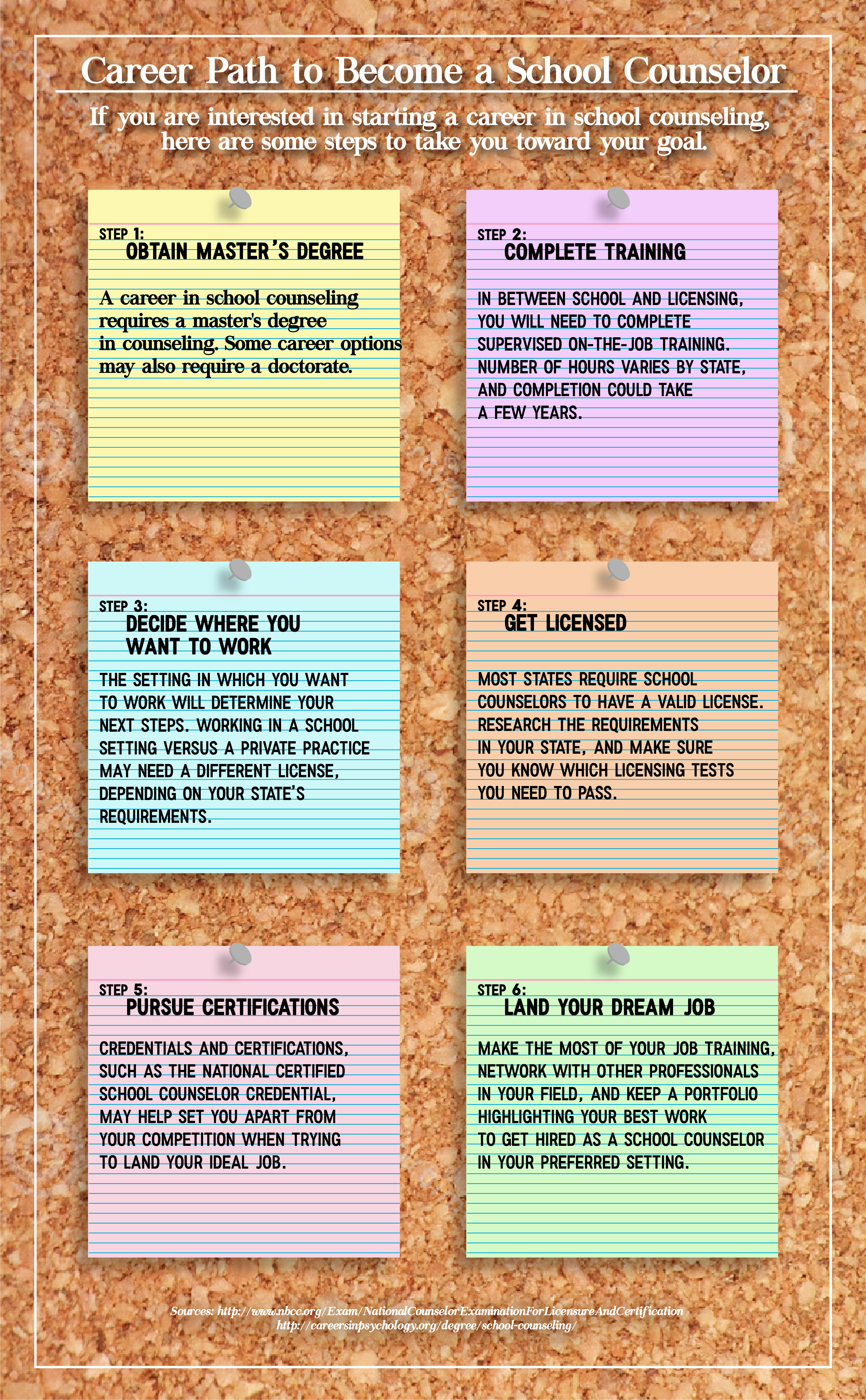 Infographic by Hannah Johnson
3. Work Under Supervision After Graduation
During or after your study program, you can intern or complete a practicum as part of your course requirements. Many programs set a certain number of these hours for you to complete, either as a graduation requirement or part of your future doctorate studies, if you decide to pursue that course. For example, one school counselor program might require 100 practicum hours, 40 of which are in direct contact with K-12 students. Additionally, to take the licensing exam to become a school counselor, you must have completed hundreds of hours of practicum or internship work.
Get familiar with the day-to-day workings of your site and don’t be afraid to ask your supervisor for any tips or important things to know while working there—it is better to ask more questions than less, especially when you are still in a learning environment.
During your school counseling internship or practicum, you will get hands-on experience in the field, generally at a school site you have chosen. You will perform most of the duties associated with your field under the direct supervision of both an on-site supervisor and your instructor or supervisor on campus. Get familiar with the day-to-day workings of your site, and don’t be afraid to ask your supervisor for any tips or important things to know while working there—it is better to ask more questions than not enough, especially when you are still in a learning environment.
4. Get Licensed as a School Counselor
After completing your educational and working hour requirements, it is time to become a board certified school counselor. First, you will need to know your state’s requirements, as they vary. The National Counselor Examination (NCE) is a 200-item exam you might sit for, as it is required to become licensed in most states. It may also be required for a national license or any potential military work you are interested in doing. The NCE website lists all the requirements for the exam and provides information on where to take it in your state. It’s a good idea to study and prepare for this exam like you would for other important, long-term tests. Find example questions from past exams and consider borrowing or ordering an NCE test prep book, which will contain helpful strategies and tips for passing your NCE successfully.
5. Optional Credentials for School Counselors
Before hiring you, most schools will prefer that you have one to two years of hands-on classroom experience. You may also need to get a teaching certificate or license. Research your state’s teaching certificate requirements, as these can differ depending on the education system. Additionally, you can pursue specializations such as career counseling or an emphasis in students experiencing addiction.
6. Get Hired as a School Counselor
The field of school counseling has many opportunities and benefits: more than 200,000 school counselors are employed every year as of 2014, and the profession has a median salary of $50,000 a year. Most educational institutions, whether K-12 schools or colleges, need counselors. Openings for these positions are generally posted through school districts or university careers sites for internal positions. You might begin your job search by researching where you would like to work and begin looking for school counseling postings in that location or ask your own college counselor for help finding a placement. Sometimes the connections you make during your internship or practicum hours can lead to future employment opportunities.
References:
- Danzinger, P. & Newman, H. (2011). School counseling concentration practicum/internship handbook. William Patterson University College of Education. Retrieved from https://www.wpunj.edu/dotAsset/315254.pdf
- National counselor examination for licensure and certification. (n.d.). National Board for Certified Counselors. Retrieved from http://www.nbcc.org/Exams/NCE
- School and career counselors: Summary. (2017, October 24). Bureau of Labor Statistics. Retrieved from http://www.bls.gov/ooh/community-and-social-service/school-and-career-counselors.htm#tab-1
- School counseling degree programs & schools. (n.d.). Retrieved from http://careersinpsychology.org/degree/school-counseling
- State certification requirements. (n.d.). American School Counselor Association. Retrieved from https://www.schoolcounselor.org/school-counselors-members/careers-roles/state-certification-requirements