 Are you struggling with the uncertainty and unpredictability of our current political climate? Are you concerned about how to help your clients weather the impact of the rapid changes taking place? You are not alone. It has been over a year and a half since the transition in the American government, but the impact continues.
Many of us are feeling the pressure of political stress—and so are our clients. According to the American Psychological Association, a poll taken in 2017 showed that 63% of Americans are stressed about the future of the United States. Further, 59 percent believe this to be “the lowest point in our nation’s history that they can remember.â€
Regardless of where we fall on the political spectrum, collective uncertainty and social discord is challenging, in and out of the office. Transition of power is especially difficult when the speed of change accelerates more quickly than expected. If you are among the marginalized and oppressed, it is likely that the change in power and ensuing polarization is causing enough stress to trigger adaptive coping strategies, both functional and dysfunctional.
This means that those who have been dealing with discrimination and oppression all their lives may now, due to the divisive social and political landscape, be navigating even more stress, worry, anxiety, and depression. For mental health professionals, this means the people seeking help from us may be initiating more conversations about discrimination and oppression than in the past.
As we navigate a more stressful collective experience, there are two main considerations that may be helpful in maximizing the quality of our support:
- Consider using the therapeutic relationship as a vehicle for empowerment and liberation from oppression and internalized oppression. Doing so can be invaluable to the mental and emotional health of our clients.
- When people seeking help bring in painful issues that trigger distress, consider taking special care to do the inner work necessary to prevent overwhelm and heal your own internalized oppression to provide the best support possible.
As mental health professionals, we have an opportunity to create a safe space to process heartbreak and foster resilience around stressful collective experiences. Therapy can help with family of origin issues, insecure attachment, cognitive behavioral patterns, emotional imbalances, and addiction.
But therapists can also play a role in helping people in therapy navigate the discrimination and marginalization that impacts their well-being. When we hold the individual and collective impact of polarization, oppression, and internalized oppression with as much importance as we do other factors, we are more able to attune, empower, and collaborate with clients in the most difficult times.
Therapist as Ally
We see oppression operating when one group has more access to power and privilege than another group, and when that power and privilege is used to maintain the status quo. But internalized oppression can be more difficult to detect.
The intersection of oppression and internalized oppression is where therapists and counselors have the greatest opportunity to help empower clients by becoming an ally. Allies choose to commit themselves to actively supporting others. They use their privilege to help reduce the impact of discrimination and suffering.
Internalized oppression perpetuates and amplifies the maintenance of the status quo by constructing subservience in the minds of oppressed groups. Taking on the prejudice of the oppressor, it may appear in therapy as any of the following:
- Self-hatred
- Self-doubt
- Self-concealment
- Fear of violence
- Feelings of inferiority
- Isolation
- Rage
- Powerlessness
- Hopelessness
- Gratefulness for being allowed to survive or have access to resources.
The intersection of oppression and internalized oppression is where therapists and counselors have the greatest opportunity to help empower clients by becoming an ally. Allies choose to commit themselves to actively supporting others. They use their privilege to help reduce the impact of discrimination and suffering.
In our role as therapist, this may include, but is not limited to:
- Helping clients learn to regulate their nervous system during political actions
- Employing positive adaptive strategies in the face of discrimination and violence
- Attending to the conflict between activated parts when feeling unsafe
- Navigating symptoms exacerbated by increased stress
- Connecting people in therapy with additional resources.
Regardless of the theoretical framework, we can help people make a radical shift in their relationship to the difficult thoughts, feelings, and bodily sensations that compromise mental and emotional health.
Inner Work
As we know, we are of greatest service to our clients when we do our own inner work. When we prioritize addressing how the intensity of the political landscape is affecting our own mental health and attitudes, we are more able to hold space for the range of experiences our clients are going through.
The active professional psychology community is 84% white, 16% people of color. Whether you are among the former or the latter, uncovering and transforming your own social conditioning can help you become more fully and compassionately present to yourself and the people you work with. Even those who are oppressed can inflict pain within their own group or unconsciously perpetuate discrimination against people from another oppressed group. Thus, it is especially important to consider ways we can unravel internalized oppression to encourage conscious connection and collaboration.
As we sit with people in session, we have the opportunity to mindfully notice our internal process and prevent unintentional enactments of the same divisions experienced within society. We are human. We will make mistakes. But by doing our inner work, we lay the foundation for the possibility of deeply supporting our clients in a larger system that may or may not be as sensitive to their needs.
The Power of Mindfulness
One of the most challenging aspects of the current political climate is that so many people are in harm’s way or have the potential to suffer injustice. Just as difficult is the thought that the earth is suffering destruction influenced by the perception that she is only valued as a disposable resource for capitalistic endeavors. These divisive experiences have grave mental health consequences, which are but a fraction of the overall negative impact on our collective well-being—for the current population as well as for those in future generations.
In an environment that encourages hostility between those who have different political opinions or backgrounds (i.e. sexual orientation, gender expression, class, race, culture, religion, or ability, among others) mindfulness can help us deal with the thoughts, feelings, and sensations that arise in our daily experience. When we intentionally pay attention to what is happening, as it is happening, without judgment, we can cultivate an internal spaciousness that gives us the opportunity to observe and respond, rather than react. As we tend to the moment, we more effectively notice an ability to pause before a trigger manifests into a reaction. This gives us a choice to consider our next course of action.
Another benefit of mindfulness is that it promotes self-compassion. Mindfulness has two wings. First, it helps us see what is true. Second, it helps us hold with love what is seen. Whatever arises in the midst of our country’s changes, we have the choice to hold with love whatever is perceived within, whether it is anger, fear, shame, helplessness, or the internalized prejudices against ourselves that occur as a result of oppression. We then can become aware of our capacity to hold intense experiences with care. This allows us to expand our window of tolerance during politically stressful times and empower ourselves to transform suffering into a more balanced, flexible, and generative expression that can benefit all.
In terms of extending mindfulness to therapy, spaciousness and compassion increase our ability to be present enough to deeply listen to a person’s struggles. When we bring our full presence to the clinical setting, we increase our ability to track and attune to a client’s internal experiences as we navigate our own. Being mindful helps us become acutely aware of what is happening in the moment, while holding in mind the relational dynamic. Remaining mindful of the therapeutic relationship helps us consider the interpersonal and intrapsychic experience the person in therapy is having.
While we can’t change the current social environment, we can be sensitive to the power dynamics in the relationship so we can work to create a therapeutic environment that supports and empowers. Political stress is challenging. But when we do our inner work and use mindful awareness in the midst of rapid social change, we can serve as a supportive ally—to ourselves and our clients.
References:
- 2005-13: Demographics of the U.S. psychology workforce. (2015). APA Center for Workforce Studies. Retrieved from http://www.apa.org/workforce/publications/13-demographics/index.aspx
- APA Stress in America survey: US at ‘lowest point we can remember;’ future of nation most commonly reported source of stress. (2017, November 1). Retrieved from http://www.apa.org/news/press/releases/2017/11/lowest-point.aspx.
- Brach, T. (2016). Radical acceptance: A Buddhist guide to freeing yourself from shame. Audio Training. Boulder: Sounds True.
- David, E. J. R., & Derthick, A. O. (2018). The psychology of oppression. New York, NY: Springer Publishing Company, LLC.
- Pheterson, G. (1986). Alliances between women: Overcoming internalized oppression and internalized domination. Signs, 12(1). pp. 146-160.
 Fidget spinners, toys that allow people to quietly fidget by spinning a device, are surging in popularity. Many companies market these toys as relievers for stress and anxiety. They hold the 16 top spots in Amazon’s toy rankings. Together with fidget cubes, the toys occupy more than 40 of the top 50 spots.
As with many toy trends, some adults have responded with frustration, derision, and even paranoia. A false story recently circulating on Facebook claimed fidget spinners could disrupt Earth’s center of gravity.
Proponents of the toy say it could help people with attention deficit hyperactivity (ADHD), autism, or anxiety by offering a focused outlet for their energy. Some schools even allow students to use fidget spinners to help them concentrate. Experts, however, note a lack of research on any link between fidget spinners and ADHD symptoms. Rather than assuming the toys will work for alleviating symptoms of ADHD, experts recommend that parents seek research-backed treatment options.
Experts also say there is no reason to worry that fidget spinners are harmful. There’s little evidence that any single toy changes behavior or cultural beliefs.
Dual Gait Testing as Early Predictor of Dementia
[fat_widget_right]Observing a person’s gait while they perform a cognitively taxing task can provide early evidence of dementia. The process, known as dual gait testing, may predict dementia in people with memory issues. According to the study, people with mild cognitive impairment whose motion slows down by about 20% while performing the cognitive task may be at an increased risk of developing dementia.
Why You Should Quit Chasing Happiness and Pursue Meaning Instead
According to a new book, The Power of Meaning: Crafting a Life That Matters, the pursuit of happiness might undermine its achievement. Meaning is what makes life worth living, the book’s author argues. Pursuing happiness as its own goal may be a distraction from the sense of purpose that is more likely to help people feel happier.
Bouldering Envisioned as a New Treatment for Depression
Bouldering, a popular form of rock climbing, may ease symptoms of depression. The authors of a new study say people who began bouldering three hours a week for eight weeks saw reductions in depression. They suggest the physical, cognitive, and social components of the sport may help. People may boulder with friends, and bouldering poses both physical and intellectual challenges.
Can Parents’ Tech Obsessions Contribute to a Child’s Bad Behavior?
Increased reliance on technology may undermine parents’ relationships with their children. According to a study that looked at surveys completed by mothers and fathers in 170 households, half of parents said technology disrupts time with their children. On average, technology interrupts parent-child interactions two to three times per day. The study suggests these interruptions may be associated with increased behavior problems from children.
Suit: SC Mental Health Needlessly Hospitalizes People
In a federal class action lawsuit, Protection and Advocacy for People with Disabilities—a disability advocacy organization—alleges that the South Carolina Department of Mental Health is unnecessarily hospitalizing people with mental health issues. A 1999 U.S. Supreme Court decision in Olmstead v. L.C. found people with mental health disabilities have a right to live in less restrictive settings. Thus, needless hospitalization or institutionalization is a form of mental health discrimination.
Meditation May Cause Negative Feelings for Some, Study Finds
Research links meditation to numerous benefits, including improvements in mental health. However, research that includes interviews with nearly 100 meditation teachers and meditators suggests it may not be positive for everyone. Some people who meditated reported side effects such as insomnia, sensitivity to light or sound, anxiety, or panic.
 Spoiler alert: The following article contains plot details and other information from the movie Get Out.
Like many Americans, I went to see the movie Get Out when it was released at the end of February. I was—also like many Americans, I imagine—both horrified and impressed by what I took in, and I haven’t been able to stop thinking about the movie’s thematic and practical implications for the therapy field since. The film comes at an important time, serving—as Ashlee Blackwell points out in an article for The Guardian—“a vital reminder that racism remains a more terrifying force than any supernatural boogeyman.”
To my friends who have expressed curiosity but don’t like the horror genre, I’ve caught myself saying the film, which can be summarized as follows, is no more disturbing than our actual racist history: Chris, a black man, accompanies his white girlfriend to her family estate. While her family is friendly, something doesn’t feel right, and he discovers a number of the estate’s black residents have gone missing. When another black man urges Chris to “get out,” he begins to uncover the truth—and learns that “getting out” may not be so simple.
It is my opinion that the film, a critical success, effectively communicates the well-warranted cultural distrust many men of color have toward medicine, toward therapy, and toward white women—all symbols of systems who have manipulated and oppressed people of color over time. [fat_widget_right]
As I reflect on the film, on the tail end of Black History Month, I thought it appropriate to situate the psychotherapy profession in the context of historical racial offenses, as it is only through naming and claiming our unjust history that we can begin to move forward in a more equitable way. I specifically want to draw attention to the ways the movie summons the corrupt racial history of medicine, of psychotherapy, and of white female allegations against black men. While Get Out, marketed as a “horror-comedy,” will likely serve as entertainment as much as it provides political commentary, its box office success suggests a resonance with audiences who are craving affirmation.
Righteous Distrust of Medicine
On her page about people of color and psychotherapy, Dr. Monnica Williams discusses the distrust with which individuals may view the medical field in general and the belief, held by many, that medical institutions themselves are racist. Historically, it was not uncommon for slaves to be abused and experimented on by white doctors. People of color could not, with their low social status, refuse to participate in experiments, and neither could they withhold consent. Thus, they were frequently victimized and even used as examples when teaching surgical techniques to medical students.
One historical horror cementing this distrust for many people of color was the Tuskegee Syphilis study, a medical experiment observing the trajectory of untreated syphilis in black men in rural Alabama. This study was conducted between 1932 and 1972 under the pretense of offering free health care, but the men were not told of the purpose of the study, the reasons behind it, or even informed they had syphilis. Doctors did not treat their patients for the disease, either: By 1947, penicillin was widely recognized as the primary treatment for syphilis, but doctors still did not prescribe it.
Many medical practices have long perpetuated white supremacy by denying people of color the same agency over their bodies and identities automatically granted to white patients. The case of Relf v. Weinberger in 1973 brought this to light with the issue of forced sterilization for black women of reproductive age, a topic addressed at length by Dorothy Roberts in her book Killing the Black Body. This theme of medical agency appears in the film Get Out wherein black bodies and minds are hunted, bid on, and used for the social, emotional, and physical gain of whites. Rose’s father, a white neurosurgeon, captures Chris for the express purpose of using his body and talents to benefit an older white man.
The ethics of informed consent are so vital to our field, but rarely are these racial dynamics examined in our professional discussions of what informed consent looks like. Even if the above examples are severe, it is important for us to know about these practices so we might approach the informed consent process with the people we work with in a delicate, responsible manner.
Righteous Distrust of Psychotherapy
What we see depends on what we’re looking for, and our lived experiences will naturally filter the way we perceive the world. As a family therapist and white woman, I was particularly haunted by scenes of hypnosis and cognitive rape perpetuated by the white mother, herself a psychotherapist, who takes advantage of the psychic vulnerabilities of Chris, a young black man with maternal family trauma. In his words, she “gets inside his head” not for benevolent purposes, but to control and abuse. The therapeutic relationship may be impacted by racial and ethnic stereotypes, though professionals in the field may not wish to admit it. These stereotypes, whether they stem from prejudice or feelings of guilt, are likely to have impact on the care and treatment of the person seeking help.
Williams points out on her webpage that many people of color approach mental health care with caution, further saying they are right to be cautious. The therapeutic relationship may be impacted by racial and ethnic stereotypes, though professionals in the field may not wish to admit it. These stereotypes, whether they stem from prejudice or feelings of guilt, are likely to have impact on the care and treatment of the person seeking help.
It is also well-documented that people of color are disproportionately diagnosed with psychosis, which has implications for over-medication and institutionalization. Another concern lies in the the possibility of people of color who are cautious or defensive in treatment being labeled as “noncompliant” with treatment. Therapy without acknowledgement and thorough analysis of both present-interactional and historical power systems only serves to maintain the status quo.
Righteous Distrust of White Women
There are two female psychologists for every male psychologist, and nearly 84% of psychologists active in the workforce are white. Thus, I feel it is important to examine the historical basis for the distrust men of color may have toward white women. In the film Get Out, Rose serves as a sort of gatekeeper of oppression—by bringing boyfriends back home to “meet the family,” she is knowingly putting them at risk. She is consistently dismissive of her boyfriend’s fears and concerns, playing up her niceness and distress when it benefits her.
In 2015, a history of of white allegations against black men resurfaced when Dyllan Roof used the phrase “They’re raping our women” to justify his murder of nine churchgoers in Charleston, South Carolina. Allegations about the “brute passion of the Negro” have been used to justify violence toward black people since the time of slavery, and these were thematically represented in Get Out when Rose gasps out, “Help me!” upon the arrival of a police car toward the film’s end.
Rather than assuming perceived reservation or suspicion to be “noncompliance” or assuming people of color seeking help are themselves “the problem,” as therapists (particularly, as white female therapists) we must turn our assessments inward. What prejudices are we projecting outward in our interactions with the people seeking our help? How do our biases affect the care we provide, and how can we communicate authentically in a way that earns (and deserves) trust?
These are questions without easy answers, but as mental health professionals, we are used to holding complexity. We must approach the difficult topic of race with both realism and accountability if we expect those we treat to be real and accountable with us.
References:
- Blackwell, A. (2016, October 6). Get Out: The horror film that shows it’s scary to be a black man in America. The Guardian. Retrieved from https://www.theguardian.com/film/filmblog/2016/oct/06/get-out-horror-film-jordan-peele-black-men
- Bouie, J. (2015, June 18). The deadly history of “They’re raping our women.†Slate. Retrieved from http://www.slate.com/articles/news_and_politics/history/2015/06/the_deadly_history_of_they_re_raping_our_women_racists_have_long_defended.html
- Lin, L., Nigrinis, A., Christidis, P., & Stamm, K. (2015). Demographics of the U.S. psychology workforce: Findings from the American committee survey. Retrieved from http://www.apa.org/workforce/publications/13-demographics/report.pdf
- Get out. (2017). IMDb. Retrieved from http://www.imdb.com/title/tt5052448
- Relf v. Weinberger, 372 F. Supp. 1196 (D.D.C. 1974). Retrieved from  https://www.splcenter.org/seeking-justice/case-docket/relf-v-weinberger
- Roberts, D. (1998). Killing the black body: Race, reproduction, and the meaning of liberty. New York: Random House.
- Schwartz, R. C., & Blankenship, D. M. (2014). Racial disparities in psychotic disorder diagnosis: A review of empirical literature. World Journal of Psychiatry, 4(4). 133-140. Retrieved from https://www.ncbi.nlm.nih.gov/pmc/articles/PMC4274585
- The Tuskegee timeline. (2016, December 8). Centers for Disease Control and Prevention. Retrieved from https://www.cdc.gov/tuskegee/timeline.htm
- Williams, M. (n.d.). African Americans and psychotherapy: Why race is important. Retrieved from: http://www.monnicawilliams.com/black-therapist.php
Dear GoodTherapy.org,
I recently attended a family reunion (full disclosure: this was in the deep south) and was horrified to discover how closed-minded and bigoted my parents have become. My family has always been relatively conservative, but this last trip showed their true colors and ignorance. They made blatantly racist remarks, said awful things about LGBT people, and proclaimed their intent to vote against extended rights for minorities.
I was appalled, to say the least, and too shocked to speak articulately on the matter at the time. It’s 2016, and yet I felt I’d entered a time machine and been transported back to 1916!
[fat_widget_right]
Now that the event has passed, I’m still troubled by their elitism and hatred, and I’m left wondering if there’s anything I can do. They live in an echo chamber of their own beliefs—meaning I know their community and friends just reflect their “values.” So I’m not very optimistic about being able to open their minds, let alone change their thought patterns and attitudes. Is it possible? Should I try regardless? In some ways I feel like I’m trying to single-handedly cure people who are addicted, so ingrained are their habits and backward ideals. I wish there were interventions for racism. —In Fairness
Submit Your Own Question to a Therapist
Dear Fairness,
Thank you for reaching out and opening this often-challenging discussion. Family can be both interesting and complicated, and when we add in hot topic discussions they become even more so.
While I deeply appreciate your desire to affect change in your family, attempting to change a deeply ingrained belief system is very challenging. As you noted, these particular family members are in an environment where those who share those beliefs surround them. When that is the case, it is extremely difficult for anything other than those beliefs to stand. In fact, there is a theory called “confirmation bias†that shows people tend to look for and interpret information in a way that supports their beliefs; anything coming their way that contradicts that may not matter.
The only thing we really have power over is ourselves. While we may attempt to impact the world and those around us, we are responsible only for our own actions. Really, no matter how hard you try, you are not responsible for “curing†them or changing their minds, thought patterns, or beliefs. The best you can do is to offer the information to them; what they do with it is in their hands. If you try to take on the burden of changing your family system, you are assuming responsibility for something that is not yours—and that is an unrealistic burden to carry.
There is a saying that being a helper is like being a lighthouse—the lighthouse just stands and shines and doesn’t go chasing boats to save. I suggest you be a lighthouse in your family and shine with justice, kindness, love, and acceptance for all people.
My suggestion is to offer the information to your family without the expectation that they can integrate it, accept it, or that it will change their beliefs. You can be a beacon of light in your family of acceptance and more progressive values, but also know that openly stating your beliefs may put you at odds with your family. You may face criticism and ridicule for stating your beliefs. Only you can determine if that’s something you’re willing to deal with in order to be a force of change. There is a chance your efforts will yield nothing, but there is a chance that others may be impacted. The trick is being able to go forward without expectations and without feeling as though changing your family is your job.
There is a saying that being a helper is like being a lighthouse—the lighthouse just stands and shines and doesn’t go chasing boats to save. I suggest you be a lighthouse in your family and shine with justice, kindness, love, and acceptance for all people. As you do so, your very presence may illuminate the dark places. When you hear your family members saying things that are racist, bigoted, or something along those lines, find ways to gently confront it. One way to call it out is when someone makes a racist, sexist, or bigoted joke, say, “I don’t get it. Can you please explain?†That way, they are forced to explicitly explain the “humor†behind the “joke,†revealing the issue. When you adopt this stance, you are not being confrontational while still illuminating the issue.
Most of all, be gentle with them and yourself. These types of thought patterns go way back and can be hard to change. While it is always worthwhile to challenge the status quo, also consider some ways in which you can make a difference for future generations. Maybe you can’t change old ways in your family, but you can work to impact how the newer generation sees the world. I’d like to commend you for your awareness and for your willingness to serve as an ally. We need more allies in this world, and your efforts are noticed and appreciated.
Sincerely,
Lisa
 In times like these, when intolerance is everywhere you look—from political campaigns to schoolyard bullying to routine traffic stops—you might feel the way so many of the people I work with in therapy do: helpless. It can seem as if nothing you do makes much of a difference. Fortunately, there is a way to create real, lasting change, and that’s by teaching our children the ideal way to treat others. It’s the very definition of thinking globally but acting locally: increasing tolerance in the world starts at home.
It’s fair to assume most parents want to raise the kid who welcomes all friends, is kind to others regardless of skin color or religious beliefs, and is unafraid of differences. But with children receiving radically different messages every day (at school, on social media, and in the news), families must be proactive in being the most influential messengers in their lives. By raising children who are aware and accepting of differences, we can help ensure that their lives will be better—more peaceful childhoods, more successful careers—and increase the likelihood the world changes for the better along with them.
Here are seven simple strategies for encouraging acceptance and open-mindedness in your family:
[fat_widget_right]
1. Start as Early as Possible
For a long time, it was assumed we were born with the tendency to judge others. After all, our brains function by recognizing patterns (“t†and “o†make the word “toâ€) and categorizing information (“apple†and “orange†are both “fruitâ€). And some studies seemed to indicate that part of our brain (the amygdala, which registers emotions such as fear) lit up when we saw faces of different colors, indicating a subconscious detection of threat. The assumption that prejudice and racism are innate made it tough to figure out how to fight these insidious issues.
More recently, these findings have been largely debunked. And some new research goes even further, indicating that young kids are uniquely unprejudiced. One study carried out on children showed that the amygdala wasn’t activated until the age of 14. In other words, there’s reason to believe that if we model acceptance early and often, kids will pick it up easily and persuasively. So don’t wait to talk to your kids until you think they can fully understand—the conversation can start with simple concepts and progress to more complex ideas over time.
2. Check Your Own Attitude
The first step to transforming your children’s outlook is to look at your own point of view. After all, children learn by mimicking. Babies watch our faces carefully to pick up social cues. They smile when we do to get a positive reaction from caregivers. Toddlers study how others handle objects so they can manipulate a spoon or a television remote. And older children hear how their parents talk about others, and imitate language used at home.
Whenever you feel your anger rising or see it in your kids, stop and ask what the other people in the scenario might be experiencing. Could that driver who just cut you off in traffic be rushing home to a sick child? Might the man yelling at the drugstore employee have been fired recently? Could the bully at school have learned violence at home?
Because the ways we talk about people, stereotype, or express fear are noticed by our children, we have to be careful about our own, perhaps unacknowledged, prejudices. If we sprinkle a more compassionate viewpoint into the way we talk and act, our kids are more likely to take on this softer point of view.
In my practice, I’ve repeatedly seen the power of compassion. When people are angry or hurt, they tend to focus solely on themselves and how they’ve been wronged. Kids, especially young ones, are already primed to concentrate on their own feelings when they’re mad or sad. By asking them to put the focus on the other person, and by being empathetic to what the other party is going through, their eyes are opened. And sometimes, their anger just melts away.
You can apply this in everyday living. Whenever you feel your anger rising or see it in your kids, stop and ask what the other people in the scenario might be experiencing. Could that driver who just cut you off in traffic be rushing home to a sick child? Might the man yelling at the drugstore employee have been fired recently? Could the bully at school have learned violence at home?
These interpretations make us more understanding and less judgmental. By aiming a more considered response at the issue, we teach an antidote to thoughtless anger and hatred.
3. Eschew the Easy Answer
It’s simple, and in a way natural, to jump to conclusions about people or lump them into categories. A girl is wearing a too-short skirt in high school? Bad morals handed down from bad parents. A group of boys are wearing hoodies? They’re in a gang.
But racial and social issues are multi-determined, meaning there are a variety of factors leading up to any one outcome. To help your child learn how to think through an issue in a complex way, look for all sides to the story by asking them a lot of questions. Start with small, local problems: What might the girl in the skirt believe about sexuality? What does her culture teach her? How did the media affect her clothing choices? Then, as their thinking becomes more mature, move on to global issues, such as immigration. Some sample questions: What might it be like to grow up in a state where religious mores are the law? How would it feel to be forced from your country, and how might you feel about the people in your new residence?
4. Use Respectful Language
If you want your child to truly believe that all people are equal, you have to walk the walk. Monitor how you respond to others and describe them. Is it possible that, sometimes without realizing it, you make a derogatory comment when someone is dressed in a way you find threatening? That you might respond to your child’s story about an annoying classmate by calling the kid “a jerk†or “stupid�
Often, we feel more justified in making fun of our own community. I hear many families poke fun at their own customs or complain about older family members’ conventions. But this criticism can sound more insulting than you realize, unintentionally passing down an attitude to your kids that it’s okay to criticize other people’s beliefs or judge their way of life.
5. Allow for Multicultural Education
It’s becoming more common for schools to tackle themes of cultural variation and to celebrate differences. Knowing more about other people’s rituals and beliefs makes them less foreign and less scary. And seeing teachers value traditions other than their own sends a powerful message to kids about how to be respectful, open-minded, and accepting.
If your child’s school hasn’t already started a program or class in multiculturalism, consider bringing up the idea. Festivals, clubs, or after-school programs are some smaller venues for getting kids involved and starting conversations around tolerance.
6. Talk Through Tragedy
Sadly, kids are being exposed to more and more violence and stories of discrimination. This also means there are many opportunities to talk through difficult issues. Although many parents are afraid of traumatizing kids by bringing up seemingly adult problems, the truth is kids are usually aware of the problems already and are often more capable of thinking about solutions than we give them credit for.
Go for honesty whenever possible, but go easy on the details, especially to young kids. Check in with them again later to see if any of the issues raised have caused them concerns or fears, or if they’ve heard anything scary from others. Don’t do all the talking; listen to their concerns, and ask if they have any ideas about how to help.
It’s okay to admit you don’t have the answers. Just sitting and experiencing sadness together can be healing in itself.
7. Get Involved
One big roadblock to compassion is the fatigue that sets in when we feel like we can’t possibly make a difference. When we take action, even in small ways, it’s an opportunity for kids to feel more involved and positive. Consider actions you can take with your kids that will help empower them, such as raising money, sending letters, or joining local meetings.
Another tip is to avoid segregating your children. Many parents hope to protect and shelter their kids by limiting their exposure to outside influences. The truth is, the more experiences they have and the more communities they join, the better able they may be to cope with the complexities of the world. Kids who go from private school to country club to family vacation, with no chance to branch outside of their community, may naturally be limited in their abilities to be flexible and open-minded. Volunteering in a different community, traveling, and joining clubs outside of their neighborhood are good ways to open their eyes.
Try one or more of the above suggestions at home. You may be surprised at how hopeful and proactive it feels to tackle this issue head-on. If you feel like you need more ideas, it can be helpful to work with a therapist or educator who specializes in working with children. Together, we can transform a moment that feels unrelentingly negative into something positive.
References:
- Leu, C. (2015).  Innate or Learned Prejudice? Turns Out Even the Blind Aren’t Color Blind on Race. California Magazine. Retrieved from http://alumni.berkeley.edu/california-magazine/fall-2015-questions-race/innate-or-learned-prejudice-turns-out-even-blind-arent
- Northwestern University: Hugenberg, K., & Bodenhausen, G. V. (2003). Facing Prejudice: Implicit Prejudice and the Perception of Facial Threat. Psychological Science. Retrieved from http://faculty.wcas.northwestern.edu/bodenhausen/PS03.pdf
- Wright, Robert. (2012, October 17). New Evidence That Racism Isn’t “Natural”. Retrieved from http://www.theatlantic.com/health/archive/2012/10/new-evidence-that-racism-isnt-natural/263785/
 Female soccer players exposed to stereotypes about their playing ability experienced significant reductions in their dribbling speed, according to a study published in the journal Psychology of Sport and Exercise.
The study is just one amid an increasingly large volume of studies on stereotype threat. Stereotype threat is the tendency of marginalized groups, such as women and people of color, to underperform when they are made consciously aware of stereotypes about their group. For example, a persistent stereotype suggests women are innately less adept at math than men. According to several studies, when women are told scientific research shows gender differences between men and women in math, they often perform worse on math tests.
Stereotype Threat Reduces Female Soccer Players’ Skill
Although women’s sports continue to increase in popularity, stereotypes suggest women are inferior athletes. To test how this affects female performance, scientists from Germany recruited 36 competitive female soccer players from three different Frankfurt soccer clubs. Each participant was timed in a dribbling exercise at the beginning of the experiment.
Each participant read a fake article about soccer. One article discussed the increasing worldwide popularity of soccer, while the other argued that women are inferior soccer players. Next, researchers asked them to indicate, using a 7-point scale, how strongly they believed the statement “I think boys and girls play soccer equally well.â€
[fat_widget_right]Researchers again timed players’ dribbling speed to assess the effects of the stereotype exposure. Women who had read the negative article about women’s athletic ability dribbled more slowly than they did before reading the article.
Stereotypes and Inequality Persist in Women’s Athletics
Female athletes are often exposed to stereotypes and discrimination, even within their own athletic leagues. Earlier this year, five members of the United States women’s soccer team filed a lawsuit alleging gender-based wage discrimination. The suit alleges that, although the team brought in $20 million more in revenue in 2015 than the men’s team, female players are paid about 25% of what male players earn.
References:
- Gorlick, A. (2009, February 24). Stereotype threat harms female, minority performance. Retrieved from http://news.stanford.edu/news/2009/february25/stereotype-threat-harms-latent-ability-022509.html
- Negative stereotypes affect female soccer performance. (2016, July 14). Retrieved from http://www.eurekalert.org/pub_releases/2016-07/e-nsa071416.php
- Quinn, D. M. (2003, January). Women, math, and stereotype threat. Retrieved from http://www.aas.org/cswa/status/2003/JANUARY2003/WomenMathStereotype.html
- U.S. women’s team files wage-discrimination action vs. U.S. Soccer. (2016, April 1). Retrieved from http://espn.go.com/espnw/sports/article/15102506/women-national-team-files-wage-discrimination-action-vs-us-soccer-federation
 A majority of Americans likely give little thought to using a public restroom beyond where the nearest one is located (and perhaps a fervent wish that the soap dispensers and toilet paper will be stocked). Most people consider the process a simple one: find the facilities, use the facilities, and leave. A bill passed in North Carolina in March, however, along with legislation currently being pursued in Tennessee, South Carolina, Minnesota, and Kansas, is making the process far less simple—and likely distressing—for many.
The North Carolina law, which requires state residents to use bathrooms and locker rooms corresponding to the sex on their birth certificate, was passed in response to a February ruling in Charlotte that protected the rights of people to use the bathroom matching their gender identity. In February, a similar bill was narrowly defeated in Washington state. The Washington bill would have repealed a December ruling affirming a person’s right to use public facilities correlating to gender identity. For transgender people—individuals whose gender identity does not align with sex assigned at birth—this law creates several challenges.
How Do the ‘Bathroom Laws’ Discriminate?
These new laws—and proposed changes to existing laws—effectively bar trans individuals who have not been able to obtain the documentation necessary to change their gender marker from using the facilities that fit their gender identity. Trans people who have not legally changed their gender marker must break the law—and face fines and/or imprisonment—every time they use the restroom.
[fat_widget_right]
Not every trans person will change their gender marker. Some do not choose to, and some are unable to: as of 2015, four states—Tennessee, Ohio, Kansas, and Idaho—did not allow a birth certificate to be changed. Where it is possible to change one’s gender marker, the process is often lengthy, costly, and not easily pursued by some. Many states require gender confirmation surgery before they will issue an updated birth certificate. In some states, individuals who wish to change their gender marker may first be required to socially transition, or live as their gender for a period of time (commonly one year). Living as one’s gender requires using the correct bathroom. North Carolina’s law not only places hardship on trans people by denying them equal rights, it may also prevent them from being able to transition.
Supporters of the law, who claim their intention is not to deny trans people equal rights, appear to be largely united under one argument: Allowing trans people to use the correct bathroom may encourage sexual predators to pretend to be transgender in order to prey on women and girls. This argument is not currently statistically supported, and it discounts the reality that sexual predators who prey on women and girls are not likely to be deterred by a law that, at best, will be difficult to enforce. It also does not consider the experience of trans people, who face extremely high rates of violence and sexual assault: Approximately half of all transgender individuals will experience sexual assault at some point in their lives.Â
Statistics gathered from national surveys show the perpetrators of sexual assault are predominantly male. Some female supporters of these “bathroom laws,” many of whom have survived a rape or other sexual assault, support the laws for this reason, saying they do not feel comfortable sharing a bathroom with men. While these feelings are certainly valid, they serve as a sweeping misgender of all trans people: Trans women are not men, regardless of the anatomy they were born with, and the trans men who will be forced to use women’s bathrooms are men. According to the National Coalition of Anti-Violence Programs (NCAVP), trans women are almost twice as likely to experience sexual violence as any other group of people, trans or otherwise, and thus may also feel uncomfortable sharing a bathroom with men.
When in public spaces, trans people frequently face discrimination, stigma, and harassment. They might be misgendered or otherwise invalidated. All of these can contribute to feelings of shame, gender dysphoria, low self-esteem, depression, or anxiety.Cisgender women (women who are not trans) greatly outnumber the entire trans population, and many people have argued cis women, as the majority, should not be placed in a position that makes them uncomfortable to accommodate relatively few trans people. (According to estimates based on survey data, roughly 0.5% of the population is trans, though the actual number is likely higher.) Yet many people may have already shared a bathroom with a trans person without realizing it. Others who shared a bathroom with a person they thought was trans and felt uncomfortable might consider asking themselves why they felt that way and whether the other person’s gender really matters.
Most people, trans, cis, intersex, or otherwise identified, have no desire to remain in a public bathroom any longer than necessary, and the National Task Force to End Sexual and Domestic Violence Against Women reports no increase in sexual violence or public safety issues in jurisdictions that have nondiscrimination laws. People who feel uncomfortable may wish to examine whether their discomfort (which is not the same as being in danger) is linked to rational fears of sexual assault or to the fear of something they do not understand and whether eliminating those moments of discomfort come at the cost of protecting the safety of another human being.
Many supporters of the bill maintain they do not view transgender people as potential sexual predators. Regardless, excluding trans people from the correct bathrooms is still likely to send the message that their identity is invalid, that they are not welcome as part of the community. These laws, which may suggest the safety and comfort of trans people is not as important as that of cis people, could be seen as discriminatory toward a minority group at risk while also failing to address the root cause for concern: sexual assault is common and might occur anywhere, among any population.
Trans People Often Face Adversity in Public Spaces
When in public spaces, trans people frequently face discrimination, stigma, and harassment. They might be misgendered or otherwise invalidated. All of these can contribute to feelings of shame, gender dysphoria, low self-esteem, depression, or anxiety. Many trans people may dread going out in public, especially alone. When public spaces cannot be avoided, they might instead avoid situations where they could be challenged, such as using public restrooms.
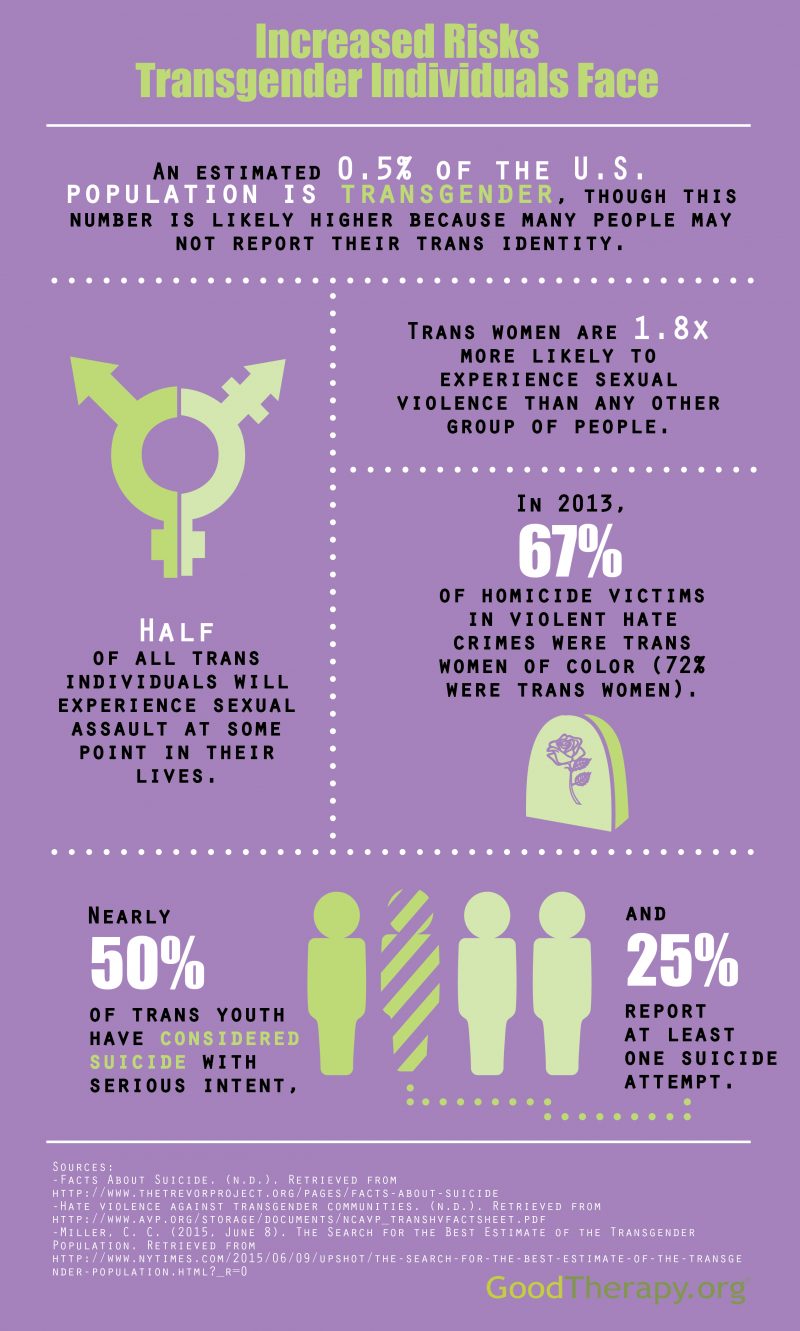
All people deserve a restroom they can use safely, without fear of harassment or violence. According to the NCAVP and Rape Response Services National Statistics, trans people face high rates of homicide, sexual assault, and violence. Trans people of color are at even higher risk: in 2013, 67% of hate violence homicide victims were trans women of color. Preventing trans people from using the facilities they feel most comfortable in may make it necessary for them to put themselves at greater risk (and also possibly out themselves as trans) in order to use the restroom.
The backlash to these rulings, and other similar rulings across the country, has been considerable, especially as transgender students across the country fight similar discriminatory measures for equal access to bathrooms and locker rooms in public schools. Critics point out not only are these laws likely to cause humiliation and distress, they clearly violate the Civil Rights Act.
Several entertainers and organizations have boycotted trips to North Carolina in support of transgender rights, and the Obama administration issued a decree in May 2016 ordering all public schools to allow trans students access to facilities corresponding to their gender identity rather than sex assigned at birth. A number of school districts across the country have refused to accept the decree, citing concerns about boys in girls’ locker rooms and the discomfort of female students.
What these school districts do not seem to address is the discomfort and distress of the transgender students who are required to either use the wrong facilities or change alone in the nurse’s office or other designated facility. In either outcome, these students may face prejudice, harassment, and abuse from other students as well as feelings of shame and isolation, among other issues. Many trans students report avoiding the restrooms entirely, an action that may affect emotional well-being as well as physical health.
Proposed Solutions to Discriminatory Bathroom Policies
Awareness of trans issues is increasing across the nation, and many young trans people have the support and encouragement of their families, but many still do not. Along with the likelihood of discrimination and ostracism at the hands of peers or family members, trans teens and preteens also face the onset of puberty and the emergence of physical features and bodily changes that may lead to gender dysphoria or exacerbate existing feelings. Many teens who wish to take hormones and begin transitioning cannot start this process without parental support. Some have the support of a mental health professional, but many lack even that.
School-level legislation that further denies the identity and existence of transgender youth may contribute to depression, anxiety, and other mental health concerns. It may also increase the risk of suicide in this population, which is already high. Among trans youth, nearly 50% have considered suicide with serious intent, and 25% report at least one attempt. The rates of suicide and other mental health concerns experienced by transgender youth are shown to decrease when they receive acceptance and support.
All-gender restrooms, already prevalent in many countries, may be the logical destination of progress, as gender becomes more understood and the male-female binary is recognized to be an outdated concept.Some point to all-gender or family bathrooms as a solution. While some trans individuals might use these restrooms when they are available, as any other person might, being allowed to only use these restrooms can still be exclusionary and may contribute to feelings of dysphoria. Others say creating bathrooms exclusively for transgender people to use would be an ideal solution, but as Attorney General Loretta Lynch pointed out in a statement announcing a federal lawsuit against North Carolina, “Not so long ago … states had signs about restrooms … keeping people out based upon a distinction without a difference.” Others have similarly drawn comparisons from the bathroom debate to the Jim Crow laws segregating people of color.
Some organizations and companies, such as Target, have responded to these laws by vocalizing their support of trans people with inclusive policies encouraging customers and employees alike to use the restroom that aligns with their gender identity. At Cooper Union College in New York, student activists removed all gendered signs on the bathroom. New placards read “restroom with urinal and stalls” and “restroom with only stalls.” Other colleges have similarly implemented all-gender restrooms with the goal of making public spaces safe and accommodating for everyone. All-gender restrooms also serve to welcome non-binary individuals, who might not feel comfortable in either men’s or women’s restrooms.
Everyone Has the Right to Safety
Many trans people across the nation still cannot use the restroom without facing threats to their personal safety. A woman in Washington, D.C. was assaulted by a security guard when she tried to use the restroom at a grocery store, and students in one North Carolina school district are now allowed to bring pepper spray to campus, which one board member claims may be a “valuable tool” for females who use the restroom on campus. Other schools encourage students to report their transgender classmates if they use the “wrong” bathroom.
Such instances of harassment and prejudice against trans people are likely to do little for the community other than foster fear and transphobia. Even if legislators and others who do not support bathroom use according to gender identity claim they are not targeting transgender people, these measures may invalidate the identity of trans people and perpetuate stigma. They also do not address the high rates of assault and violence trans people experience. Safe public restrooms are a necessity for all, and trans individuals prevented from using the correct restroom may not only face threats to their bodily safety, but also diminished mental and emotional well-being due to stress, anxiety, shame, and dysphoria.
All-gender restrooms, already prevalent in many countries, may be the most logical destination of progress, as gender becomes more understood and the male-female binary is recognized to be an outdated concept. Until then, allowing individuals to choose a restroom based on their gender—and perhaps caring a bit less about who is using what restroom—may be the best solution to an issue that was never really a problem.
References:
- Banchiri, B. (2016, February 23). Charlotte passes transgender rights law: Will North Carolina let it stand? Retrieved from http://www.csmonitor.com/USA/Politics/2016/0223/Charlotte-passes-transgender-rights-law-Will-North-Carolina-let-it-stand
- Bellware, K. (2014, July 18). Gender-neutral bathrooms are quietly becoming the new thing at colleges. Retrieved from http://www.huffingtonpost.com/2014/07/18/gender-neutral-bathrooms-colleges_n_5597362.html
- Borrello, S. (2016, April 22). Sexual assault and domestic violence organizations debunk ‘bathroom predor myth.’ Retrieved from http://abcnews.go.com/US/sexual-assault-domestic-violence-organizations-debunk-bathroom-predator/story?id=38604019
- Carollo, L. (2016, April 25). What happened when I tried to comply with North Carolina’s new bathroom law. Retrieved from http://www.vox.com/2016/4/25/11490498/north-carolina-bathroom-law-transgender
- Changing birth certificate sex designations: State-by-state guidelines. (2015, February 03). Retrieved from http://www.lambdalegal.org/know-your-rights/transgender/changing-birth-certificate-sex-designations
- Cobb, J. (2016, May 30). Opening doors. The New Yorker. Retrieved from http://www.newyorker.com/magazine/2016/05/30/north-carolinas-retrograde-step
- Connelly, J. (2016, February 10). ‘Bathroom bill’ aimed at transgender persons fails in state Senate. Retrieved from http://www.seattlepi.com/local/politics/article/The-bathroom-bill-blocking-toilet-use-by-the-6821841.php
- Facts about suicide. (n.d.). Retrieved from http://www.thetrevorproject.org/pages/facts-about-suicide
Hate violence against transgender communities. (n.d.). Retrieved from http://www.avp.org/storage/documents/ncavp_transhvfactsheet.pdf - Levin, S. (2016, May 12). Obama orders public schools to allow transgender students access to restrooms. Retrieved from http://www.theguardian.com/society/2016/may/13/obama-public-schools-transgender-access-restrooms
- Lopez, G. (2016, April 18). 9 questions about gender identity and being transgender you were too embarrased. Retrieved from http://www.vox.com/2015/4/24/8483561/transgender-gender-identity-expression
- Lowder, J. B. (2016, April 27). Breitbart proves what we already knew: Trans women are not bathroom predators. Retrieved from http://www.slate.com/blogs/outward/2016/04/27/breitbart_helpfully_shows_trans_women_are_not_bathroom_predators_cis_men.html
- Miller, C. C. (2015, June 08). The search for the best estimate of the transgender population. The New York Times. Retrieved from http://www.nytimes.com/2015/06/09/upshot/the-search-for-the-best-estimate-of-the-transgender-population.html?_r=0
- Ng, A. (2016, May 11). North Carolina schools let students bring pepper spray to class–in case transgender students use bathrooms. Retrieved from http://www.nydailynews.com/news/national/n-schools-students-bring-pepper-spray-class-article-1.2633430
- Pearson, M. (2016, May 10). AG Loretta Lynch moves into spotlight with NC bathroom law speech. CNN. Retrieved from http://www.cnn.com/2016/05/10/politics/loretta-lynch-north-carolina
- Rape Response Services National Statistics. (n.d.). Retrieved from http://www.rrsonline.org/?page_id=944
- Redden, M. (2016, March 29). New York college moves to strip gender markings from all bathrooms. The Guardian. Retrieved from http://www.theguardian.com/world/2016/mar/29/gender-bathrooms-cooper-union-college-new-york
- Tan, A. (2016, May 19). Security guard arrested after allegedly assaulting transgender woman trying to use women’s bathroom. ABC News. Retrieved from http://abcnews.go.com/US/security-guard-arrested-allegedly-assaulting-transgender-woman-womens/story?id=39227006
- Transgender Bathroom Hysteria, Cont’d. (2016, April 18). Retrieved from http://www.nytimes.com/2016/04/18/opinion/transgender-bathroom-hysteria-contd.html?_r=4&mtrref=undefined&gwh=459A290B6C63807CACCEAADDE4A5626A&gwt=pay&assetType=opinion
- Understanding the Perpetrator. (n.d.). Retrieved from https://sapac.umich.edu/article/196
Wow, that’s a really tough issue to face. I’m glad you wrote, and I hope I can help you out some.
My first question is how do these colleagues know about the hiring process? Many companies encourage a strict confidentiality for human resources to avoid this very issue, and I am concerned that this information seems to be readily available and that it was shared openly.
Second, with regard to your question of being hired on your merit and the frustration you’re feeling, it’s important to remember that affirmative action was put into place because, historically, minorities have a harder time being employed. Studies have shown that résumés with minority names get 50% fewer callbacks for interviews than white-sounding names. Some people call this “everyday racism,†and it is one of the ways racism becomes systematic. You mentioned that there is a company mandate to diversify, and it sounds like the company sorely needs it and your hire may be one of the ways they are attempting to rectify it.
[fat_widget_right]
It could also be that you were the strongest candidate and the information you received is faulty. I question why your colleagues would feel it necessary to share this information with you and what they hoped to gain by doing so.
I also wonder whether this experience has activated some part of you, a part you’re not necessarily conscious of, that harbors feelings of inadequacy. Most people don’t get through life without taking on some of that in childhood, through no fault of their own. It’s important to recognize feelings that might be triggering and to remind yourself of your own value, even in the face of signs and experiences that may seem devaluing. You know you’re worthy of this position; as you said, you’re smart, resourceful, and a hard worker. If your employer didn’t know that before you were hired, it surely does by now.
As far as whether you should go to Human Resources, that is a deeply personal decision. Do you think you can work at this company with this awareness and the accompanying questions? Will you be able to live with the answer if they acknowledge that they hired you based on your status as a minority? Are you comfortable working in an environment where deeply personal and private conversations such as why a person was hired over another are made common knowledge?
Unfortunately, this is a situation many minorities still have to deal with and there’s still a long way to go in terms of eliminating racism.
It seems to me that this great opportunity has been tainted for you, and understandably so. It may be worthwhile to have a conversation with HR to express your concerns. At the very least, they may make some changes in how information is protected. As you noted, you may be seen as “rocking the boat” if you do that and some people might not like it. It may make for a challenging work environment, but you have to weigh whether the benefit of speaking up is more than the possible cost.
Unfortunately, this is a situation many minorities still have to deal with and there’s still a long way to go in terms of eliminating racism. There are many who have the same questions you do and who feel they have to work harder or perform better to prove they deserve what they have gotten. It’s not an easy situation to be in, so I encourage you to call upon your support system to help you process this situation and your feelings about it. It might also be worthwhile to seek out a therapist who can help you further process what you’re feeling.
I encourage you to take care of yourself while you decide what to do—rest well, spend time with loved ones, and do what makes you feel good. After you’ve allowed yourself to process and release some of the emotional charge, if you decide to go to HR, you will be grounded, confident, and responsive, and less likely to be offended or reactive.
Wishing you well and hoping for the best,
Lisa
Thank you for reaching out with such a powerful and important question. I commend you for taking the time and being thoughtful, considerate, and deliberate in planning your course of action with what could be a highly sensitive situation.
[fat_widget_right]
My first thought about this is whether you’ve spoken to your girlfriend about your concerns. Does she know about your family’s tendencies? She may have similar feelings or worries, and together the two of you can discuss the various options and come to a decision that best suits everyone. I’m quite confident that she has been dealing with various forms of racism for quite some time, as she was in an interracial relationship and now has biracial children. Given that, she may have her own perspectives on how to deal with situations like this in a way that is supportive to her and the children. If you haven’t yet spoken with her about this, I would suggest you start there. Not only will having that discussion clear things up for you and help you clarify your course of action, it will help build your relationship by fostering open and caring communication.
As the saying goes, the best defense is a good offense. I suggest you openly discuss this with the whole family, talk about your concerns, and plan a strategy.
Should you both decide to attend the family reunion, you may indeed be faced with the challenges you are concerned about. As the saying goes, the best defense is a good offense. I suggest you openly discuss this with the whole family, talk about your concerns, and plan a strategy. Discuss the fact racism still exists, it’s still a problem for minorities, and it can be incredibly hurtful to be on the receiving end.
If your family makes racist comments, you can choose how to handle it. You can decide as a family if you are going to address the comments calmly and rationally, or if you will decide to remove yourself from the situation. You can plan a response such as, “I will not allow my family to be subjected to this sort of racist behavior. If you want us to stay, you will apologize and refrain from further comments of that nature.†The other option is to choose to leave immediately.
What is NOT a good option is to lose control, get angry, and make a scene. As difficult as it may be to remain calm in those types of circumstances, nothing is ever resolved by acting in anger. If you are concerned that you can’t handle this sort of situation without getting angry and making a scene, I suggest you not be in it at all.
It sounds as though this relationship has the potential to be long-term, as you seem committed to her and the children. If that is the situation, you will be faced with a lot of racism, microaggressions, and other painful situations for as long as racism continues to be an issue in our world. Sadly, there is a long way to go on that front. You are in a unique position to act as an ally for your girlfriend’s children, and in some ways, for all people of color.
If you and your girlfriend decide to go to your reunion and face what can possibly arise, you are opening yourselves up to be uncomfortable, hurt, and upset. On the other hand, you may be opening up opportunities for dialogue, reflection, and maybe even change in your family. This is not an easy situation, and it will require much of you and your girlfriend to navigate it with grace, but I believe that with honesty, openness, and a willingness to engage, you can manage it. I hope you believe that, too.
Best wishes in the journey!
Lisa
 As we covered in last month’s article on microaggressions, they are often subtle, racial insults by well-intentioned people. And they’re experienced by people of color on a regular, sometimes daily, basis. One study found that 96% of African-Americans reported that they experienced microaggressions within the previous year.
Some of the most common microaggressions that racial minorities experience are:
- When shopping or dining, the assumption that they are service workers rather than customers.
- The assumption that minorities are likely thieves and thus are followed around retail stores. A black woman shared that this happens to her “at least once a week at places where I am receiving some kind of service.â€
- Critical and offensive comments, stated as fact, on how minorities talk, dress, or style their hair. For example: comments that a person is “too loud†or “speaks so well,†as though it is unexpected from someone of their culture.
- Not understanding racial and cultural differences and assuming that racial minorities are the same ethnicity. For example, when my Japanese friend moved to Chinatown, people constantly asked her if she felt “at home.†She’s not Chinese. It’s not the same.
- Assuming that all Latinos speak Spanish. No other ethnic group in the United States is expected to be bilingual.
- Asking, “What are you?†when unable to identify his or her racial or ethnic background.
[fat_widget_right]
While there are individual instances of microaggressions, there are also environmental ones. These are microaggressions that occur and are supported on a larger, societal scale:
- The Oscars is a perfect example of the environmental aspects of microaggression. An all-white actor/actress nominee selection for the Academy Awards ceremony sends the message that white is the standard and the only important perspective or influence there is.
- The constant bombardment of feisty, neck-rolling black women in media as a standard and accepted representation of black women.
- Questioning and challenging the need for minority spaces within larger organizations that are dominated by the majority. For example, when I was planning a meeting for social workers of color (in a predominantly white organization), I heard the comment, “This offensive. This is wrong.â€
- Finally, the denial by people in the majority of racial experiences is a cornerstone of microaggressions.
What can be done about it? A multipronged approach is needed. First, people inflicting the pain need to stop. As in any relationship, when someone is hurt, the person who caused the hurt needs to stop the painful action, apologize, and commit to not repeating it.
Of course, this is easier said than done. Change is a long process, just like in relationships. Mistakes will be made, and painful interactions will continue to occur. But making a commitment not to engage in microaggressions is a useful start.
Here are some concrete steps and important considerations:
Stop and Think Before Speaking
How will your comment be received? Does the setting make a difference? Is it something you should say to another person?
I recently had a white friend ask me about commenting on a black woman’s hair. She knew that hair was an important and sensitive topic in the black community, and she wanted to be respectful in complimenting this woman’s hair. We talked it through and discussed what she wanted to say, why she wanted to say it, and her relationship with the woman. It seemed “safe†to compliment the woman’s hair.
Context Matters
And then I asked about the environment. Where would they be and who else would be present? Those factors can have a big impact; in this case, it changed my perspective. Suddenly a compliment no longer was “safe†and felt different when singled out to one black woman in a room of white women.
For the record, when my friend approached me to ask her question and have this discussion, she prefaced it by saying she wanted to ask me something related to race and understood if I didn’t want to have the conversation with her. She didn’t act on her privilege and assume that she could ask me anything because she’s white and I’m black. This is very different than when people approach minorities and ask them questions about race assuming that they will represent their entire race—another form of microaggression.
For those of us on the receiving end of microaggressions, we need to acknowledge its impact on us. Constant exposure to microaggressions has a significant toll on the physical and mental health of racial minorities. Research demonstrates that the cumulative effects of microaggressions are devastating. They can lead to feelings of isolation, self-doubt, and frustration.
Recognize It for What It Is
We need to acknowledge a microaggression for what it is. To ignore or dismiss it allows it to fester within us, causing harm to who we are as people. This isn’t to say it should be at the forefront of our minds each day, or that you need to confront everything you experience. But it does mean that you need to be aware that this happens and has an effect. Then you can prepare to deal with it.
Awareness Is Key
There are some situations and environments where you may experience microaggressions more frequently. If you are in an environment where you are the “only,†this may be one of those situations. Be aware of this so you can prepare for those times.
Do a Self-Inventory
The hardest part of dealing with microaggressions is that they are easily deniable.
I just like your hairstyle. What’s the big deal?
OK, so you don’t speak Spanish. It was an honest mistake. Don’t overreact!
These are common responses when calling out microaggressions. When you experience a microaggression, there’s something inside you telling you that you’ve been hurt. Perhaps you get a knot in your stomach, flashes of warmth, an instant headache, or a voice saying, “That’s not right.†Often there is some physical experience that acts as a red flag for you. Pay attention to it.
Seek Support
Have someone in your corner who sees and understands microaggressions. You need someone you can talk to and explain what happened, your feelings, and to do some reality testing with. Because the offender and bystanders will likely deny and even become defensive about microaggressions, you need someone you can talk to without defending your experience.
If you don’t feel comfortable talking to someone in your life, seeking the guidance of a qualified therapist can help you sort through your feelings about your experiences.
Let It Out
Don’t let the self-doubt, anger, or frustration eat away at you or cause you more harm. Whether it’s walking, talking, screaming, crying, or running, find a way to let the pain out. After you’ve done this, you’ll be able to think clearly and decide on your next plan of action.
To Confront or Not Confront?
There are pros and cons to this, particularly in work settings, often placing us in a catch-22. Each circumstance and each person is different. What you need in your life changes with time and environment. Be compassionate and flexible with yourself as you make the decision to confront or not confront a microaggression.
The societal and environmental aspects of microaggressions need to change. Though it may seem overwhelming trying to change centuries-long systems of oppression, “never doubt that a small group of thoughtful, committed citizens can change the world; indeed, it’s the only thing that ever has†(Margaret Mead).
References:
- Klonoff, E. A., & Landrine, H. (1999). Cross-validation of the schedule of racist events. Journal of Black Psychology, 25, pp. 231-254.
- Pierce, C., Carew, J., Pierce-Gonzalez, D., & Willis, D. (1978). An experiment in racism: TV commercials. In C. Pierce (Ed.), Television and education, 62-88. Beverly Hills, CA: Sage.
- Steele, C. M., Spencer, S. J., & Aronson, J. (2002). Contending with group image: The psychology of stereotype and social identity threat. In M. Zanna (Ed.), Advances in experimental social psychology, 23, pp. 379-440. New York: Academic Press.
- Sue, D. W., Capodilupo, C. M., Torino, G. C., Bucceri, J. M., Holder, A. M. B., Nadal, K. L., & Esquilin, M. (2007). Racial microaggressions in everyday life: Implications for clinical practice, American Psychologist, 62(4), pp. 271-286.