
by Dr. Jocelyn Markowicz, Psychologist
Tyler Perry Talks Psychology: Teaching Resiliency with the Message to Climb and Maintain
Tyler Perry, the infamous producer and actor, within the full breadth of his creative fortitude, delivered the best simplification of the concept of resilience. In his guest talk at a church in Texas, he provided a powerfully simple way to inspire resilience. In his speech, he told the audience to “Climb and Maintain.†His message aimed to inspire people not to give up on their dreams even in the face of problems and hardship. In short, Perry spoke about resilience.
Resilience
Resilience is a concept developed in the field of psychology. Resilience focuses on climbing and maintaining in pursuit of your goal. The climb is the action(s) you take toward your goal, while the maintenance is your ability to resist the risks in the physical and social environment, overcoming stress and adversity to maintain relatively good psychological and physical health (Garmezy, 1983; Werner &Â Smith, 1982) and achieve your dreams.
Are we all innately resilient? Can we develop resiliency if we do not possess it? If we “climb and maintain†as Tyler Perry inspires us to do, will it lead to success? Psychological research has provided the answers regarding who can climb and maintain and what outcomes may arise from persisting through life stressors. Let’s take a look.
Is Resiliency an Innate Trait? No.
When children are born, their parents often hope that they will be able to teach them everything they need to overcome obstacles, persist despite challenges, and achieve their dreams. However, despite this hope, parents may discover that their children give up easily, do not believe in themselves, and fall short of fighting through adversity. Are some children naturally more able to cope with stress and persist through adversity toward achieving their dreams? Are some children ill-equipped by nature to handle life’s challenges? Psychologists determined that resilience is less of an innate trait than it is a trait that is developed over time (Trivedi et al., 2011). Essentially, resilience can be learned. This means that parents can help their easily conquered or sluggishly motivated child persist through the stress toward achieving their dreams.Â
If resilience is learned, how do we help someone develop resiliency?
How Can We Develop Resiliency?
Resiliency involves coping mechanisms and support systems necessary to promote well-being (Luthar & Brown, 2007). Therapy is an excellent resource for resiliency development. In therapy, individuals, couples, and families learn about effective coping mechanisms. They are encouraged to utilize them to progress through stressful life situations. Therapy also becomes part of a support system that strengthens the development of resiliency muscles to motivate you to persist. We are biologically designed to connect with others. Healthy family, peer, and career support systems also enable us to strengthen our internal systems so that we can effectively cope and persist toward our goals. Starting therapy is part of the climb, and continuing treatment is part of the maintenance toward your life goals.Â
How Do We Climb and Maintain?
Increasing an individual’s resilience can help improve mental health (Koelmel, Hughes, Alschuler, & Ehde, 2017). The American Psychological Association (APA, 2020) offered greater detail regarding how to “climb and maintain†towards your life goals. They suggested several ways that describe the climbing process that Tyler Perry illuminated.Â
Climb
In order to act towards your goals, according to APA, you have toÂ
- Be proactive.
- Take steps to move toward your goals.
- Look for opportunities of self-discovery to inform the next steps you take.
Maintain
APA offered ways to maintain your climb as well:Â
- Embracing healthy thoughts
- Accepting change
In essence, in order to maintain your climb, you have to accept the inevitability of change that will require you to revise your perspective and elevate your thinking.Â
Overcoming Stress
Optimal mental health is important to successfully overcome life stressors. The higher you climb towards your dreams, the larger those stressors can become. To maintain your climb towards your dreams, you must take care of your mental health. Therapy can help you cope with stressors and offer needed support in the face of adversity.Â
How Can Therapy Motivate People to Want to Develop Resiliency?
Often, the most challenging part of motivating someone is determining how. What is the best way to challenge and encourage this specific person?Â
The act of climbing sounds simple enough. You move one foot out in front of you. You then take the other foot and move it up to join or pass its partner. Wait, that described walking. How is climbing different from walking? Climbing adds pressure on the joints due to elevation. To climb, you must indeed start with one foot, not just placed in front, but higher than your walking step. Then you must take the other foot and also put it higher than your walking step. A movement toward your goals requires moving with added weight and strain.Â
We sometimes need motivation to move through pressure. Therapists use a technique called Motivational Interviewing (MI) to help individuals take the steps toward resiliency development. Motivational Interviewing is a method of eliciting an individual’s motivation for change, then guiding them to act on that motivation. Motivational Interviewing is perfect for individuals needing help to get motivated enough to start their climb as well as for those who need support and encouragement to maintain. Motivational Interviewing has been wonderfully successful at improving motivation and action at a rate of 80-95% (Rubak, Sandaek, Lauritzen, & Christensen, 2005). Thank you, Tyler Perry, for talking psychology so that others can seek help on the journey toward their dreams!
To find a therapist who can help you grow in resiliency, start your search today!
References
American Psychological Association. (2020, February 1). Building your resilience. http://www.apa.org/topics/resilience
Garmezy, N. (1983). Stressors of childhood. In N. Garmezy & M. Rutter (Eds.),Stress, coping, and development in children(pp. 43– 84). New York, NY: McGraw-Hill.
Koelmel, E., Hughes, A. J., Alschuler, K. N., & Ehde, D. M. (2017). Resilience mediates the longitudinal relationships between social support and mental health outcomes in multiple sclerosis. Archives of Physical Medicine and Rehabilitation, 98, 1139 –1148.
Luthar, S. S., & Brown, P. J. (2007). Maximizing resilience through diverse levels of inquiry: Prevailing paradigms, possibilities, and priorities for the future. Development and Psychopathology, 19, 931-955.
Rutter, M. (1987). Psychosocial resilience and protective mechanisms. American Journal of Ortho-psychiatry, 57, 316 –331.
Trivedi, R. B., Bosworth, H., Resnicow, K. & McMaster, F. ( 2012). Motivational Interviewing: moving from why to how with autonomy support. International Journal of Physical Activity, 9-19.
Rubak, S., Sandaek, A., Lauritzen, T., & Christensen, B. (2005). Motivational interviewing: a systematic review and meta-analysis. British Journal of General Practice, 55(513): 305–312.
Trivedi, Ranak & Bosworth, Hayden & Jackson, George. (2011). Resilience in Aging. 10.1007/978-1-4419-0232-0_12.
Werner, E. E., & Smith, R. S. (1982).Vulnerable but invincible: A longitudinal study of resilient children and youth. New York, NY: McGraw-Hill.
 What’s the Difference Between a PsyD and a PhD In Psychology?
March 21, 2019 • By Crystal Raypole
A doctoral degree isn’t required to provide therapy, and many qualified mental health professionals who work with clients don’t have one. But some professionals in the field of psychology further their studies in research, professional psychology, or both by obtaining a doctoral degree.
Even in terms of psychology, doctoral degrees aren’t all the same and differ in a few key ways. In brief terms, people with a PsyD (Doctor of Psychology) degree generally use their psychology training to work with people seeking therapy. People who hold PhD (Doctor of Philosophy) degrees typically teach, conduct research, or consult professionally in mental health fields.
Whether you’re narrowing down a career path or trying to make sense of a potential therapist’s credentials, it can help to know more about what distinguishes a PsyD from a PhD.
RESEARCH DOCTORATES VS. PROFESSIONAL DOCTORATES
Completing any apa-accredited doctoral degree involves conducting research, but the research focus will usually depend on the type of degree being pursued.
For example, students in a research doctorate (PhD) program will work toward the development and discovery of new knowledge and theories. This research work is helpful in preparation for postdoctoral educational careers or work with other researchers conducting experimental trials and studies.
Students in a professional doctorate (PsyD) program work to apply existing research to better understand (and attempt to solve) issues in their field of study. This application may lead to the development of new ideas and research methods, but original research is not the primary goal. This applied research work helps students with professional development and prepare for careers as mental health clinicians in a variety of settings.
In terms of psychology, people holding a PhD are more likely to have careers teaching psychology or working with other researchers to develop experimental trials and studies looking at mental health issues and treatment. People who have a PsyD are more likely to become clinical psychologist’s.
But this isn’t always the case. Some people with PhDs may choose to apply specialized knowledge and research to a clinical setting and work hands-on with people. Similarly, some people holding a PsyD may enter a research-based field to learn more about the contributing factors in mental health concerns and evidence for or against certain treatments. Both research and professional doctorate programs can lead to success in either area of professional practice.
WHAT IS A PHD in Psychology?
Before 1970, a PhD was the only option for students who wanted to get a doctoral degree in a psychology field. Today, mental health professionals interested in research, clinical trials, or psychology education may choose to get a PhD.
Before 1970, a PhD was the only option for students who wanted to get a doctoral degree in a psychology field.
Some professionals with a PhD will still provide therapy full-time. For example, a therapist who treats a certain mental health issue may have obtained a PhD conducting evidence-based research on the issue and potential treatments in order to provide the best care. In other words, a therapist whose PhD research focused on a particular mental health issue or type of therapy may provide more specialized treatment than a therapist who treats a range of concerns.
A master’s degree is usually needed to enter a PhD program, though a bachelor’s degree might be accepted in graduate school programs that allow students to complete a master’s and doctoral degree at the same time.
Because space is limited in PhD programs, the acceptance rate is generally 15% at most. To be accepted, good GRE scores, a high GPA, and strong letters of recommendation are generally necessary.
The length of a PhD program varies, but between 5 and 8 years is fairly standard. The cost may be quite high, depending on the school, but many schools offer tuition waivers and/or stipends to students who teach or assist with research. A dissertation is required for graduation. Students must become licensed after graduation.
WHAT IS A PSYD?
Clinical psychology programs are designed for students who want to develop their knowledge of psychology research and apply it when providing therapy.
While it’s not necessary to have a PsyD in order to work with clients, some people may prefer to further their education and become licensed psychologists before establishing a therapy practice or working for a private practice. Having a doctorate can mean an increase in income and a wider range of job opportunities to choose from.
Although PsyD programs are more focused on clinical skills and care than on research, mental health professionals with a PsyD are required to apply research in their studies. Professionals who have a PsyD may have more specialized knowledge than professionals with only a master’s degree. This could be important to some people seeking help for a rare or difficult-to-treat mental health issue.
As with a PhD program, a master’s degree may be required to enter a PsyD program. Acceptance rates for PsyD programs tend to be higher than those for PhD programs. About 40% of people applying are accepted. On average, a PsyD program takes slightly less time to complete than a PhD program. PsyD students who want to enter clinical practice may find a PsyD program a better fit. However, the overall cost of getting a PsyD may be higher since financial aid is usually not offered. A dissertation or project is required coursework for graduation, and students must also become licensed after graduation.
Insert Table
| PHD In Psychology | PSYD (Doctor of Psychology) | |
| What’s the focus? | Strong focus on research. Ideal for those interested in clinical practice, academia, and research. | Strong focus on clinical. Ideal for those interested in hands-on, straightforward practice of Psychology without dedicating professional time to research or academia. |
| Competitive? | Fairly competitive. Acceptance rate is generally 15% at most | Requires less time to complete and About 40% of people applying are accepted |
| Program options? | Plentiful Programs | Alternative to PhD Psychology Programs |
| Funding | Many Schools Offer Tuition Waivers And/or Stipends | Financial Aid Is Usually Not Offered |
| Career path Options | Multiple career path options:
|
Primary career path is Clinical Psychology and working directly with patients. |
SHOULD I PURSUE A PHD OR A PSYD?
Some people may consider a PhD the highest degree available in psychology or believe a PhD is superior to other psychology degrees, but this isn’t necessarily the case. What sets the two degrees apart is the skill sets they’re most likely to develop.
If you’re trying to decide between degree programs, consider what direction you’d like your career path to take. Do you want to teach? Does research interest you? A PhD program may be the better fit. If you already know you want to work with clients, a PSYD degree may be ideal.
A PhD and PsyD differ, but they are still similar degrees. They both help psychology students develop research skills and knowledge they can apply to education or clinical practice.
If you are a recent graduate and starting your career as a mental health professional, click here to learn how GoodTherapy can help you start connecting with referrals and the resources you need to jump-start your career.
References:
- Michalski, D. S., & Fowler, G. (2016). Doctoral degrees in psychology: How are they different, or not so different? American Psychological Association. Retrieved from https://www.apa.org/ed/precollege/psn/2016/01/doctoral-degrees
- PsyD vs. PhD: What’s the difference? (n.d.). Retrieved from https://www.allpsychologyschools.com/psychology/psyd-vs-phd-programs
- What’s the difference between a PsyD and a PhD in psychology? (2017, April 25). Retrieved from https://www.capella.edu/blogs/cublog/doctor-of-psychology-or-phd-in-psychology
© Copyright 2019 GoodTherapy.org. All rights reserved.
 Do you have strong interpersonal skills and a passion for helping students navigate the world of education? If so, you could excel as a school counselor. School counselors provide resources for students who want to learn how to pursue their academic and professional futures, and they also work with students who have learning difficulties or mood issues that interfere with their success in school. Whether providing K-12 education support, helping undergraduates navigate the world of higher education, or getting students to the next step in graduate school, thousands of opportunities for school counselors exist.
Like many health-related fields, specific requirements for becoming a school counselor can vary from state to state, so check with the American School Counseling Association for details. Otherwise, read on to find out how you can get started.
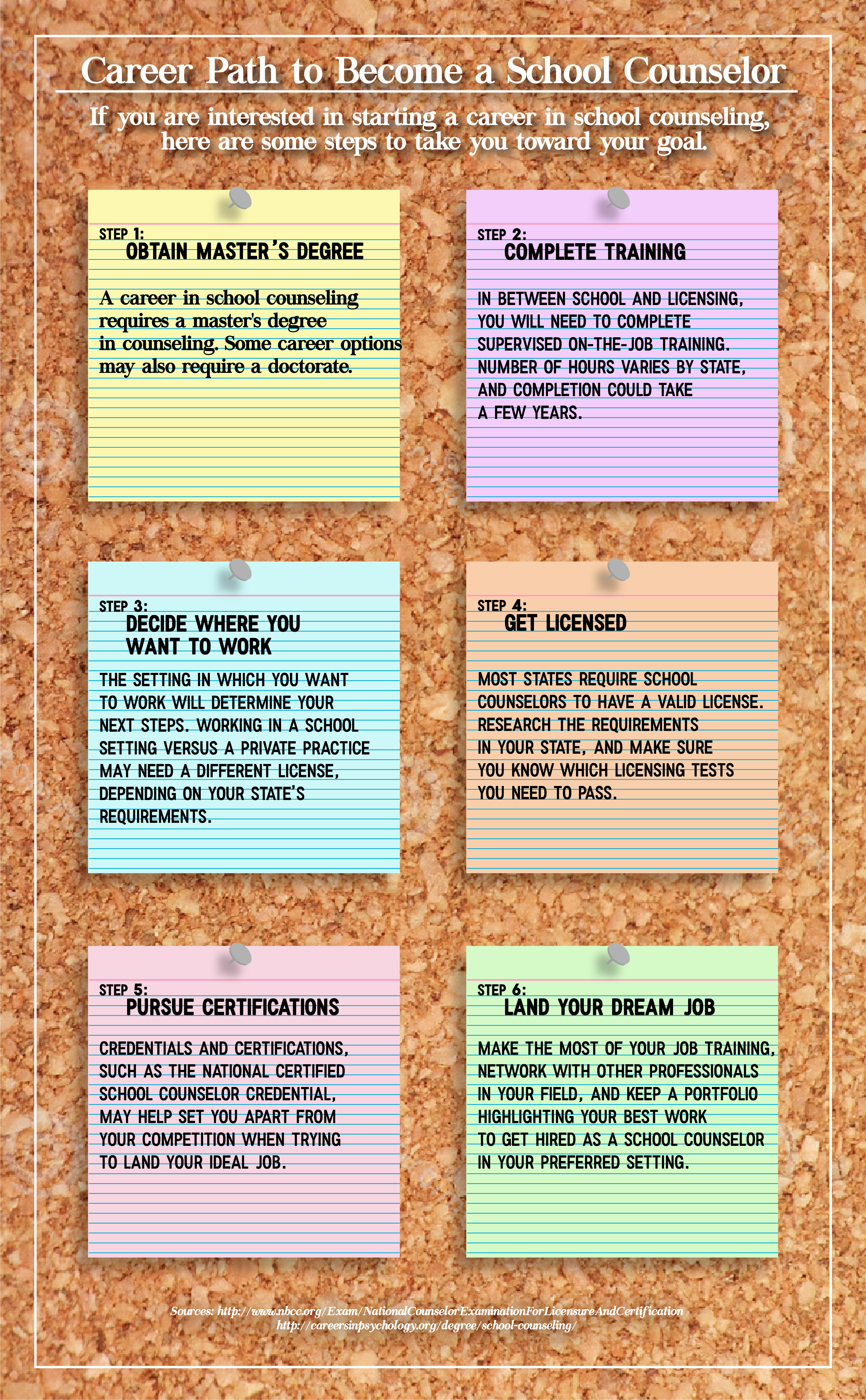
1. Lay the Foundation with Undergraduate Studies
As with similar fields of study, people intending to become school counselors will need a substantial academic background. Your first step is to decide where you want to go to college and apply. Depending on your current level of education, this could mean applying for an undergraduate or graduate program. While your undergraduate degree is not typically required to be in education or counseling, it is often helpful to choose a major that reflects knowledge and understanding of the theories and practices required for counseling. Students who major in subjects such as psychology, sociology, or counseling may find they have acquired a feel for the work involved with becoming a school counselor, and as an extension, are well prepared for their graduate studies. [fat_widget_right]
2. Get Your Master’s Degree in School Counseling
Depending on your program, receiving a master’s degree means learning counseling and guidance techniques for multiple age groups and ability levels. During this process, which may take 1-2 years, you can explore areas of specialization, such as K-12 education, behavior issues, or education for children with developmental delays. According to US News & World Report, some of the top-rated counseling programs in the country are at University of Maryland, College Park, and University of North Carolina, Greensboro. However, there are many worthwhile programs across the country depending on your preferred home base.
 Infographic by Hannah Johnson
3. Work Under Supervision After Graduation
During or after your study program, you can intern or complete a practicum as part of your course requirements. Many programs set a certain number of these hours for you to complete, either as a graduation requirement or part of your future doctorate studies, if you decide to pursue that course. For example, one school counselor program might require 100 practicum hours, 40 of which are in direct contact with K-12 students. Additionally, to take the licensing exam to become a school counselor, you must have completed hundreds of hours of practicum or internship work.
Get familiar with the day-to-day workings of your site and don’t be afraid to ask your supervisor for any tips or important things to know while working there—it is better to ask more questions than less, especially when you are still in a learning environment.
During your school counseling internship or practicum, you will get hands-on experience in the field, generally at a school site you have chosen. You will perform most of the duties associated with your field under the direct supervision of both an on-site supervisor and your instructor or supervisor on campus. Get familiar with the day-to-day workings of your site, and don’t be afraid to ask your supervisor for any tips or important things to know while working there—it is better to ask more questions than not enough, especially when you are still in a learning environment.
4. Get Licensed as a School Counselor
After completing your educational and working hour requirements, it is time to become a board certified school counselor. First, you will need to know your state’s requirements, as they vary. The National Counselor Examination (NCE) is a 200-item exam you might sit for, as it is required to become licensed in most states. It may also be required for a national license or any potential military work you are interested in doing. The NCE website lists all the requirements for the exam and provides information on where to take it in your state. It’s a good idea to study and prepare for this exam like you would for other important, long-term tests. Find example questions from past exams and consider borrowing or ordering an NCE test prep book, which will contain helpful strategies and tips for passing your NCE successfully.
5. Optional Credentials for School Counselors
Before hiring you, most schools will prefer that you have one to two years of hands-on classroom experience. You may also need to get a teaching certificate or license. Research your state’s teaching certificate requirements, as these can differ depending on the education system. Additionally, you can pursue specializations such as career counseling or an emphasis in students experiencing addiction.
6. Get Hired as a School Counselor
The field of school counseling has many opportunities and benefits: more than 200,000 school counselors are employed every year as of 2014, and the profession has a median salary of $50,000 a year. Most educational institutions, whether K-12 schools or colleges, need counselors. Openings for these positions are generally posted through school districts or university careers sites for internal positions. You might begin your job search by researching where you would like to work and begin looking for school counseling postings in that location or ask your own college counselor for help finding a placement. Sometimes the connections you make during your internship or practicum hours can lead to future employment opportunities.
References:
- Danzinger, P. & Newman, H. (2011). School counseling concentration practicum/internship handbook. William Patterson University College of Education. Retrieved from https://www.wpunj.edu/dotAsset/315254.pdf
- National counselor examination for licensure and certification. (n.d.). National Board for Certified Counselors. Retrieved from http://www.nbcc.org/Exams/NCE
- School and career counselors: Summary. (2017, October 24). Bureau of Labor Statistics. Retrieved from http://www.bls.gov/ooh/community-and-social-service/school-and-career-counselors.htm#tab-1
- School counseling degree programs & schools. (n.d.). Retrieved from http://careersinpsychology.org/degree/school-counseling
- State certification requirements. (n.d.). American School Counselor Association. Retrieved from https://www.schoolcounselor.org/school-counselors-members/careers-roles/state-certification-requirements