 It’s no news that dating apps and the rise of social media have revolutionized and expanded upon the concept of “online dating†that took off in the 1990s. While this directly affects people from all walks of life, this article seeks to focus on the unique experiences that gay men face which are amplified by the changes to the dating culture that the world has seen over the past decade. Â
 In the world before such technology was available, to meet other guys, gay men relied heavily upon specific locations such as gay bars to meet other men with similar inclinations. While it’s true that not everyone at the bar on a given night is gay, most are, and, if they are not gay, it’s quite possible that if a gay man met a heterosexual man or woman at such a place, while they may not be interested themselves, he/she/they might know someone who is a gay man and make an introduction. All of this is to illustrate what has been lost with the slow death and decline of the gay bar and gay neighborhood scene that has gone hand in hand with the increased convenience of connectivity gay dating apps have provided; gay men experience more isolation and less connection than they have in the past without these places available to meet people the traditional way.  Â
To examine precisely what, then, dating apps leave gay men, it’s most efficient to begin with the type of space dating apps provide. The online world is undeniably convenient when it comes to its location-based abilities to provide available potential partners within a given proximity to every user. However, as Wade, R.M. and Pear, M. (2022) suggest, “the greater anonymity of virtual environments enables users to express harmful and discriminatory sentiments much more visibly, frequently, and aggressively than in most physical environments.†In other words, because guys have no fear of having to deal with the social repercussions of what they say when they “speak†to someone, they are more emboldened and/or callous when they hand out their opinions or rejection.Â
Dating apps provide the convenience (and even safety) of “blocking†anyone they do not wish to communicate with. Therefore, if one man initiates a conversation with another, he is putting himself at immediate risk of being blocked without any kind of acknowledgment or explanation for the rejection, and such rejections are more painful than ones where they are politely said something like “thank you for the offer, however, I am not interested.†Â
Today’s easy come easy go convenience and the anonymity barrier and distance that are now afforded everyone has brought about with it the age of “ghosting,†where there is a culture of silent dismissal. So even if a guy is successful in getting another guy to agree to a date, and given how small the dating pool already makes this task no easy feat, there is still the risk of arriving at the date and looking down at his phone on his way or after arriving to find that his date has blocked him without apology, explanation, or even a word. Again, this kind of rejection stings much more acutely than plans canceled with what was once considered common communication.Â
Obstacles With Gay Dating Apps
If focused more acutely on what the dating app culture is leaving gay men to contend with is the increased objectification of the physical form. It is no secret that men are visual creatures, but because of this, the importance of a single photo is crucial on these dating apps because one quick impression makes or breaks getting blocked or completely ignored at best. This causes men to abruptly encounter and persistently deal with self-image issues regarding weight, age, skin color, and a host of other body-related characteristics. These issues are old and were certainly present before, but the app dating culture reinforces and reproduces them daily as it is a requirement before communication can even be earned.Â
While combating these obstacles, and again thanks to the anonymity of gay dating apps, gay men have the unique challenge of dealing with more men who are either married or at the very least “not out, discreet.†These men holding onto a straight/heterosexual identity while stepping quietly into the dating pool by creating a profile to satisfy their same-sex attractions and curiosities adds another layer of homophobia-related damage to sift through when finding a partner. An unfortunate part of app dating in the gay world is determining whether or not someone is lying at the onset of communication. The lies could include not disclosing the fact he is a married man or a lie could be that while openly admitting to the guy he is talking to on the app that he is married, he is still cheating on his spouse behind her back and that is what some gay men are left to choose from. Â
Further, if is accepted that it is indeed best to “be friends first,†in relationships rather than being sexual up front, gay dating apps are once again not the answer. Because users have the quick and easy ability to pour their hearts out and self-disclose at faster rates, by the time the date comes around, the two daters already feel as if they know each other well and become sexually active more quickly than they would have had met any other way. This leaves them not stopping to take the time to get to know the other person and diminishes the “trust building, easy communication, and companionship†that strong relationships are known to have (Brenner, A., 2022).Â
Gay Dating Apps and Mental Health
Ultimately, gay dating apps and the culture that is arguably more hurtful than it is helpful to mental health are successful because of their success in sustaining the trapping illusion of time. Gay men are caught in the belief that by being on dating apps and quickly accessing partners from a wider pool than the small one around them has to offer they are saving time. However, because any one conversation partner can disappear at a moment’s notice as discussed, there is a necessity for speaking to multiple partners at the same time to maintain the feelings of pursuing and winning or being pursued and winning which leaves everyone on the apps in a constant cycle of both anticipating and handing out rejection. In the end, the more rejection a person receives, the more comfortable they become in handing it out to others.Â
In the wise words of Elizabeth Bishop, “The art of losing isn’t hard to master.†Focusing on real relationships in life that are built on stronger foundations than shallow, insincere, and forced connections or it “may look like a disaster.†Â
The moral of this detailing of an offense to psychological well-being is to recognize and see the game of dating apps for what it is. Clients within the gay community should focus on self-improvement strategies both mental and physical that support a healthier person that is ready when the right person comes along, whether that’s the old-fashioned way or being one of the lucky lottery winners on a dating app. Those seeking mental health strategies can inquire about mindfulness-based interventions as self-compassion does wonders to counter the barrage of negative messaging from apps in gay dating (GoodTherapy, 2018). Therapists working with this population should have an understanding of the degree of rejection that exists within the gay community in addition to the marginalization that has happened and still happens in society.  Â
ReferencesÂ
Brenner, A. (2022). 5 Reasons It’s Better to Be Friends Before Lovers. Psychology Today.Â
GoodTherapy. (2018). How to improve self-esteem. Â
Wade, R. & Pear, M. (2022). A good app is hard to find: Examining differences in racialized sexual discrimination across online intimate partner-seeking venues. International Â
journal of environmental research and public health.Â
 Discussions about coming out typically deal with telling the parents. That makes sense, especially for young people still living at home. However, siblings play a role in the process as well: they can help ease the way or contribute to the conflict. They may have issues of their own stemming from a sibling’s coming out. No matter the situation, these issues should be acknowledged.
There are many factors that may determine how siblings react to your coming out as lesbian, gay, bisexual, or transgender: their age, their relationship with you, maturity level, parental influence, religious views, and so on. In general, if you were close before, you will probably remain close. Your sibling may even have guessed already, or maybe you told him or her first. The sibling may take your side if your parents give you a hard time. Even if the sibling is much younger than you, his or her support may be very meaningful.
On the other hand, if the relationship was not good to begin with, siblings can make the experience all that much harder. Old jealousies or resentments may have new fuel. There is a new vulnerability that the sibling can choose to take advantage of. In cases where parents are accepting of who you are, such a sibling may be even more enraged and do everything he or she can to make your life miserable.
[fat_widget_right]
When you come out, your life changes—hopefully for the better, but in some challenging ways, too. The life of a sibling can also change as a result of having a LGBT brother or sister. Sometimes siblings are pressured to take sides. In some families, they may be forced to play peacekeeper. They bear witness to anger, disappointment, fears, and criticisms that may fly back and forth. If they are of school age, they may be the butt of jokes, bullying, or even hatred. Parents and the LGBT child may be so wrapped up in their own problems that the sibling issues aren’t addressed.
When you come out, your life changes—hopefully for the better, but in some challenging ways, too. The life of a sibling can also change as a result of having a LGBT brother or sister.
Many of these issues may occur even when you and your siblings are adults when you come out. The relationship issues you had as kids may never have been resolved. Old rivalries may be stirred up, and the chance to be the “good†child may be too strong to resist. In addition, adult siblings may have to deal with the feelings and reactions of a romantic partner and/or children. If the partner’s feelings differ from the sibling’s, it could cause conflict in the relationship. The adult sibling may feel protective of older parents, sympathy or empathy for his or her brother or sister, sadness over the rift between the parents and the newly out sibling, and so on. These feelings may be subconscious, making them even harder to work with.
Naturally, there are families in which both the parents and the siblings are loving and accepting of their LGBT family member. That is, of course, the best-case scenario, an ideal outcome of coming out. When this is not your situation, however, here are some things to remember:
- Acknowledge any support you get from siblings in coming out. Share your gratitude.
- Regardless of what your relationship is like, know that your siblings may be affected by your decision.
- Be aware of how your relationship may affect a sibling’s attitude. If the relationship is poor, you may think you don’t care what the sibling thinks. But he or she can abuse this new knowledge to “out†you to the rest of the family, friends, or school when you aren’t ready.
- Don’t use your sibling as the middle person between you and your parents. Let your sibling act (or not act) on his or her own.
- Give your sibling a chance to share his or her experiences. Try to be sympathetic and offer support, regardless of his or her level of support for you.
- Remember that if a sibling is young, he or she might have questions or be confused. Talk about it. Be as open as is age-appropriate. And, hard as it may be, try not to bad-mouth your parents. Your sibling needs them.
No matter what your relationship with your siblings is like, your decision to come out is likely to affect them—and, more than likely, your relationships with them. Being aware of this, and being prepared to handle it, can help your coming-out process go as smoothly as possible.
 Parents searching for a safe place for their transgender, gender nonconforming, or nonbinary child usually have a lot of questions. One of the first things parents who reach out to me ask is, “What is gender dysphoria?” This is usually followed by, “How is it affecting my child?”
Understanding gender dysphoria is an important part of the journey to support trans youth. But many parents may not be sure what this concept means. Put simply, gender dysphoria is an internal conflict between the sex a person was assigned at birth and the gender they identify with. It is often described as a feeling of discomfort with the body a person lives in and their deeper sense of gender. This conflict can be seen in many ways. Body dysphoria, depression, anxiety, eating disorders, and self-harming behaviors are a few, but there are others. All of these symptoms can be seen as attempts to manage the deregulation that can occur when a person’s body does not represent their gender.
Gender dysphoria may be first felt in puberty, when physical changes of development begin. Children can experience discomfort before puberty, but these feelings usually become stronger as differences between the physical body and internal sense of gender increase. Imagine knowing you are male, having a masculine sense of self—in a body that begins to develop breasts. This disconnect can cause extreme anguish and anger in adolescents. Many also say they feel trapped. [fat_widget_child_counselor_right]
How Does Dysphoria Manifest?
This internal conflict is different for each person, but it is often seen as depression or anxiety. Looking in the mirror and seeing a body that does not express your internal sense of self can cause pain, unsettled feelings, and disconnect. Psychological pain may show up in a child’s behavior. Many adolescents refuse to attend school and withdraw from social interactions. Your child may drop activities that require physical contact, like sports, and avoid situations where they would need to expose their body, like pool parties.
At its most intense, body dysphoria in teens can lead to suicidal thoughts and attempts, as well as self-harming behaviors and disordered eating. These actions often result from the need to control a body that feels completely out of control and to ease the pain of an internal disconnect. These symptoms are signs that a higher level of care is needed. A therapist trained to offer support to transgender, gender nonconforming, and nonbinary adolescents may be the best person to provide this care.
Help for Gender Dysphoria
A therapist who is well-versed in working with trans youth is vital for creating a safe space for kids and families to address the challenges of gender dysphoria. The goal in therapy is not to change how a person feels or expresses their gender. Rather, it is for children and their parents to explore tools and methods of support for the feelings that surround the distress of not being able to physically express their true self.
It is important for families to develop a dynamic that is informed, supportive, and curious about their child’s journey as they explore their gender. This dynamic can create a space where different expressions of gender can be safely explored. This exploration may help relieve distress that occurs with dysphoria.
It is important for families to develop a dynamic that is informed, supportive, and curious about their child’s journey as they explore their gender.
Some of the first ways this exploration may take place is with social expression. Through social expression, a child or teen can develop their sense of self and affirm their gender identity. Your child may try out different styles of clothing and new hairstyles and ask you to refer to them by pronouns that fit their gender. They may choose a new name or try out several new names before they determine the one that fits best. These expressions can be seen as the first step in aligning themselves with their internal sense of being male, female, some of both, or neither. By supporting your child’s expressions and identity, you can help ease their distress and help them find a deeper and clearer sense of self.
The next step may be medical transition. Medical treatments that help align physical characteristics with gender include:
- Puberty blockers. These help prevent the developmental changes of puberty. They can help reduce distressing changes in trans children who have not yet decided on hormone therapy.
- Hormone therapy. Hormones cause physical changes that support internal gender identity.
- Gender confirmation surgery. Some trans people may pursue surgery to completely match their physical body to their gender, but others may choose certain types of surgery only.
It is important to understand that not all people who identify as transgender, gender nonconforming, or nonbinary are interested in pursuing complete medical transition. They may choose some aspects and reject others. For example, your teen may be interested in hormone therapy but not feel ready for gender confirmation surgery. This personal choice is a part of each person’s transition.
You can help your child by encouraging open discussion and taking their feelings and wishes into account. Ask what your child thinks about medical transition. Do your own research so you can have informed discussions with your child. Careful research can help you help your child make decisions based on accurate information and informed consent.
Exploring these topics can bring up strong emotional reactions. But it is important for both you and your child that you are able to support them during their transition and talk through their options from an informed, caring position instead of a fearful, reactive one. [amazon_affiliate]
Some families may need more help and support to explore these feelings and assist a child who is dealing with the painful reality of gender dysphoria. If you are struggling to find the best way to offer support to your child, you may find it helpful to talk through your feelings with your own therapist or counselor.
References:
- American Psychiatric Association. (2013). Diagnostic and statistical manual of mental disorders (5th ed.). Arlington, VA: American Psychiatric Publishing.
- Rood, B. A., Reisner, S. L., Surace, F. I., Puckett, J. A., Maroney, M. R., & Pantalone, D. W. (2016). Expecting rejection: Understanding the minority stress experiences of transgender and gender nonconforming individuals. Transgender Health, 1(1), 151–164. doi: 10.1089/trgh.2016.0012
- Sherer, I., Baum, J., Ehrensaft, D., & Rosenthal, S. M. (2015, January 1). Affirming gender: Caring for gender-atypical children and adolescents. Contemporary Pediatrics. Retrieved from http://contemporarypediatrics.modernmedicine.com/contemporary-pediatrics/news/affirming-gender-caring-gender-atypical-children-and-adolescents?page=full
- Steensma, T. D., McGuire, J. K., Kreukels, B. P., Beekman, A. J., & Cohen-Kettenis, P.T. (2013). Factors associated with desistence and persistence of childhood gender dysphoria: A quantitative follow-up study. Journal of the American Academy of Child and Adolescent Psychiatry, 52(6), 582-90.
 Many of us are raised to follow a particular religion, and many of those religions have some negative messages about sexual and gender diversity. These early religious messages can have a significant impact on the way LGBTQIA individuals perceive themselves, their sexual orientation and gender identity, and their self-worth.
Some people find leaving the religious organization they were raised to follow is the choice that best enables them to live as their true selves. Still, even those who have taken this action may continue to struggle with shame and guilt about being LGBTQ+. Others find their religion and spirituality are just as important to their identities as their gender and sexual orientation and struggle to reconcile all aspects of their identity.
The ideas of religion and sexuality have been at the forefront of my mind in recent months. Whether I am looking back on my own childhood experiences with religion and how those impacted my own sexual identity or witnessing affirming messages of inclusive churches during Pride week, I have long been interested in the ways LGBTQ+ people can move beyond negative messages about their identities in the face of ever-present religious pressures.
What really kicked off my interest in this topic was a recent conversation with a past Jehovah’s Witness who was excommunicated from his church when it was discovered he was gay. This person still felt a deep, burning desire to engage in his spiritual and religious beliefs and was constantly at odds with what his beliefs said about who he was as a person and his identity as a gay man. He felt as though he had to choose either his sexuality or his spirituality, and that if he chose to love who he wanted to love, he would be doomed eternally. As a result, his journey has been painful and alienating. [fat_widget_right]
What are the impacts of this struggle on mental health? LGBTQ+ people raised in religious environments that do not affirm their identities often experience depression, anxiety, suicidal ideation, negative self-image, and addiction, among other concerns.
Internalized homophobia, which is the tendency to feel shame about being non-heterosexual or gender diverse, is more common in religious LGBTQ+ people (Barnes & Meyer, 2012), and is linked to experiences of depression, anxiety, and suicide. These painful experiences are often worse when someone grows up in a culture that does not accept who they are, and the experience can place a false sense of morality or choice on sexuality and gender.
Combating Stress and Shame
Those raised according to the faith of a non-affirming religion may struggle to overcome internal feelings of guilt, shame, and stress. How can these be addressed?
One of the most important and effective ways to combat stress and shame resulting from non-affirming messages is to focus on maintaining positivity and self-love around your LGBTQ+ identity while engaging in self-reflection about your religious attitudes and whether they are helping you or not.
One option is to leave the religious group that fosters messages of shame and persecution, but the outcome of this choice could be feelings of spiritual emptiness, loneliness, and isolation from family, friends, and one’s community. Another option might be to question religious attitudes that feed internalized shame while maintaining your engagement with your religious community, but this may not give you enough distance from shame-based messages.
One of the most important and effective ways to combat stress and shame resulting from non-affirming messages is to focus on maintaining positivity and self-love around your LGBTQ+ identity while engaging in self-reflection about your religious attitudes and whether they are helping you or not (Page, Lindahl, & Malik, 2013). This is often a complicated task.
How can a person question negative messages about sexuality and gender learned through religion?
- Speak to someone who understands: It can be helpful to find an affirming person who has a similar religious upbringing to discuss experiences with in order to gain some insight on where those shaming messages stem from. If you don’t know someone you feel safe talking to about this, a compassionate and empathic counselor who is trained in working with members of the LGBTQ+ community or friends and supportive family can often help you sort out your thoughts and feelings.
- Notice self-defeating thoughts: We all struggle with self-defeating thinking that leads us to view ourselves less compassionately than we could. Taking a deep look at those thoughts and where they come from is a helpful and positive step. Try keeping a journal to help you identify patterns in your thinking about your sexuality and gender in addition to your spiritual health.
- Challenge ideas that suggest your sexual orientation or gender is a moral choice: The only choice a person has, when it comes to sexual and gender identity, is to live as the person they are or to hide that identity from others. Sexuality and gender are not moral choices; they are aspects of identity. If you are surrounded by messages that being LGBTQ+ means you are sinful, morally wrong, or doomed, it is in your best interests to challenge those ideas. Challenging or resisting them might mean speaking up about it, resisting in your own mind, or leaving the people or organizations inflicting those ideas on you.
- Remind yourself that spiritual fulfillment is not the same as religiosity: Most people find comfort and strength from spiritual experiences and beliefs. Although spiritual fulfillment can be achieved through being part of a religion, religion is not necessary for finding spiritual fulfillment. It might be helpful to think about what your religion gives you that you benefit from or what you miss about the religion you grew up in. Ask yourself whether there are other ways to meet those spiritual needs and whether the religious ideas you know are benefiting you.
- Create a new community: For many, leaving a religion means leaving behind people and traditions you love, and this can feel very lonely. Start anew by creating a community of people who accept you for who you are and who think and feel in ways similar to you. It may be helpful to begin by researching ways to volunteer or get involved in your community by meeting and reaching out online to other people going through similar experiences.
References:
- Barnes, D. M., & Meyer, I. H. (2012). Religious affiliation, internalized homophobia, and mental health in lesbians, gay men, and bisexuals. American Journal of Orthopsychiatry, 82(4), 505-525.
- Page, M. J. L., Lindahl, K. M., & Malik, N. M. (2013). The role of religion and stress in sexual identity and mental health among lesbian, gay, and bisexual youth. Journal of Research on Adolescence, 23(4), 665-677.
Dear GoodTherapy.org,
I need some friendly feedback with a problem I am stuck with. I am a 60-year-old male who was diagnosed 23 years ago with gender dysphoria. I have just “dealt” with it by staying in the closet, seeing a therapist as needed, and basically choosing not to entertain the idea of transition for family concerns. I am now single again, have met a nice cis woman, and would like to get serious—but I am unsure if I should be totally open about this part of me. I have always been a person of integrity, honest and truthful, which sometimes hurts others but it’s who I am.
[fat_widget_right]
When I shared this with a woman once before, it ruined a chance for marriage. She was unable to even talk about it and chose to walk away. I never transitioned even partially or lived as the opposite gender. Is it important that I mention this now?
I realize society is more supportive than ever before, but there are still plenty of folks in the world who abhor anything that does not fit into the male-female binary. I have read numerous accounts where other men in a similar situation never said anything, got married, then out of the blue would share this part of them or would start cross-dressing again and naturally the wife was taken by surprise, shocked, and confused. Usually, the marriage ends and everyone is hurt.
I haven’t cross-dressed in 20 years and have no plans to start up again, but this doesn’t ease my fear at what might happen if I come clean with my new partner and prospective wife. What to do? —Questioning
Dear Questioning,
Thank you so much for writing in with this topic.
When I first sat down to reply, my inclination was to offer what I hope will be received as comfort: reassurance that you have multiple choices regarding your own communication. You are under no moral obligation to disclose any idea about gender (or anything else) to another person if you don’t want to. Your gender is your truth, and your gender does not make up the entirety of who you are.
But I imagine you are writing to a therapy website for a reason. If you were okay continuing to do what you’ve already done in relationships (after at least one very powerful, very negative experience disclosing in the past), I don’t think you would have taken the time to construct this letter.
I would like to gently challenge the narrative you have about your disclosure “ruining a chance for marriage,†shifting the blame away from you individually. Was it not your partner’s rigidity about sex and gender that pushed you away? Can we think about this as a paradigm incompatibility rather than a mistake you yourself made?
In general, if someone is looking for a “serious†relationship (as you say you are now), a critical part of the early stages is getting to know the other person and collecting evidence for whether you will be compatible long-term, is it not? It sounds like some of the anxiety you are experiencing is the normal anxiety of any person in a new relationship—“Will this person turn and run if I share what I really feel inside? Is it safe to trust this person?†Of course, in your case, some of the baggage also carries a gendered focus you have been painfully discouraged from sharing in the past. So far, though, you’ve only alluded to a sharing of ideas, which I hope any partner would remain available for.
I think deconstructing and delineating gender roles is helpful in any relationship, not just in a relationship where one partner is transgender or gender dysphoric. It sounds like you may not decide to “medically†transition in a surgical or hormonal sense, but wouldn’t it be nice to break out of the confines of masculinity as they may be prescribed upon you?
I imagine you have witnessed a great deal of social change regarding gender roles across your lifespan. From this, and from other life experiences, what have you come you expect from yourself, and what do you need in order to feel supported, affirmed, and loved in your relationships? If this includes permission to be fluid and expansive in your expressions of gender, then that is something you are entitled to pursue. If this includes simply the space to air what you’re thinking, free of judgment, that is also completely reasonable. If the relationship is healthy, your partner should not attempt to serve as some sort of mind police for which thoughts are and aren’t okay for you to have and for you to explore. In my experience, our identities, thoughts, and desires are not very good at obediently conforming to socially-sanctioned categories.
When I am working with someone who has come to therapy to explore their sense of gender identity, one of my subgoals is to help them seek out affirming community outside of the therapy room. Whether you decide to formally “transition†or not, having folks around who will appreciate your honesty and not force you to adapt to rigid and even false categories will help you feel more liberated in all of your relationships.
You don’t mention what region you live in, but I will acknowledge that certainly some places are friendlier than others toward those who don’t fit into a simple male-female binary where biological sex and expressed gender align. I also won’t pretend that my own age bracket (I’m 29) isn’t generally more accepting of gender expansion than your generation in many cases. But that doesn’t mean the resources for support and understanding aren’t out there. To find in-person support, PFLAG, a wide-ranging national organization, should be able to connect you to affirming transgender resources within an hour’s travel or so of where you are living if you are living in the States. I’ve also listed some other online communities in the Resources section at the end of this article.
It is nice to have the freedom to speak difficult and complicated truths within our partnerships. But it’s not just nice: this freedom also forms the foundation of safety and trust.
I have found that establishing a social support net that can “catch†you when the going gets tough—whether this support comes remotely or in-person—can, in a sense, lower the stakes of a relationship. You have reinforcement. But that doesn’t mean that there isn’t a specially-reserved form of terror for our most intimate partnerships, particularly if we have experienced abandonment following the decision to open up in the past.
In 2007, I gave a report on what was then referred to as Gender Identity Disorder, which included a description of the legal entitlements of spouses to recipients of this diagnosis. If individuals were married, spouses used to be required to sign off on a medical decision if their partner was seeking sexual reassignment surgery. Remembering this report has me thinking now: what are the functions of disclosing gender dysphoria to one’s partner? Is it to clear the air, or is it maybe to help them plan for some sort of action? It summons the idea that our identities are most often formed in relation to others, and that to have a partner who challenges gender might mean we challenge our own identities, too. Marriage and intimate partnership can create a sort of collaborative identity formation, but this doesn’t mean you should sacrifice that which is precious to you.
Are you interested in wearing differently-gendered clothing in the presence of your partner or in trying out different kinds of sex other than p-i-v intercourse? These are behaviors of interest to a broad range of people, including those who do not identify as trans. I do not ask these things to suggest that gender dysphoria is the same as having a cross-dressing kink, or is a kink at all. I ask because my ideas about communication on the topic of gender dysphoria are informed by the same kind of openness and honesty I encourage when working with sexual minorities and kinksters.
My concern for you continuing to maintain the status quo of past relationships is that our unrealized desires so often have a way of breeding resentment if pushed away or neglected for too long, either by ourselves or by our partners. It seems you have more than two decades of experience with this.
It is nice to have the freedom to speak difficult and complicated truths within our partnerships. But it’s not just nice: this freedom also forms the foundation of safety and trust. I am admittedly biased; as a relational therapist, I have a strong leaning to encourage others to put all their cards on the table and to keep the lines of communication open. But I’m not alone. For example, in his “sexpert†blog, Reid Mihalko claims that it’s what we’re NOT saying that’s damaging our relationships. He makes the following case for transparency:
“If you share the things you think might end the relationship and the relationship doesn’t end, now you’re having a Relationship with a Capital R! Sure it’s scary to say the scary things, and it’s bound to kick up a lot of emotional flotsam at times, but what if you and your partners could work through it? What if letting the “cat out of the bag†built more trust and a deeper sense of security and intimacy than wondering if your partner is withholding important things from you?
When you say what is not being said, especially the big, bad, hairy, scary stuff, you model for your loved ones that they can share all the things they’re not saying, too. Over time, you get to know your partners more as they get to know you more, and you’ll realize that they’re choosing to be in a relationship with the real you, not some façade of who you think they need you to be.”
I will admit that we do not live in a universally gender-progressive utopia, and it is certainly not often safe—emotionally or physically—to disclose our grapplings with traditional gender roles. As an example of complex intersectional identities, Asiel Adan Sanchez shares a complex narrative about how their relationship to a Mexican cultural identity complicates their gender identity narrative and how the traditional notion of coming out can lead to cultural and ethnic erasure. I won’t pretend these categories are simple. I also don’t know your cultural context, your given family history, or how long your previous relationships lasted: certainly these factors can reasonably affect your choices about how you experience and express gender. Since you are the only one who has to live your life, only you can know what decisions are best for your specific context.
Your letter brings to the surface so many ethical quandaries we all wrestle with regarding intimate disclosure! To what extent are our partners entitled to the regulation of our minds and of our bodies? No matter how you answer these questions for yourself and your new relationship, I sincerely hope you find a safe, affirming, and healthy way to explore feelings, roles, and identities—not just in a confidential therapy room or anonymous online forum, but in the safety of romantic partnership as well. I wish you the best!
Warmly,
References:
- Adan Sanchez, A. (2017, July 7). The whiteness of ‘coming out’: culture and identity in the disclosure narrative. Archer Magazine. Retrieved from http://archermagazine.com.au/2017/07/culture-coming-out
- Mihalko, R. (2012, March 20). Say what’s not being said: Reid’s formula for difficult conversations. Reid About Sex. Retrieved from http://reidaboutsex.com/difficult-conversation-formula
Resources:
- Center for Gender Sanity
- The Gender Book
- Gender Spectrum
- Trans Mentors International
- Transgender Support Live Chat:
- World Professional Association for Transgender Health
 Sophia Dembling wrote, “One of the risks of being quiet is that the other people can fill your silence with their own interpretation: You’re bored. You’re depressed. You’re shy. You’re stuck up. You’re judgmental. When others can’t read us, they write their own story—not always one we choose or that’s true to who we are.â€
But sometimes even when others could choose to “read†us—by being curious, asking questions, and collaborating with us and honoring what we value—they choose to write over us instead. This is particularly true when one person has more social power or when their values are already maintained by external forces. They have more permissions already; they have more of a voice. In these situations, we might not be quiet by nature so much as silenced.
Asserting Experience and Identity
Some aspects of our lives come more pre-packaged and scripted than others—namely, our stories about gender. And we haven’t got a fighting chance to tell our own gender story if it’s been decided for us before we are even able to speak or choose our own adornments—for most of us, this takes place before we are even born. Ideally, babies would come into a home where love can be flexibly provided for many variations of expression—but many of us will be subconsciously “shaped†into something “More Appropriate†if we deviate from culturally-sanctioned ideals. [fat_widget_right]
If you are cisgender, this may not feel oppressive. If your community affords men and women (and your gender is one or the other) a great deal of fluidity, flexibility, and freedoms, this may not feel so bad.
But even if this is your experience, it is not everyone’s—or even most people’s—experience. Keeping this in mind, listen for stories that differ from your own.
Transgender and gender non-conforming folks claim the permission of asserting (not choosing) their gender identity and sense of self rather than accepting what has been assigned to them. This becomes increasingly necessary if what has been given to them (“prescribed†gender, typically based on the sex category assigned to a person at or before birth) never fit that person, no longer fits that person, or sometimes doesn’t fit that person. Transgender and gender non-conforming people are claiming their own power over their bodies and voice.
It is here I want to assert my position: unless a person is directly harming another person, how they want to speak or adorn themselves is not for us to decide—unless we are that person’s parent. When we take on a parental role with a person we are not parenting, we are indicating we have decided we are not equals with the person, that we cling to a sense of power over them. (For instance, when we become the “gender police.â€)
Narrative Therapy: Co-Creating Meaning
The following description of narrative therapy comes from the Dulwich Centre in Adelaide, Australia: “Narrative therapy seeks to be a respectful, non-blaming approach to counselling and community work, which centres people as the experts in their own lives.†I distinguish here between therapy styles that give people expertise over their own lives vs. the power our mental health system has traditionally exerted over those who come for help. Narrative therapists co-create meaning with the people they are treating; traditional therapy prescribes meaning onto the experiences of the person in therapy.
Narrative therapy acknowledges the power discrepancies between therapist and person in therapy but seeks to minimize them as much as possible. This modality is a collaborative, democratic style of therapy where what something means to the person in treatment is equally or more valuable than what something means to the therapist.
(I don’t want to pretend a truly democratic relationship can exist between therapist and person in therapy. Not only is there a transaction of money, but—in the case of individuals advocating for their own gender transition and especially in the case of those desiring hormone therapy—therapists are also in a position to determine whether or not the individuals they are treating are “of sound mind.†Thus they are the gatekeepers of access to desired medical treatments.)
Narrative therapy acknowledges the power discrepancies between therapist and person in therapy but seeks to minimize them as much as possible. This modality is a collaborative, democratic style of therapy where what something means to the person in treatment is equally or more valuable than what something means to the therapist. It involves listening to the words of the person receiving therapy, tracking the themes relevant to their life, and determining which stories were authored authentically by the individual and what stories were told to them and enforced by the Powers That Be.
Tactics Used in Narrative Therapy
In an attempt to subvert some of the gatekeeping power that has existed within my profession since its origin, I wanted to write about some narrative therapy tactics that can be self-taught and used by the chosen family and communities of transgender and gender non-conforming individuals in order to support and enrich their loved ones’ sense of self! Chances are, you are already using some of them.
- The “Constitutionalist Self.†This term refers to a view of the self as malleable and continuously de-constructed and re-constructed through interactions. Who we are is largely determined through relationships and dialogue. Before engaging in the process of “deconstruction,†explained below, this sense of self is often derived from experiences fitting into the dominant narrative. Others—parents, teachers, etc.— often inadvertently “guide” this sense of self without even realizing it.
- The Dominant Story. This is a name for the story with the most influence and power, often uncritically accepted as “true.†It tends to reflect societal values and might feel oppressive in nature, telling us what “should” be true but often isn’t. For example, girls should be quiet and submissive; boys should be aggressive and assertive.
- Subjugated story/stories. This term refers to stories obscured by The Dominant Story, such as when someone cannot see the ways in which they are hard-working and supportive because they are bombarded with messages that they have failed in some other way (by being handicapped, by being unemployed). Another example might be someone who wants to view and present themselves as feminine, maternal, and nurturing but keeps focusing on (and being reminded of) their “mannish hands†and “broad shoulders.” These traits, often associated with manhood and masculine posturing, serve as distraction from the stereotypically “feminine†traits they are attempting to story. Somehow, certain stories are allowed and valued while others are not. Exceptions to normative stories are discouraged, often in subtle ways.
- Deconstruction. This term refers to the postmodern process of constructing new meanings by examining hidden (often cultural/political) agendas and assumptions. Deconstruction begins when someone is able to tell their story in a context where the dominant cultural story can be viewed as a highly influential text the person did not totally author.)
- Building Leagues. Narrative therapists assist the people they work with in the linking of resources and community—groups of people facing similar problems, sometimes called “Leagues†or “Communities of Concernâ€â€”to develop a sense of solidarity and power in numbers. League members learn from one another as peers rather than experts. For many, joining a gender support group or having other friends who are trans or gender non-conforming eliminates some pressures to educate and sometimes allows people to let down their guard in different ways than they might with a cisgender peer.
- Identifying “Outsider Witnesses.†Narrative therapists assist people in identifying those who will affirm and support their new story. Which people in a person’s life are interested in learning their correct pronouns, their own unique style, the origin of their chosen name? Who values them for their chosen values and the ways in which they express them? It is a beautiful moment when our loved ones can see us in the ways we want to be seen.
- Re-authoring. When we re-author our lives, we are choosing which elements are important and which are not. When we practice this narrative, we live our preferred story “as if†it were true. Over time, with enough traction and support, it becomes true. (This is different from being disconnected or living in delusion; we don’t fail to account for others’ experiences of reality. Rather, we seek out ways of living that are conscientious, critical, and authentic to what we value.)
In Practice
How can we do this? One of my favorite exercises to facilitate with multiple people in therapy is to ask them to think of a time they felt confident and tease this out. I have them name what they valued about that version of themselves and what made it possible. The other person (or people) is/are assigned to “track†instances of when they caught that person exhibiting those traits in their present life, in their present interactions. This can be effective for people battling depression, when they feel the “old†them is lost, as this can serve to remind them their “true” self still exists—but this exercise can also be of great benefit in affirming the gender expressions of those we love!
If your friend or loved one is transitioning, find out the values of the gender identity they are looking to embody and affirm them! If your friend’s experience of self exists outside of the language surrounding gender, don’t praise them for being “rational and fair†or for being “so pretty and thin.†Instead, figure out what matters to them and make an effort to witness them living these values authentically in the world. See them in the ways they need to be witnessed and affirmed.
References:
- Blakeslee Salkil, S. E., & Goff, J. D. (2014). LMFT Exam Preparation Workshop [Powerpoint]. Self-Published: Family Education Resources, LLC.
- Dembling, S. (2012). The introvert’s way: Living a quiet life in a noisy world. New York, New York: Perigee Books.
- Dulwich Centre. (n.d.). What is narrative therapy? Retrieved from: http://dulwichcentre.com.au/what-is-narrative-therapy
- Family Solutions Institute. (2011). Marriage and family therapy national licensing examination preparation: MFT glossary. Jamaica Plain, MA: Self-published.
 Editor’s note: This article is meant to provide information about gender transition and why a transgender person may choose to transition. It does not attempt to speak for trans people. We recognize everyone has a different experience, and we welcome you to share yours in the comment section below.
“So, when are you getting surgery?”
“Are you taking hormones yet?”
“Why would you want to go to all that trouble?”
These are just a few of the questions people in the process of coming out as transgender might face. Friends and family members who may have little to no understanding of gender transition or of what it means to be trans may ask invasive questions, make inappropriate inquiries, or say things that are invalidating or hurtful, regardless of intention.
[fat_widget_right]
Transition—the process by which an individual begins to live as a member of another gender—can be complex. It may involve many steps for some and fewer for others. These steps might include changes to legal documents, gender confirmation surgery, alterations to physical appearance, name and pronoun changes, and hormone replacement therapy, among others.
A person’s reason for choosing to transition, and the goals they have regarding transition, are personal and unique. Some individuals may not pursue certain aspects of transition, whether through personal choice, lack of resources, or lack of access. There is no single “right” way to transition. A person’s gender identity does not depend on whether they have had surgery or if they are taking hormones.
Why Do People Transition?
A person might realize they are trans (that their gender identity does not align with their birth sex designation) at any point in life. Some people may first experience an internal sense of identity that does not match their external characteristics in early childhood. Others report realizing this in puberty or later. Societal gender norms and expectations may contribute to a person’s realization of their true gender identity. These assumptions can also contribute to dysphoria, as a person might first attempt to conform to societal expectations by expressing a gender identity they do not have.
Gender dysphoria, which is believed to result from a mismatch between the brain’s internal map of the body and the actual physical body, is experienced by many trans people. The feelings of distress frequently associated with this condition may have a negative impact on a person’s quality of life.
Transition, whether social, through hormone therapy, through surgery, or through some combination, often improves feelings of dysphoria, though it may not relieve them completely. The goal of many is for their gender to be perceived correctly by others, which is often referred to as “passing.” Typically, people transition to align their physical appearance and characteristics with their gender identity. Many people begin the process after years of dysphoria and distress, and transitioning may help them feel as if they are finally able to be their true selves.
Understanding Transition
Family members and friends may find a person’s true gender difficult to accept. “You’ll always be ____ to me,” a mother might say, without the intention of harm. But this type of remark may be invalidating and cause distress in individuals who no more chose their gender identity than they chose to be born with blue eyes or brown hair. Participating in therapy or counseling sessions can help family members accept a person’s gender identity. In counseling, they may be able to ask questions, come to a better understanding of what it means to be transgender, and learn more about what transition entails.
According to Kimber Shelton, PhD, a licensed psychologist in Duncanville, Texas, transitioning can have significant psychological, social, and physical benefits: “In my experience, individuals who transition express that the desired effects of hormones and surgery outweigh the potential risks (such as increased acne or balding from hormone replacement therapy).”
Anxiety and depression caused by gender dysphoria may diminish as dysphoria improves. Individuals who no longer have to make uncomfortable adjustments—such as hiding unwanted physical characteristics—may not only feel better physically but may have greater confidence and self-esteem, Shelton also said.
Social Transition
People generally begin the transition process on their own before seeing a therapist or doctor. Even if a person has decided on medical transition, it may not be possible to begin immediately. Social transition is the first step for many, and some people may transition only socially.
Socially transitioning means a person makes changes in appearance and social situations to reflect their gender. This may include changes to hairstyle and clothing, name and pronoun changes, and use of different bathrooms/gendered facilities. When a trans person first comes out as trans, they often share their correct pronouns and their chosen name. They might share this widely—at home, school, or work—or they might disclose these changes only to family and close friends. Using the correct pronouns and the name a person has chosen shows support and acceptance of that person’s identity, but using an incorrect name and pronouns, beyond invalidating that person, could place them in danger or subject them to discrimination, harassment, or abuse in some situations.
Legal Transition
The legal process of gender transition typically requires several steps, and in America, the process varies widely between states. All states allow name changes, but birth certificates issued in the states of Idaho, Kansas, Ohio, and Tennessee cannot currently be changed. This restriction can prevent trans people who desire to change their gender marker from being able to fully transition. Many trans people do not wish to disclose the fact they are trans, but being unable to change their gender marker may force them to do so and can prevent them from changing other documents.
Seeking education about the issues and concerns trans people face and offering acceptance and support can be of great benefit not only to a trans friend or family member but to the trans community.
Some states or individual treatment agencies require the completion of certain aspects of transition before providing others. For example, several states require gender confirmation surgery before issuing a birth certificate bearing the correct gender marker. Because this surgery is expensive and often not covered by insurance, it may be out of reach for some who desire it. Individuals who choose to transition without surgery but want their legal documents to reflect the correct gender may also be prevented from achieving this goal.
Steps for legal transition might include:
- Changing name (may require a court order)
- Updating Social Security card (often necessary for an updated driver’s license)
- Updating license/other identification (may require an amended birth certificate). A U.S. passport or passport card reflecting a person’s correct gender can be obtained with a letter from a physician, regardless of the requirements in that person’s state of residence.
- Changing gender marker on birth certificate
- Updating other documents such as wills, transcripts, or diplomas
Hormone Therapy
Some people choose to take hormones as part of their transition process. Hormone therapy, which helps people develop secondary physical characteristics that reflect their true gender, can greatly impact those who are transitioning. People who choose to take hormones may see changes right away, but it can take years before the changes are complete. Some changes are not reversible, but others are, and hormone therapy will typically continue for the rest of a person’s life, unless that person chooses to stop taking hormones. The effects of hormones may vary, and changes cannot be predicted or controlled. They may take effect more quickly in some individuals than in others.
In most states, individuals seeking hormone therapy need a letter from a mental health professional confirming the presence of gender dysphoria and recommending hormone therapy to treat it.
Male to Female (MtF) Hormone Therapy
People assigned male at birth who choose to take hormones will generally take estrogen and anti-androgens, also known as androgen blockers. Estrogen both feminizes features and helps to suppress testosterone, while anti-androgens block the effects of testosterone. Effects may include:
- Breast development
- Redistribution of body fat and loss of muscle mass
- Changes in thickness to body hair
- Increased skin sensitivity and softness
- Changes in feelings and mood
- Decreased libido and fertility, as well as other sexual side effects. The testes will shrink, as may the penis.
MtF hormone therapy does not have an effect on beard hair or voice. Voice therapy can help women reach the desired pitch and modulation, while laser hair removal and other treatments may be necessary for lasting facial hair removal.
Female to Male (FtM) Hormone Therapy
Testosterone is taken people who were assigned female at birth. Effects of testosterone may include:Â 
- Development of acne due to thicker, oilier skin
- Increased libido
- Clitoral growth
- Stopped periods
- Redistribution of body fat and increased muscle mass
- Deepening voice
- Possible hair loss, change in hair growth pattern
- Body hair growth
- Changes in feelings and mood
Testosterone does not cause breast size to decrease, though the redistribution of body fat may make them less firm, and it cannot change the size of a person’s hands or feet. Anecdotal evidence suggests some men may experience a small growth spurt, but a slight increase in height might also be attributed to change in posture.
Nonbinary Hormone Therapy
Society has traditionally adhered to a gender binary that recognizes male and female identities. Many trans people do transition from female to male or male to female, but those who have a nonbinary, genderqueer, or other identity may also transition (though some nonbinary people do not identify as transgender). Though in the past the Standards of Care for the Health of Transexual, Transgender, and Gender-Nonconforming People reflected a gender binary rather than a wider spectrum of gender, the current edition uses language reflecting the acceptance of nonbinary and genderqueer people.
Though society is beginning to recognize and accept the existence of nonbinary identities, some people may find it difficult to accept other genders or understand why nonbinary individuals want to transition. It may be helpful to remember nonbinary individuals are no less transgender than those who have a gender that may be more familiar. They can still experience dysphoria, be misgendered, and desire to pass in society as a member of their gender, and hormone therapy can benefit them in the same way it benefits other trans people.
Hormone Therapy for Adolescents
Some youth may know they are transgender and want to begin transition, but their parents or doctors may want them to wait until they are more “certain†of their gender identity. However, waiting can be harmful, as changes that occur in puberty may induce dysphoria, which can have an effect on mental health. Trans teens often experience high levels of depression and substance abuse and have a high risk of suicide. Those who are able to transition typically report significant improvements in mental health and emotional well-being.
Health care professionals often prescribe puberty blockers, which delay the development of physical characteristics associated with sex assigned at birth, to trans youth until they are considered old enough to begin hormones. Some researchers suggest waiting until age 16, as the effects of hormone therapy on developing bodies are not entirely known.
Gender Confirmation Surgery (GCS)
Previously known as gender reassignment surgery or sex reassignment surgery, GCS alters a person’s genitalia and/or chest in order to reflect their gender. Calling these procedures “gender confirmation surgery” may help reinforce the fact gender identity is not a choice.
 In the past, GCS was typically considered cosmetic, and trans people could expect little to no help from insurance companies. Today, many of these surgeries are known to be medically necessary for trans people, as aligning the physical body with internal identity can greatly relieve distress, mental health symptoms, and suicidality. All major psychological, psychiatric, and medical organizations in the U.S. have made statements to this effect, and many insurance companies now cover some GCS procedures, including mastectomy, gonadectomy, and genital reconstructive surgery.
Surgery to alter facial features, contour the body, modify the voice, increase breast size, or change nose shape or size may assist in the masculinization or feminization of physical characteristics. However, most insurance companies still consider these procedures cosmetic.
To receive gender confirmation surgery, individuals typically need to provide one or two letters of referral from a qualified mental health professional. Some providers require the individual to have had hormone therapy and lived as their gender for a period of time before receiving surgery (though this requirement may be waived in some cases).
Adults who do not have sufficient insurance may have to pay for medical procedures out-of-pocket, which may not be feasible for some. Shelton points out the ability to transition through surgery or hormone therapy is a privilege not everyone has. Some trans people do not have access to any health care resources at all and are unable to pursue any type of medical transition.
How to Offer Support
Some people believe trans people are confused, that they want to transition to be “different,” or that the surgery and hormones they need are nonessential. However, research has shown transgender people are not confused; hormone therapy and GCS can greatly increase quality of life; and the potential risks of hormone therapy and surgery are often far outweighed by the positive effects of transition. Seeking education about the issues and concerns trans people face and offering acceptance and support can be of great benefit not only to a trans friend or family member but to the trans community as a whole.
Immediately referring to a person by the correct pronouns and their chosen name, when that person has shared that information, is one way to show support. If a mistake is made with a person’s name or pronouns, apologizing, correcting the mistake, and moving on is often the best way to handle it.
Avoiding questions that could be considered invasive is also a way to show support. Being expected to provide information about “all things trans” can place the burden of being an educator on people who may not want or be able to take on this role and may lead to them experiencing emotional distress. This expectation may also be colored with the assumption that every trans person will take the same approach toward transition.
Some people may willingly discuss their transition, but it is important to respect their boundaries by allowing them to begin the conversation, direct it, and end it when they no longer feel comfortable.
Simply offering acceptance can be a significant mark of support, and doing so is likely to help an individual transition with greater ease.
- American Counseling Association. (2010). American Counseling Association Competencies for Counseling with Transgender Clients. Journal of LGBT Issues in Counseling, 4(3), 135-159.
- American Psychological Association. (2015). Psychological practice guidelines with transgender and gender nonconforming clients. American Psychologist, 70(9), 832-864.
- Ashbee, O., & Goldberg, J. M. (2006). Hormones: A guide for MTFs. Vancouver: Canadian Rainbow Health Coalition and Vancouver Coastal Health.
- Changing birth certificate sex designations: State-by-state guidelines. (2015, February 23). Retrieved from http://www.lambdalegal.org/know-your-rights/transgender/changing-birth-certificate-sex-designations
- Chen, A. (2015, July 22). Health effects of transitioning in teen years remain unknown. NPR. Retrieved from http://www.npr.org/sections/health-shots/2015/07/22/424996915/health-effects-of-transitioning-in-teen-years-remain-unknown
- Coleman, E., Bockting, W., Botzer, M., Cohen-Kettenis, P., DeCuypere, G., Feldman, J., Fraser, L. … Zucker, K. (2011). Standards of care for the health of transsexual, transgender, and gender non-conforming people, version 7. International Journal of Transgenderism, 13:165-232. Retrieved from https://www.researchgate.net/publication/254366000_Standards_of_Care_for_the_Health_of_Transsexual_Transgender_and_Gender_Non-Conforming_People
- FAQ on access to transition-related care. (n.d.). Retrieved from http://www.lambdalegal.org/know-your-rights/transgender/transition-related-care-faq
- Gender Identity Research and Education Society. (2007). A guide to hormone therapy for trans people. London: DH Publications. Retrieved from http://www.teni.ie/attachments/9ea50d6e-1148-4c26-be0d-9def980047db.PDF
- Gender reassignment surgery. (2015, October 23). Retrieved from http://www.aetna.com/cpb/medical/data/600_699/0615.html
- Grant, J. M., Mottet, L. A., Tanis, J., Harrison, J. Herman, J. L., & Keisling, M. (2011). Injustice at every turn: A report of the national transgender discrimination survey, executive summary. National Center for Transgender Equality and National Gay and Lesbian Task Force. Retrieved from http://www.thetaskforce.org/injustice-every-turn-report-national-transgender-discrimination-survey-executive-summary/
- Hoffman-Fox, D. (2014, May 7). Ask a gender therapist: Can I transition if I’m non-binary or genderfluid? Retrieved from http://darahoffmanfox.com/ask-gender-therapist-can-transition-im-non-binary-genderfluid
- Information on transitioning and transgender health. (n.d.) Retrieved from http://www.revelandriot.com/resources/trans-health
- James, A. (2015, May 31). Legal issues for transgender people. Retrieved from http://www.tsroadmap.com/reality/legalindex.html
- Medical/Hormonal: Typical Results. (n.d.). Retrieved from http://www.transgendercare.com/medical/resources/tmf_program/tmf_program_6.asp
- The rights of transgender people in Washington state. (2016, May 27). Retrieved from https://aclu-wa.org/docs/rights-transgender-people-washington-state
- Schechter, L. S. (2012, April 20). ‘Gender confirmation surgery’: What’s in a name? The Huffington Post. Retrieved from http://www.huffingtonpost.com/loren-s-schechter-md-facs/gender-confirmation-surgery_b_1442262.html
- Segal, C. (2015, June 9). What hormone therapy means for transgender people. PBS NewsHour. Retrieved from http://www.pbs.org/newshour/rundown/hormone-therapy-means-transgender-people
- Social affirmation (transition). (2015). Retrieved from http://www.ftmaustralia.org/transition/social-transition
-
Tannehill, B. (2014, October 11). 16 myths about gender confirmation surgery. Retrieved from http://everydayfeminism.com/2014/10/gender-confirmation-surgery
- Transition. (n.d.). Retrieved from http://transwhat.org/transition
- Understanding the passport gender change policy. (2014). Retrieved from http://www.transequality.org/sites/default/files/docs/kyr/passports_2014.pdf
 A majority of Americans likely give little thought to using a public restroom beyond where the nearest one is located (and perhaps a fervent wish that the soap dispensers and toilet paper will be stocked). Most people consider the process a simple one: find the facilities, use the facilities, and leave. A bill passed in North Carolina in March, however, along with legislation currently being pursued in Tennessee, South Carolina, Minnesota, and Kansas, is making the process far less simple—and likely distressing—for many.
The North Carolina law, which requires state residents to use bathrooms and locker rooms corresponding to the sex on their birth certificate, was passed in response to a February ruling in Charlotte that protected the rights of people to use the bathroom matching their gender identity. In February, a similar bill was narrowly defeated in Washington state. The Washington bill would have repealed a December ruling affirming a person’s right to use public facilities correlating to gender identity. For transgender people—individuals whose gender identity does not align with sex assigned at birth—this law creates several challenges.
How Do the ‘Bathroom Laws’ Discriminate?
These new laws—and proposed changes to existing laws—effectively bar trans individuals who have not been able to obtain the documentation necessary to change their gender marker from using the facilities that fit their gender identity. Trans people who have not legally changed their gender marker must break the law—and face fines and/or imprisonment—every time they use the restroom.
[fat_widget_right]
Not every trans person will change their gender marker. Some do not choose to, and some are unable to: as of 2015, four states—Tennessee, Ohio, Kansas, and Idaho—did not allow a birth certificate to be changed. Where it is possible to change one’s gender marker, the process is often lengthy, costly, and not easily pursued by some. Many states require gender confirmation surgery before they will issue an updated birth certificate. In some states, individuals who wish to change their gender marker may first be required to socially transition, or live as their gender for a period of time (commonly one year). Living as one’s gender requires using the correct bathroom. North Carolina’s law not only places hardship on trans people by denying them equal rights, it may also prevent them from being able to transition.
Supporters of the law, who claim their intention is not to deny trans people equal rights, appear to be largely united under one argument: Allowing trans people to use the correct bathroom may encourage sexual predators to pretend to be transgender in order to prey on women and girls. This argument is not currently statistically supported, and it discounts the reality that sexual predators who prey on women and girls are not likely to be deterred by a law that, at best, will be difficult to enforce. It also does not consider the experience of trans people, who face extremely high rates of violence and sexual assault: Approximately half of all transgender individuals will experience sexual assault at some point in their lives.Â
Statistics gathered from national surveys show the perpetrators of sexual assault are predominantly male. Some female supporters of these “bathroom laws,” many of whom have survived a rape or other sexual assault, support the laws for this reason, saying they do not feel comfortable sharing a bathroom with men. While these feelings are certainly valid, they serve as a sweeping misgender of all trans people: Trans women are not men, regardless of the anatomy they were born with, and the trans men who will be forced to use women’s bathrooms are men. According to the National Coalition of Anti-Violence Programs (NCAVP), trans women are almost twice as likely to experience sexual violence as any other group of people, trans or otherwise, and thus may also feel uncomfortable sharing a bathroom with men.
When in public spaces, trans people frequently face discrimination, stigma, and harassment. They might be misgendered or otherwise invalidated. All of these can contribute to feelings of shame, gender dysphoria, low self-esteem, depression, or anxiety.Cisgender women (women who are not trans) greatly outnumber the entire trans population, and many people have argued cis women, as the majority, should not be placed in a position that makes them uncomfortable to accommodate relatively few trans people. (According to estimates based on survey data, roughly 0.5% of the population is trans, though the actual number is likely higher.) Yet many people may have already shared a bathroom with a trans person without realizing it. Others who shared a bathroom with a person they thought was trans and felt uncomfortable might consider asking themselves why they felt that way and whether the other person’s gender really matters.
Most people, trans, cis, intersex, or otherwise identified, have no desire to remain in a public bathroom any longer than necessary, and the National Task Force to End Sexual and Domestic Violence Against Women reports no increase in sexual violence or public safety issues in jurisdictions that have nondiscrimination laws. People who feel uncomfortable may wish to examine whether their discomfort (which is not the same as being in danger) is linked to rational fears of sexual assault or to the fear of something they do not understand and whether eliminating those moments of discomfort come at the cost of protecting the safety of another human being.
Many supporters of the bill maintain they do not view transgender people as potential sexual predators. Regardless, excluding trans people from the correct bathrooms is still likely to send the message that their identity is invalid, that they are not welcome as part of the community. These laws, which may suggest the safety and comfort of trans people is not as important as that of cis people, could be seen as discriminatory toward a minority group at risk while also failing to address the root cause for concern: sexual assault is common and might occur anywhere, among any population.
Trans People Often Face Adversity in Public Spaces
When in public spaces, trans people frequently face discrimination, stigma, and harassment. They might be misgendered or otherwise invalidated. All of these can contribute to feelings of shame, gender dysphoria, low self-esteem, depression, or anxiety. Many trans people may dread going out in public, especially alone. When public spaces cannot be avoided, they might instead avoid situations where they could be challenged, such as using public restrooms.
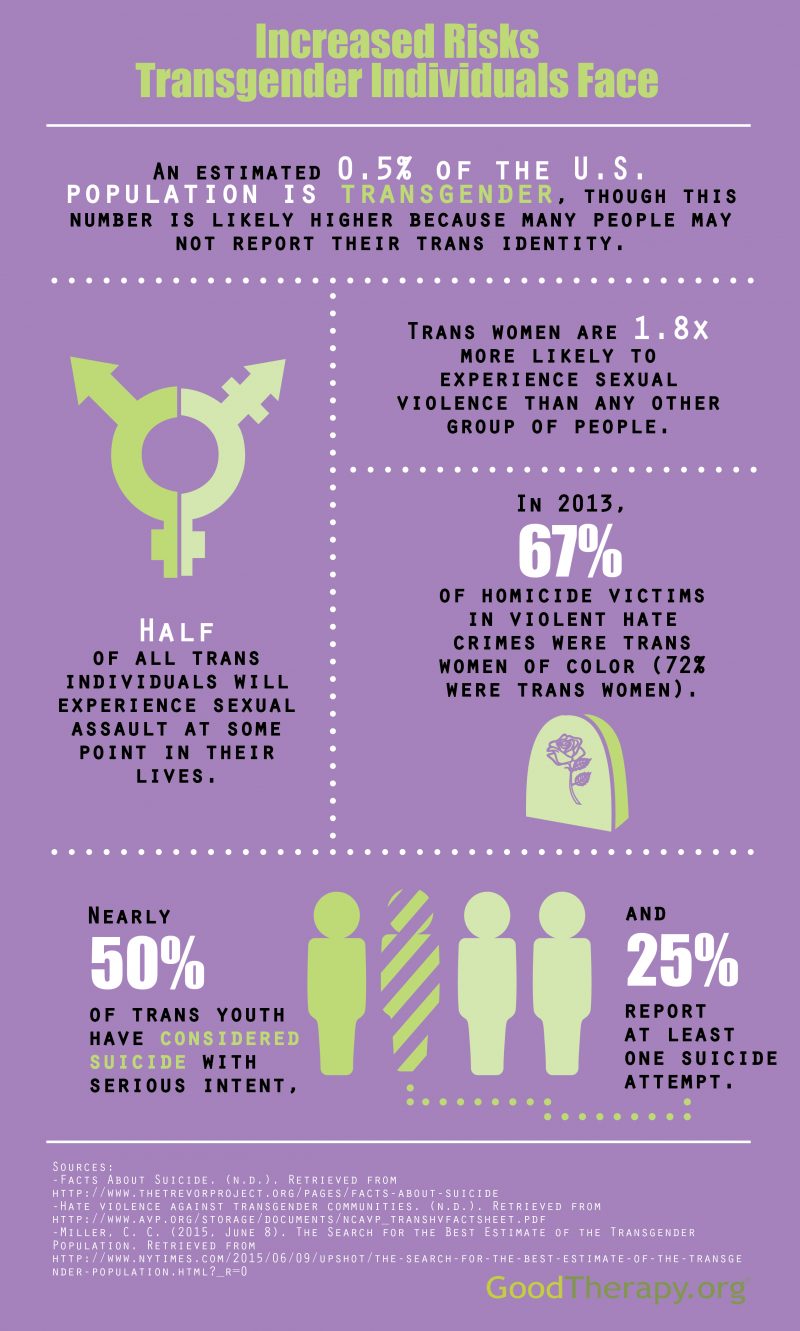
All people deserve a restroom they can use safely, without fear of harassment or violence. According to the NCAVP and Rape Response Services National Statistics, trans people face high rates of homicide, sexual assault, and violence. Trans people of color are at even higher risk: in 2013, 67% of hate violence homicide victims were trans women of color. Preventing trans people from using the facilities they feel most comfortable in may make it necessary for them to put themselves at greater risk (and also possibly out themselves as trans) in order to use the restroom.
The backlash to these rulings, and other similar rulings across the country, has been considerable, especially as transgender students across the country fight similar discriminatory measures for equal access to bathrooms and locker rooms in public schools. Critics point out not only are these laws likely to cause humiliation and distress, they clearly violate the Civil Rights Act.
Several entertainers and organizations have boycotted trips to North Carolina in support of transgender rights, and the Obama administration issued a decree in May 2016 ordering all public schools to allow trans students access to facilities corresponding to their gender identity rather than sex assigned at birth. A number of school districts across the country have refused to accept the decree, citing concerns about boys in girls’ locker rooms and the discomfort of female students.
What these school districts do not seem to address is the discomfort and distress of the transgender students who are required to either use the wrong facilities or change alone in the nurse’s office or other designated facility. In either outcome, these students may face prejudice, harassment, and abuse from other students as well as feelings of shame and isolation, among other issues. Many trans students report avoiding the restrooms entirely, an action that may affect emotional well-being as well as physical health.
Proposed Solutions to Discriminatory Bathroom Policies
Awareness of trans issues is increasing across the nation, and many young trans people have the support and encouragement of their families, but many still do not. Along with the likelihood of discrimination and ostracism at the hands of peers or family members, trans teens and preteens also face the onset of puberty and the emergence of physical features and bodily changes that may lead to gender dysphoria or exacerbate existing feelings. Many teens who wish to take hormones and begin transitioning cannot start this process without parental support. Some have the support of a mental health professional, but many lack even that.
School-level legislation that further denies the identity and existence of transgender youth may contribute to depression, anxiety, and other mental health concerns. It may also increase the risk of suicide in this population, which is already high. Among trans youth, nearly 50% have considered suicide with serious intent, and 25% report at least one attempt. The rates of suicide and other mental health concerns experienced by transgender youth are shown to decrease when they receive acceptance and support.
All-gender restrooms, already prevalent in many countries, may be the logical destination of progress, as gender becomes more understood and the male-female binary is recognized to be an outdated concept.Some point to all-gender or family bathrooms as a solution. While some trans individuals might use these restrooms when they are available, as any other person might, being allowed to only use these restrooms can still be exclusionary and may contribute to feelings of dysphoria. Others say creating bathrooms exclusively for transgender people to use would be an ideal solution, but as Attorney General Loretta Lynch pointed out in a statement announcing a federal lawsuit against North Carolina, “Not so long ago … states had signs about restrooms … keeping people out based upon a distinction without a difference.” Others have similarly drawn comparisons from the bathroom debate to the Jim Crow laws segregating people of color.
Some organizations and companies, such as Target, have responded to these laws by vocalizing their support of trans people with inclusive policies encouraging customers and employees alike to use the restroom that aligns with their gender identity. At Cooper Union College in New York, student activists removed all gendered signs on the bathroom. New placards read “restroom with urinal and stalls” and “restroom with only stalls.” Other colleges have similarly implemented all-gender restrooms with the goal of making public spaces safe and accommodating for everyone. All-gender restrooms also serve to welcome non-binary individuals, who might not feel comfortable in either men’s or women’s restrooms.
Everyone Has the Right to Safety
Many trans people across the nation still cannot use the restroom without facing threats to their personal safety. A woman in Washington, D.C. was assaulted by a security guard when she tried to use the restroom at a grocery store, and students in one North Carolina school district are now allowed to bring pepper spray to campus, which one board member claims may be a “valuable tool” for females who use the restroom on campus. Other schools encourage students to report their transgender classmates if they use the “wrong” bathroom.
Such instances of harassment and prejudice against trans people are likely to do little for the community other than foster fear and transphobia. Even if legislators and others who do not support bathroom use according to gender identity claim they are not targeting transgender people, these measures may invalidate the identity of trans people and perpetuate stigma. They also do not address the high rates of assault and violence trans people experience. Safe public restrooms are a necessity for all, and trans individuals prevented from using the correct restroom may not only face threats to their bodily safety, but also diminished mental and emotional well-being due to stress, anxiety, shame, and dysphoria.
All-gender restrooms, already prevalent in many countries, may be the most logical destination of progress, as gender becomes more understood and the male-female binary is recognized to be an outdated concept. Until then, allowing individuals to choose a restroom based on their gender—and perhaps caring a bit less about who is using what restroom—may be the best solution to an issue that was never really a problem.
References:
- Banchiri, B. (2016, February 23). Charlotte passes transgender rights law: Will North Carolina let it stand? Retrieved from http://www.csmonitor.com/USA/Politics/2016/0223/Charlotte-passes-transgender-rights-law-Will-North-Carolina-let-it-stand
- Bellware, K. (2014, July 18). Gender-neutral bathrooms are quietly becoming the new thing at colleges. Retrieved from http://www.huffingtonpost.com/2014/07/18/gender-neutral-bathrooms-colleges_n_5597362.html
- Borrello, S. (2016, April 22). Sexual assault and domestic violence organizations debunk ‘bathroom predor myth.’ Retrieved from http://abcnews.go.com/US/sexual-assault-domestic-violence-organizations-debunk-bathroom-predator/story?id=38604019
- Carollo, L. (2016, April 25). What happened when I tried to comply with North Carolina’s new bathroom law. Retrieved from http://www.vox.com/2016/4/25/11490498/north-carolina-bathroom-law-transgender
- Changing birth certificate sex designations: State-by-state guidelines. (2015, February 03). Retrieved from http://www.lambdalegal.org/know-your-rights/transgender/changing-birth-certificate-sex-designations
- Cobb, J. (2016, May 30). Opening doors. The New Yorker. Retrieved from http://www.newyorker.com/magazine/2016/05/30/north-carolinas-retrograde-step
- Connelly, J. (2016, February 10). ‘Bathroom bill’ aimed at transgender persons fails in state Senate. Retrieved from http://www.seattlepi.com/local/politics/article/The-bathroom-bill-blocking-toilet-use-by-the-6821841.php
- Facts about suicide. (n.d.). Retrieved from http://www.thetrevorproject.org/pages/facts-about-suicide
Hate violence against transgender communities. (n.d.). Retrieved from http://www.avp.org/storage/documents/ncavp_transhvfactsheet.pdf - Levin, S. (2016, May 12). Obama orders public schools to allow transgender students access to restrooms. Retrieved from http://www.theguardian.com/society/2016/may/13/obama-public-schools-transgender-access-restrooms
- Lopez, G. (2016, April 18). 9 questions about gender identity and being transgender you were too embarrased. Retrieved from http://www.vox.com/2015/4/24/8483561/transgender-gender-identity-expression
- Lowder, J. B. (2016, April 27). Breitbart proves what we already knew: Trans women are not bathroom predators. Retrieved from http://www.slate.com/blogs/outward/2016/04/27/breitbart_helpfully_shows_trans_women_are_not_bathroom_predators_cis_men.html
- Miller, C. C. (2015, June 08). The search for the best estimate of the transgender population. The New York Times. Retrieved from http://www.nytimes.com/2015/06/09/upshot/the-search-for-the-best-estimate-of-the-transgender-population.html?_r=0
- Ng, A. (2016, May 11). North Carolina schools let students bring pepper spray to class–in case transgender students use bathrooms. Retrieved from http://www.nydailynews.com/news/national/n-schools-students-bring-pepper-spray-class-article-1.2633430
- Pearson, M. (2016, May 10). AG Loretta Lynch moves into spotlight with NC bathroom law speech. CNN. Retrieved from http://www.cnn.com/2016/05/10/politics/loretta-lynch-north-carolina
- Rape Response Services National Statistics. (n.d.). Retrieved from http://www.rrsonline.org/?page_id=944
- Redden, M. (2016, March 29). New York college moves to strip gender markings from all bathrooms. The Guardian. Retrieved from http://www.theguardian.com/world/2016/mar/29/gender-bathrooms-cooper-union-college-new-york
- Tan, A. (2016, May 19). Security guard arrested after allegedly assaulting transgender woman trying to use women’s bathroom. ABC News. Retrieved from http://abcnews.go.com/US/security-guard-arrested-allegedly-assaulting-transgender-woman-womens/story?id=39227006
- Transgender Bathroom Hysteria, Cont’d. (2016, April 18). Retrieved from http://www.nytimes.com/2016/04/18/opinion/transgender-bathroom-hysteria-contd.html?_r=4&mtrref=undefined&gwh=459A290B6C63807CACCEAADDE4A5626A&gwt=pay&assetType=opinion
- Understanding the Perpetrator. (n.d.). Retrieved from https://sapac.umich.edu/article/196
 As a therapist who specializes in working with LGBTQ (lesbian, gay, bisexual, transgender, queer) teens and their families during the coming-out process, I am often witness to the reactions parents have to a teen revealing his or her sexual identity. These reactions range from “We suspected for quite a while†to “We had no idea!â€
As I work with these families, the expectation is that therapy needs to focus on the issues surrounding the teen coming out. While this support for the LGBTQ teen is vital, in my experience, parents may need just as much support. Parents are often in territory that is new to them and they may not have developed the language to speak effectively and sensitively with their teen, or the awareness to sort through their own changing perspectives.
One of the most basic things that I have parents focus on is that the child they have lived with and known for years is still the same person. One of the most supportive things any parent can offer at the moment of coming out is simply a hug and reassurance that there is still a relationship based on love. Remember that when a teen comes out to his or her family, he or she has probably been thinking about and building anxiety around how that coming-out experience will play out and be received. Simply connecting with the teen will help to relieve some of the anxiety and reassure the teen that there is still space for him or her in the family story.
[fat_widget_right]
It is also important at the beginning to simply listen and support. Even with parents who suspect that a teen may be gay, it is important that they take time to process some of their own feelings before opening up a litany of questions and concerns. When parents are caught completely off guard when a teen comes out, it is vital to offer loving support to the teen and at the same time recognize that there are questions and concerns that there may not be answers to immediately. Parents may need time to adjust to this new information and to process it.
As parents begin the process of unraveling their feelings about their teen’s sexual orientation, it is also a good time to gather information and learn more about what it means to be a member of the LGBTQ community beyond stereotypes and popular conceptions. Parents can join organizations such as PFLAG and gather the latest info regarding LGBTQ teens on the GLSEN website. As parents become more educated, they can release some of their fears and build a foundation for conversation with their teen.
As the process continues, another question that may arise is, “Who gets to know?†The coming-out process is just that, a process, and how the information is disseminated is worth discussing. Often, a teen will come out to one parent first and then ask for that information to be held in confidence for a time. There is no need to force the conversation, and it can help the process a lot if the teen feels like he or she is in charge of who gets to know. It is also common for a sibling, friend, relative, or teacher to know first, so I encourage parents to be OK with the fact they may not be the first to know.
Finally, don’t forget that while it should be a priority to be open and available to converse with your teen about his or her sexual identity, it is not all that he/she is. He or she is still facing all of the same battles and angst that other teens go through as they develop their identity. Be sure to support LGBTQ teens in all their efforts in life, including school, hobbies, sports, friendships, and spirituality. Though it may seem like the coming-out story is the most important thing on the list at the moment, teens are complex, vital, intriguing, and amazing people who are open to guidance, acceptance, and love in all forms and areas.
I hear your struggle and pain, and you are not alone. It is so hard to know just what the right thing to do for your kids may be when you see them potentially heading down a road that could make their lives more difficult and quite possibly more dangerous.
The best thing you can do for your son is offer him unconditional love and support by letting him know that you love him as he is, for who he is, and that nothing can change that. Whether he eventually realizes himself to be a member of the LGBTQIA community or is simply just drawn to more traditionally feminine toys and activities, he is likely to hear about these things from his peers. By trying to protect him from the hate and mockery of others, you may unintentionally give him the message that you don’t think his choices are OK and that he needs to hide who he is. He needs to have a safe place to be himself, and that should be with you. (It should be everywhere, really, but with you is a must.)
[fat_widget_left]
That said, you can also equip him for living in your community. You can give him the tools he needs to combat bullying and hate. At 7, he is probably at least somewhat aware of how others may respond to him. You can talk with him about possible reactions to him choosing an Elsa costume over a Spider-Man costume. Empower him to make choices and prepare him for the ramifications. Let him know that the problem is NOT in his choice, but in the ignorance and bigotry that exist in the world. Help him find allies in the community—friends, teachers, other parents—who support him. Bullying and hate are terrible things, but they can be managed with support. Kids who internalize feelings that who they are is not OK suffer terribly, often feeling shame, isolation, and loneliness. These are the kinds of feelings that lead to hopelessness, depression, and even suicide.
Your question resonates deeply with me. My 4-year-old son is also drawn to dresses and make-up. He loves trucks and dinosaurs, but he chose to be Elsa for Halloween this year (it’s a popular costume!). When he wanted to wear a dress to school last week, I hesitated. When he was 2 or 3 it was no big deal, but lately I’ve seen that his peers respond in less accepting ways to cross-gender preferences. He wore the dress, but we practiced what he might say to friends if they laughed, made fun of him, or called him a girl. The moment we walked into the classroom, a group of boys did exactly that. He responded with, “Nope, I’m a boy. I just wanted to wear this.†And that was the end of it. Granted, at 4 and 5, kids are generally more accepting than at 7, but I hear your fears and your concerns, and all you can do is equip him to handle what he may face—and the best way to do that is by making sure he knows there is nothing wrong with him.
If I can also offer a little clarification as well: There is a difference between gender preferences, gender expression, gender identity, and sexual orientation. Preferring toys and objects that are traditionally associated with a different gender does not necessarily have anything to do with gender identity or sexual orientation. Your son may be more sensitive and nurturing than his male peers. There are girls his age who prefer some of the more traditionally male toys. That does not necessarily mean they are gay or straight or bisexual. Nor does it mean that those girls identify more as masculine or the boys identify more as feminine. Kids like what they like. We are the ones who make meaning of it and attach labels.
If you need support for yourself or your son in figuring out how to navigate through these issues, find a therapist who works with gender fluidity. Whether or not your son is gay, a therapist trained in LGBTQ+ issues would have a lot of resources and strategies for navigating how to be different in an intolerant community.
Best of luck,
Erika